
What Causes Carbon Monoxide Build-Up in Commercial and Industrial Buildings
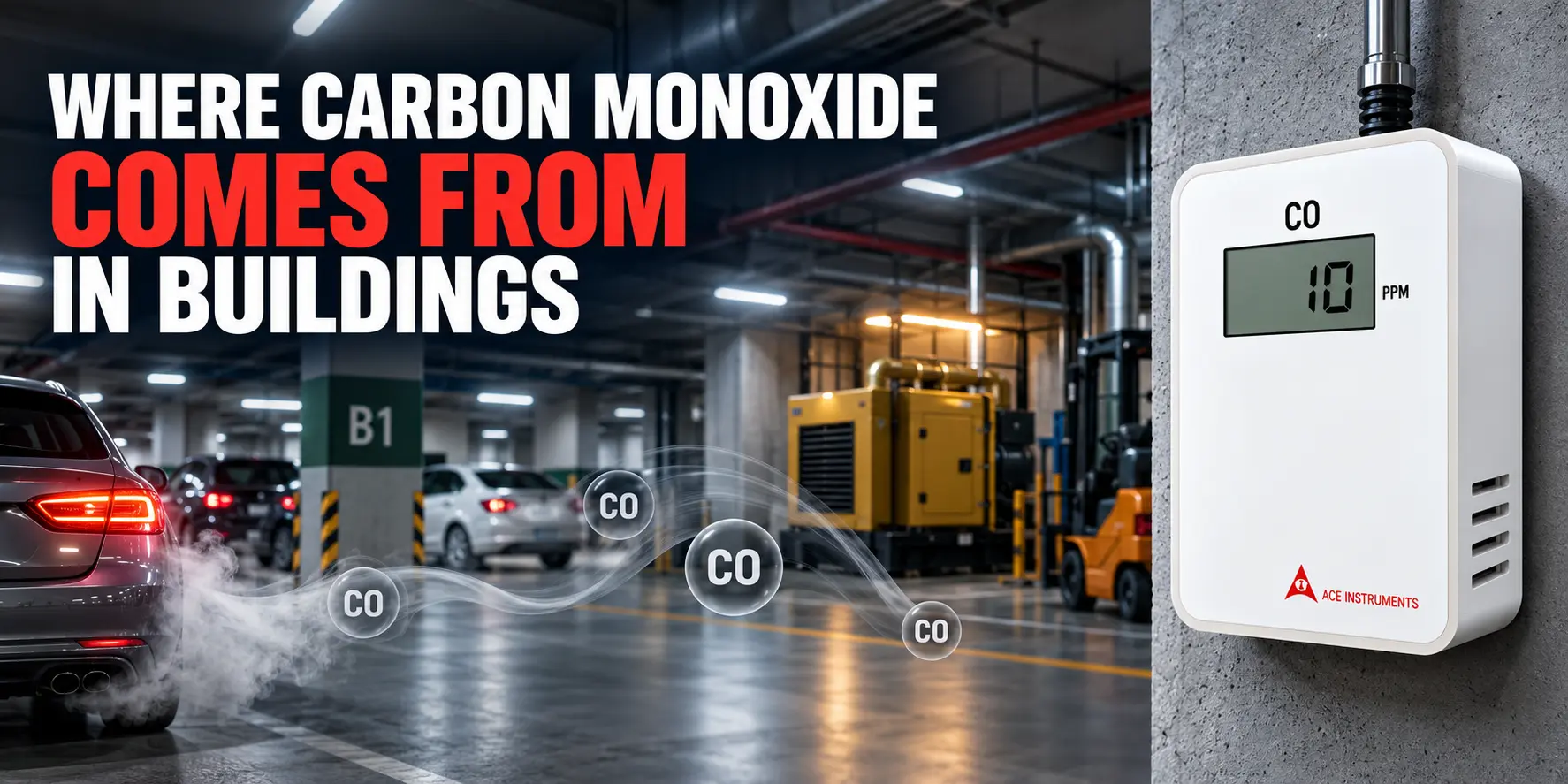
Carbon monoxide accumulates in commercial buildings wherever fuel is burned in an enclosed space with insufficient ventilation. The gas is produced by incomplete combustion, which occurs in every real engine, generator and boiler to some degree, and enclosure is what turns a routine emission into a hazardous concentration.
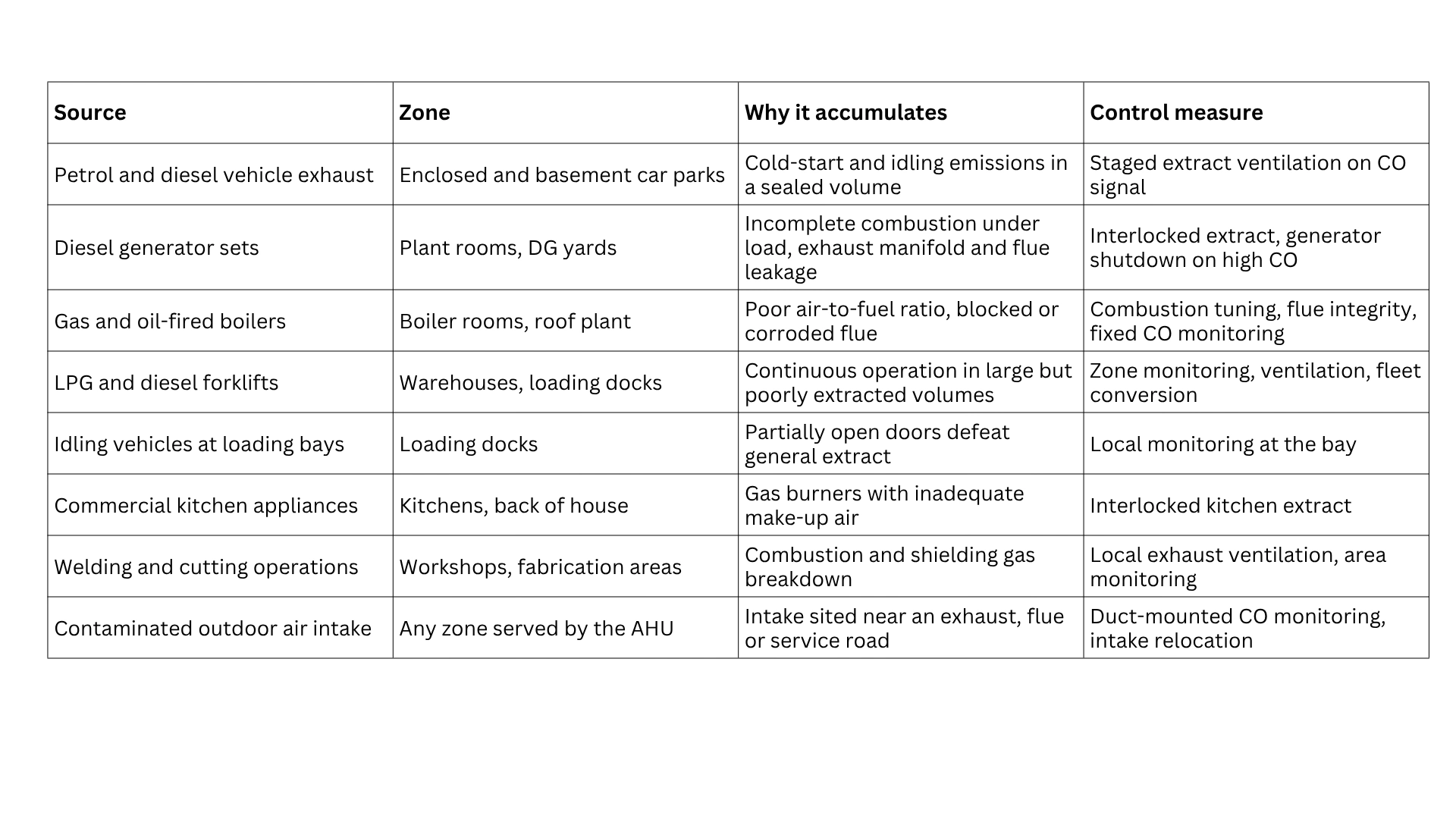
Understanding the sources zone by zone is more useful than understanding the chemistry, because monitoring is specified by zone. The table below maps every common source in a commercial or industrial facility to where it accumulates and how it is controlled.
Carbon monoxide sources by building zone
Why enclosure matters more than emission rate
A diesel engine running in open air produces the same carbon monoxide as one running in a basement. The difference is entirely in what happens next.
Carbon monoxide has a relative density of 0.967 compared with air, which is close enough to neutral that it neither rises to a ceiling nor pools at floor level. It mixes through the available volume. In an open environment that volume is effectively unlimited and concentration stays near background. In an enclosed car park or plant room, the volume is fixed, and concentration rises in direct proportion to emission divided by ventilation rate.
This has two consequences that shape monitoring design. First, there is no safe height at which to stand, and therefore no ceiling void or floor level where the gas conveniently concentrates. The gas is where the people are, which is why detectors are mounted in the breathing zone. Second, ventilation is the only meaningful control. Concentration is a ratio, and the denominator is the only term a building operator can change in real time.
The three highest-risk zones
Enclosed car parks combine the largest number of intermittent sources with the most variable emission profile. Cold starts produce disproportionate carbon monoxide, peak concentrations track occupancy patterns rather than time of day, and the space is used by members of the public who have no exposure training. The design approach for basement car park monitoring reflects that combination.
Generator and boiler rooms present a different profile: fewer sources, higher potential concentrations, and a failure mode involving flue or exhaust leakage that produces no visible or audible warning. In Indian commercial buildings, where diesel generator sets are near-universal, this is the most commonly under-monitored zone. Plant room monitoring is treated separately for this reason.
Warehouses and loading docks invert the usual assumption that a large volume is a safe one. Forklift fleets operate continuously through a shift, dilution is slow across a large floor plate, and the resulting exposure is cumulative rather than acute. The relevant risk is an eight-hour time-weighted average approaching the 50 ppm OSHA limit under 29 CFR 1910.1000 Table Z-1, not a dramatic peak. Warehouse and loading dock monitoring addresses that distinction.
The source that is easiest to miss
Every zone above is a place where combustion happens. The exception, and the most commonly overlooked path, is contamination of the air handling system itself.
An air handling unit does not distinguish between clean and contaminated air at its intake. If a fresh air intake sits near a generator exhaust discharge, a service road, a loading bay or a flue termination, carbon monoxide is drawn in and distributed to every zone the unit serves. The same applies where a car park shares any return air path with occupied floors.
The concentrations involved are usually modest, which is exactly why the problem persists undetected. A steady 15 to 25 ppm distributed building-wide does not trigger a room-level alarm set for a plant room, but it represents continuous exposure well above the WHO Air Quality Guidelines eight-hour figure of 10 mg/m³, approximately 9 ppm. Detecting it requires measurement in the air stream itself, which is the case for duct-mounted carbon monoxide monitoring.
From source identification to monitoring specification
A monitoring specification that starts from the zone list above will be materially better than one that starts from a product catalogue. Each identified source implies a monitored zone, each monitored zone implies a detector count and placement, and each placement implies an output and control action.
Ace Instruments supplies fixed carbon monoxide instrumentation under the IAQ Detectors brand for every zone described here. The AI-CO Carbon Monoxide Transmitter covers room and area monitoring in car parks, plant rooms and warehouses, and the AI-CO-D Duct Carbon Monoxide Transmitter addresses air handling contamination. Where combustion risk coexists with oxygen displacement or flammable gas, the oxygen and LEL ranges cover the adjacent hazards.
Ace Instruments has designed and manufactured indoor air quality instrumentation in Hyderabad since 1991, with more than 1,000 installations worldwide. The IAQ Detectors carbon monoxide range is CE certified and manufactured under an ISO 9001:2015 registered quality system. Threshold values for judging measured concentrations are set out in the carbon monoxide exposure reference, and the full product range in the carbon monoxide category.
Frequently asked questions
What is the most common source of carbon monoxide in commercial buildings?
Vehicle exhaust in enclosed car parks is the most common source of carbon monoxide in commercial buildings, followed by diesel generator sets and LPG or diesel forklifts. All three share the same cause: fuel burned where combustion air is limited and exhaust cannot disperse. Carbon monoxide is produced whenever combustion is incomplete, and enclosure is what turns a normal emission into an accumulation.
Can HVAC systems spread carbon monoxide through a building?
Yes. An air handling unit distributes whatever enters its return or fresh air intake to every zone it serves. If a generator exhaust, loading bay or flue discharge is near an intake, or if a car park shares a return path with occupied floors, carbon monoxide is carried building-wide. This is why duct-mounted carbon monoxide monitoring is specified in addition to room-level monitoring.
Why does carbon monoxide accumulate in basements?
Carbon monoxide accumulates in basements because they combine a combustion source with limited natural ventilation and no buoyancy-driven escape path. Carbon monoxide has a relative density of 0.967 compared with air, so it neither rises out nor settles into a pocket, but mixes through the whole volume. Without mechanical extract, concentration rises until emission stops.
Do electric vehicles reduce carbon park carbon monoxide levels?
Electric vehicles reduce carbon monoxide emissions in car parks proportionally to their share of the fleet, but they do not remove the requirement for monitoring. Mixed fleets remain the norm, ventilation design and fire NOC conditions are based on worst-case occupancy, and battery charging introduces separate hazards. Monitoring requirements are set by code and approval conditions, not by the current vehicle mix.
Know the latest trends in IAQ solutions from the Ace Instruments team


Get inspired and learn more
Instruments that exceed your technical expectations
Comprehensive and customized IAQ solutions for all applications

