
Safe Carbon Monoxide Levels in PPM: Commercial Exposure Limits
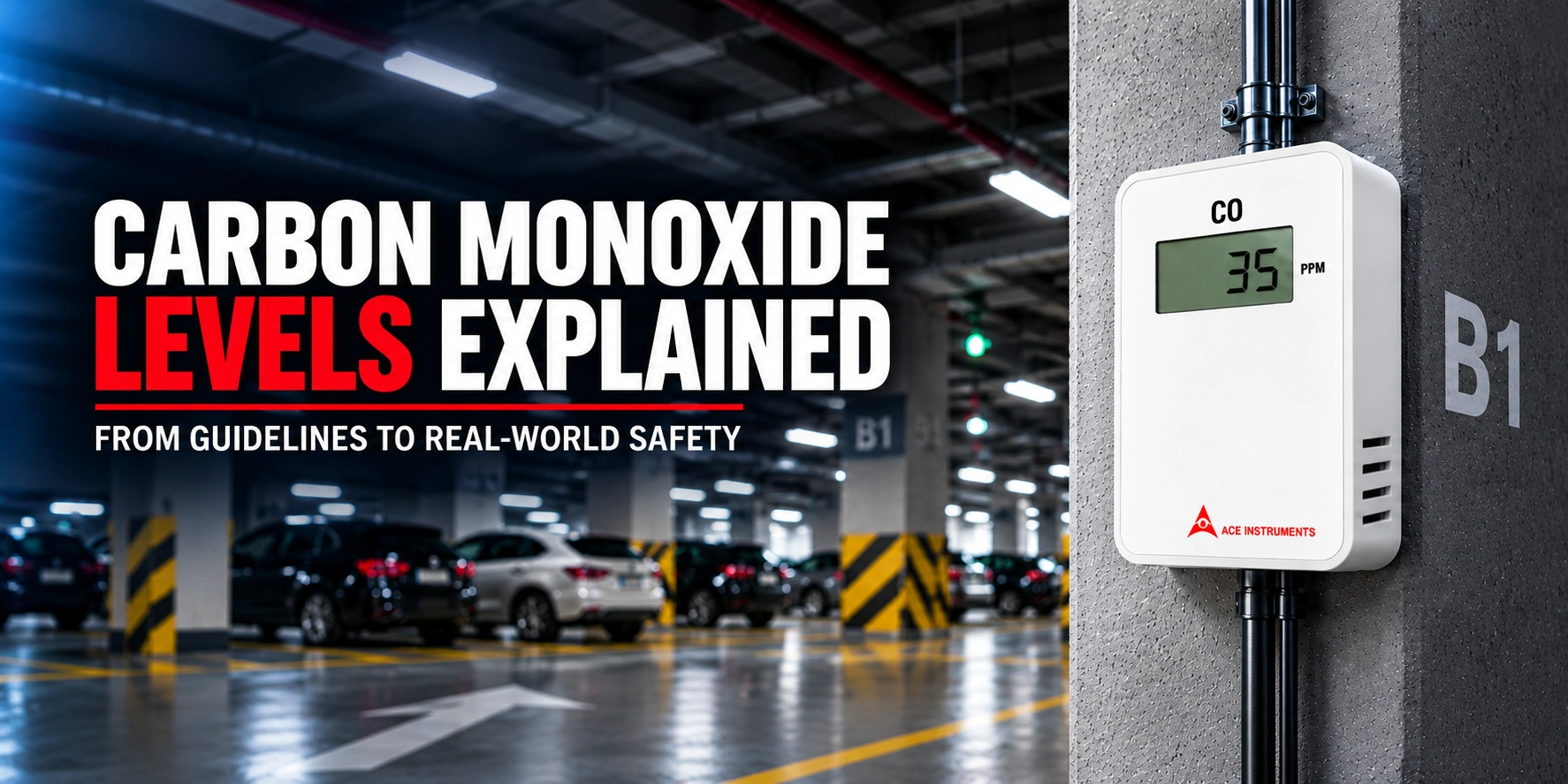
A safe carbon monoxide level in continuously occupied commercial space is below 9 ppm as an eight-hour average, a figure derived from the 10 mg/m³ guideline retained in the WHO 2021 Air Quality Guidelines. The legally enforceable workplace limit is considerably higher, at 50 ppm averaged over eight hours under OSHA 29 CFR 1910.1000 Table Z-1.
Both numbers are correct. They answer different questions, and confusing them is the most common error in carbon monoxide specification. The table below sets out every threshold a facilities engineer, safety officer or HVAC consultant is likely to encounter, with the averaging period that gives each one its meaning.
Carbon monoxide threshold reference table
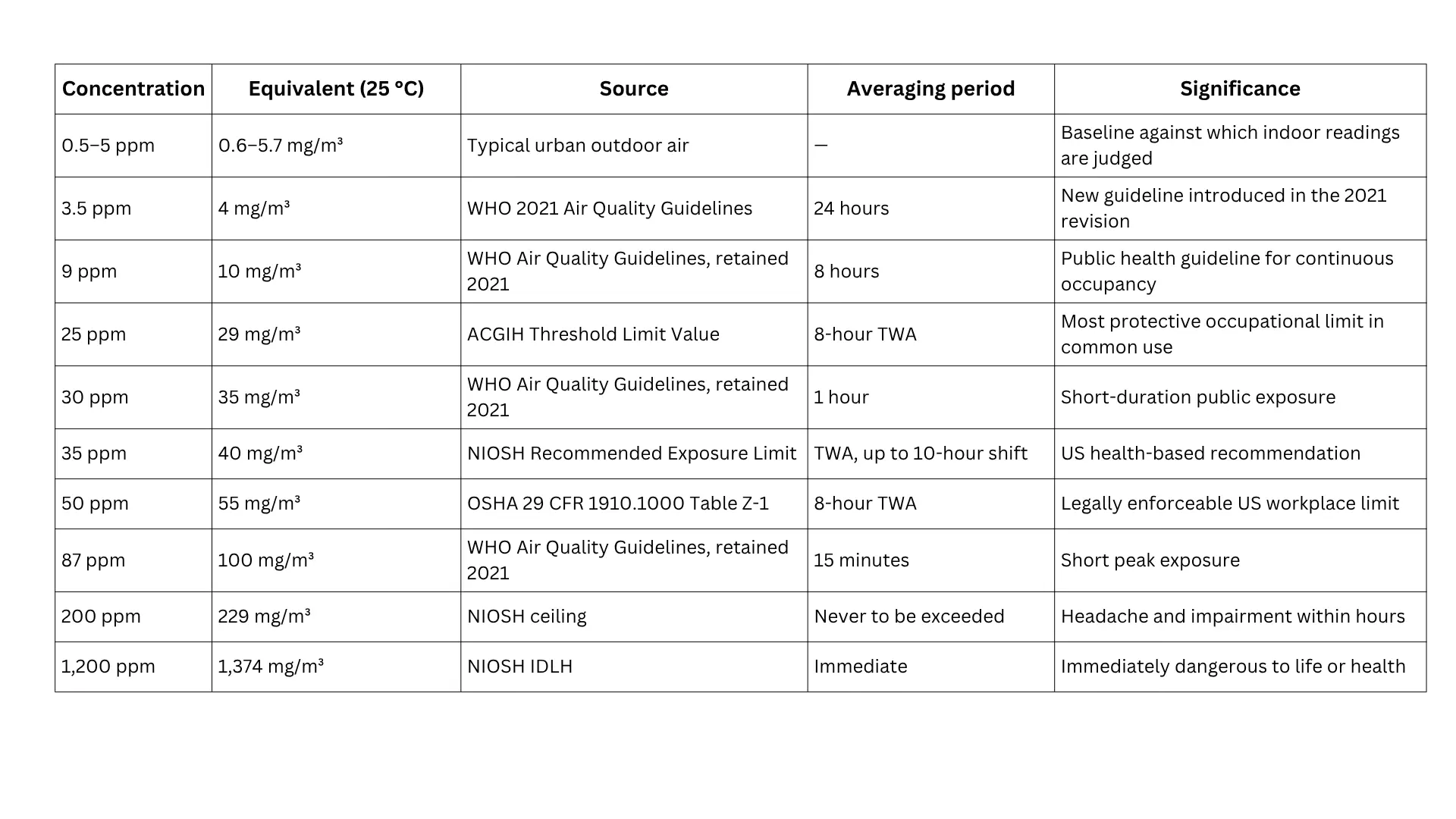
Conversions use 1 ppm CO = 1.145 mg/m³ at 25 °C and 760 mmHg. At 20 °C the factor is 1.165, which is why published figures differ slightly between sources.
Why the numbers disagree
The thresholds above span a factor of more than three between 9 ppm and 50 ppm for what is nominally the same eight-hour window. The divergence is not a disagreement about the chemistry. It reflects three different questions being asked.
Public health guidelines such as the WHO 2021 Air Quality Guidelines protect the whole population, including people with cardiovascular disease, pregnant occupants and the elderly, over a lifetime of exposure. Occupational limits protect a healthy adult workforce over a working career, with exposure bounded by the shift. Enforcement limits, of which OSHA 29 CFR 1910.1000 Table Z-1 is the clearest example, additionally reflect what was demonstrably achievable when the regulation was written.
For a commercial building specifier the practical consequence is straightforward. Design against the occupational limits where the space is a workplace with defined shift patterns, such as a warehouse or plant room. Design against the public health guidelines where the space is occupied by members of the public who did not choose the exposure, such as a retail concourse or an enclosed car park.
What the concentrations do physiologically
Carbon monoxide is toxic because it binds to haemoglobin far more readily than oxygen does, forming carboxyhaemoglobin and displacing the oxygen the blood should be carrying. The effect is cumulative within a shift: dose is concentration multiplied by time, which is exactly why occupational limits are written as time-weighted averages rather than instantaneous ceilings.
This has a direct design implication. An instrument that reports only an instantaneous reading cannot demonstrate compliance with a time-weighted limit. A monitoring point in an occupied industrial space needs to log continuously so that an eight-hour average can be reconstructed, not simply an alarm on a peak.
The relationship also explains why the NIOSH exposure limit of 35 ppm sits below the OSHA figure. NIOSH selected the lower value to keep carboxyhaemoglobin saturation within a margin that avoids cardiovascular effects, whereas an eight-hour exposure at 50 ppm produces a materially higher saturation in most workers.
From exposure limits to alarm setpoints
Exposure limits are not alarm setpoints, and treating them as though they were produces systems that alarm too late to be useful. A limit describes an average that must not be exceeded over a shift. An alarm setpoint is an instantaneous trigger chosen so the average never gets close.
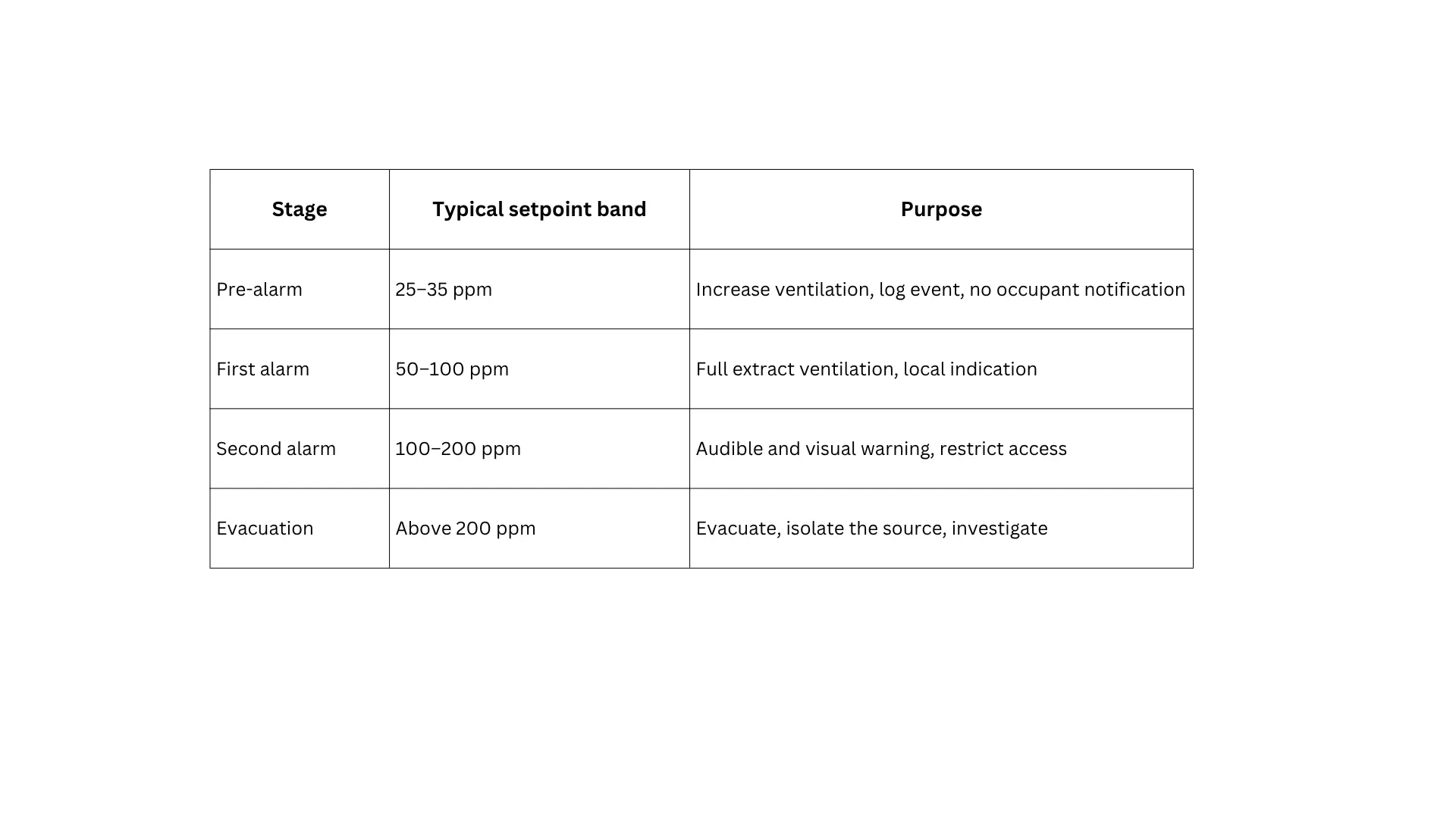
These bands reflect common commissioning practice rather than a universal requirement. EN 50545-1, the European standard governing apparatus for detecting carbon monoxide and nitrogen oxides in car parks and tunnels, is explicit that alarm levels are variable and may be adapted to national and local regulations. In India, the applicable state fire service conditions and the National Building Code 2016 requirements determine the values that will actually be approved.
Measuring at the levels that matter
The thresholds that govern commercial buildings cluster between 9 ppm and 50 ppm. An instrument intended to demonstrate compliance therefore needs meaningful resolution and stability across the lower part of its range, not merely the ability to detect a gross release.
Fixed monitoring at these concentrations is almost always electrochemical, because the technique offers the selectivity and low-end resolution that semiconducting and infrared alternatives cannot match at single-digit ppm. The AI-CO Carbon Monoxide Transmitter from Ace Instruments, supplied under the IAQ Detectors brand, uses an electrochemical detection element for exactly this reason, and the duct-mounted AI-CO-D applies the same technique to return air streams.
Two further points affect whether measured values can be trusted. Electrochemical cells drift over their service life, so a documented calibration and bump testing schedule is what converts a reading into evidence. And placement determines whether the instrument sees representative air at all, which is why mounting height and coverage are treated as design decisions rather than installation details.
Carbon monoxide is also routinely confused with carbon dioxide during specification, despite the two gases requiring different detection technology, different thresholds and different control responses. The distinction between CO and CO2 monitoring is worth settling before any instrument is selected.
Selecting instrumentation for commercial and industrial compliance
Carbon monoxide monitoring is a compliance instrument first and a safety device second. The numbers it produces are used to demonstrate that a workplace stayed within an enforceable limit, or that a ventilation system responded as its design intent required. That places the burden on accuracy, traceability and documented maintenance rather than on alarm loudness.
Ace Instruments has manufactured fixed indoor air quality instrumentation from its Hyderabad facility since 1991, and supplies the full carbon monoxide range under the IAQ Detectors brand. Every instrument is CE certified and manufactured under an ISO 9001:2015 registered quality system, with over 1,000 installations worldwide across commercial, industrial and pharmaceutical facilities. The complete range is available through the carbon monoxide category, and threshold monitoring for related parameters through the carbon dioxide and indoor air quality categories.
Frequently asked questions
What is a safe carbon monoxide level in ppm?
A safe carbon monoxide level for continuously occupied commercial space is below 9 ppm averaged over eight hours, derived from the 10 mg/m³ eight-hour figure retained in the WHO 2021 Air Quality Guidelines. Occupational limits are higher because they assume a healthy adult working a defined shift: the ACGIH Threshold Limit Value is 25 ppm and the enforceable OSHA limit under 29 CFR 1910.1000 Table Z-1 is 50 ppm, both as eight-hour time-weighted averages.
At what ppm does carbon monoxide become dangerous?
Carbon monoxide becomes acutely dangerous above 200 ppm, the ceiling concentration NIOSH states should not be exceeded at any time, and it is immediately dangerous to life or health at 1,200 ppm. Between 50 ppm and 200 ppm the hazard is cumulative rather than immediate, which is why occupational limits are expressed as time-weighted averages rather than instantaneous values.
What is the OSHA limit for carbon monoxide?
The OSHA permissible exposure limit for carbon monoxide is 50 ppm as an eight-hour time-weighted average for general industry, set in 29 CFR 1910.1000 Table Z-1. This is the only figure in common use that carries legal force in the United States. The NIOSH recommended exposure limit of 35 ppm and the ACGIH Threshold Limit Value of 25 ppm are health-based recommendations rather than enforceable limits.
How many ppm of CO should trigger an alarm in a commercial building?
Fixed carbon monoxide monitoring in commercial buildings is commonly configured with a first-stage alarm between 25 ppm and 35 ppm and a second stage between 50 ppm and 100 ppm, so that ventilation responds well before any enforceable limit is reached. Setpoints are not fixed by any single standard: EN 50545-1 states that alarm levels are variable and may be adapted to national and local regulations.
Know the latest trends in IAQ solutions from the Ace Instruments team


Get inspired and learn more
Instruments that exceed your technical expectations
Comprehensive and customized IAQ solutions for all applications

