


Description
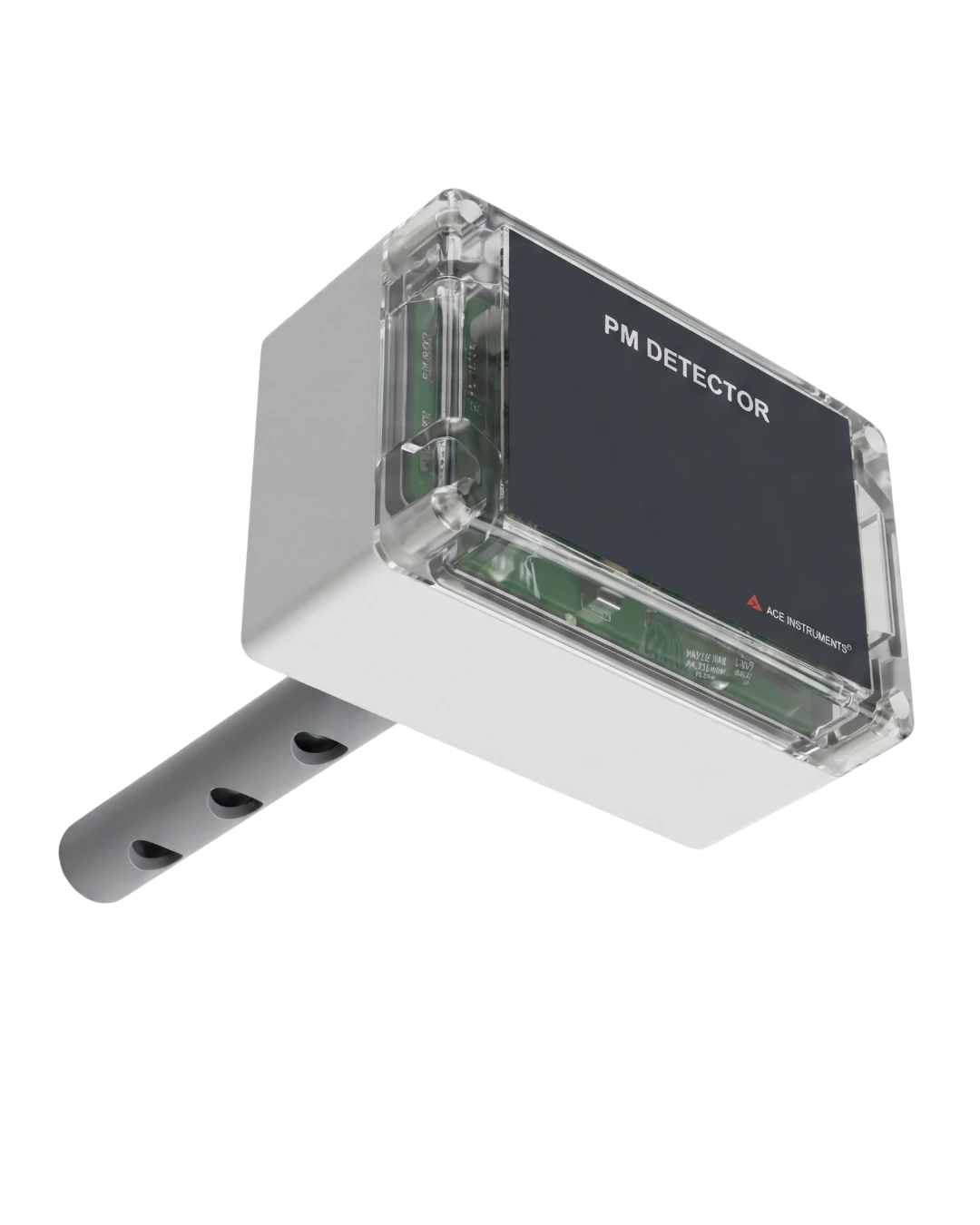
The duct mounting particulate matter detector (AI-PM-DT) is suited for mounting in HVAC ducts in a rugged IP54-rated plastic enclosure with an adjustable duct clamp. Powered by the latest in sensing technology, the instrument leverages laser-scattering based sensors for the reliable measurement of particulate matter, specifically PM2.5 and PM10.
The duct particulate matter sensor is suitable for mounting in ducts (return air/supply ducts). This enables building managers to ensure effectiveness of filtration units like HEPA, ULPA, MERV filters installed in the buildings. Higher trending particulate matter values in the sampled air implies additional sources of PM, or filter clogging.The duct particulate matter detector ensures that users benefit from 24x7 particulate matter insight, identify issues early and take corrective action.
Particularly in air handling equipment, PM 2.5 duct type fine dust sensors provide very high sensitivity coupled with simple installation and programming. Regardless of your space's occupancy levels, the probes quickly give accurate measurements, which lowers implementation, upkeep, and operational expenses. The sensors provide extremely high precision because of their special mechanical construction, which permits air to enter and escape through the same aperture. This special feature allows for precise measurement in the air handling unit's input or exit air ducts.
Applications include indoor air quality monitoring for fine dust pollutants in offices, retail spaces, educational institutions and is well suited with RS-485 Modbus communication for the monitoring of smart buildings and smart industrial applications.
Filter Condition Monitoring
Mounted downstream of an HVAC filter bank, the transmitter continuously tracks particulate levels passing through the ductwork, giving facility teams a direct, real-time indicator of filtration performance. A sudden rise in PM2.5 or PM10 downstream typically signals filter breakthrough, saturation, or bypass leakage, allowing maintenance teams to schedule filter replacement proactively rather than on a fixed calendar basis, before air quality in occupied spaces is affected.
Outdoor Air Quality Monitoring
Positioned at the fresh air intake, the transmitter can also detect outdoor pollution events entering the HVAC system. In a typical office, PM2.5 can spike to 50+ µg/m³ during laser printing, cooking in a nearby kitchen, or occupancy peaks, well above the WHO 24-hour guideline of 15 µg/m³, and outdoor sources like traffic pollution or regional smoke events can push levels higher still. Monitoring at the intake point allows the BMS to respond to elevated outdoor PM by adjusting damper position or filtration strategy before contaminated air circulates through the building.
Features
- Laser scattering principle based sensor for PM2.5 & PM10
- IP54 rated duct mounting ABS plastic enclosure
- Optional RS-485 Modbus Communication
Applications
Hospital Wards:
Verifies that ventilation air supplied to patient care areas meets particulate cleanliness requirements, supporting infection control protocols
School Classrooms:
Monitors HVAC-supplied air quality to help maintain healthier learning environments across densely occupied spaces
Pharmaceutical Production:
Confirms filtration performance at the duct level in manufacturing areas where particulate control is tied to product quality and compliance
Food Processing:
Tracks particulate levels in HVAC systems serving production areas, supporting hygiene standards and contamination control
HVAC-Served Commercial Spaces:
Provides ongoing verification that central air handling systems are delivering clean, properly filtered air throughout occupied zones
BMS Integration
With RS485 Modbus communication, the transmitter feeds real-time PM1, PM2.5, and PM10 data directly into the Building Management System, enabling automated responses such as filter change alerts, adjusted outdoor air intake, or ventilation rate changes based on actual particulate conditions inside the ductwork, rather than fixed schedules alone.
Specifications
Gain insight into your IAQ solution and know technical specifications
Frequently Asked Questions
1. Is the AI-PM-DT a suitable alternative to Greystone PM, Honeywell PM2.5 or Siemens duct particulate matter transmitters?
Yes, the AI-PM-DT Duct Particulate Matter (PM2.5, PM10) Transmitter is designed as a dependable alternative for duct-mounted particulate matter and indoor air quality monitoring applications commonly handled by products such as:
- Greystone PMDT Series (PMDTBXB, PMDTBXM, PMDTBRX)
- Honeywell C7363 Series (C7363A, C7363B)
- Siemens QSM Series (QSM2100, QSM2162)
The AI-PM-DT offers:
- Simultaneous monitoring of PM2.5 and PM10 particulate matter
- Real-time air quality indication with high accuracy sensing
- Analog and Modbus communication options
- Easy integration with BMS, PLC, and SCADA systems
- Reliable long-term monitoring performance for commercial and industrial environments
- Duct-mount design suitable for HVAC air quality monitoring applications
It is suitable for commercial buildings, hospitals, pharmaceutical facilities, cleanrooms, laboratories, data centers, educational institutions, and industrial HVAC environments.
It can be considered for projects where users are evaluating alternatives to comparable duct-mounted particulate matter monitoring systems from these brands.
Greystone, Honeywell, Siemens and other mentioned brands are trademarks of their respective owners. Ace Instruments is not affiliated with or endorsed by any of the aforementioned companies.
2. What is the AI-PM-DT Duct Particulate Matter Transmitter?
The AI-PM-DT is a duct-mounted particulate matter transmitter designed to continuously monitor PM2.5, PM10, and duct air temperature inside HVAC ducts and Air Handling Units (AHUs). It provides real-time measurements to Building Management Systems (BMS), helping facility managers maintain healthy indoor air quality, verify filtration performance, and optimize HVAC operation.
3. What is particulate matter (PM)?
Particulate matter (PM) consists of microscopic airborne particles such as dust, smoke, soot, pollen, combustion by-products, and other pollutants. Fine particles can affect occupant health, indoor air quality, and HVAC system performance, making continuous monitoring essential in modern buildings.
4. What parameters does the AI-PM-DT measure?
The transmitter continuously measures:
- PM2.5 (Fine particulate matter)
- PM10 (Coarse particulate matter)
- Duct Air Temperature
All measurements are transmitted via RS485 Modbus for integration with Building Management Systems, PLCs, SCADA systems, and HVAC controllers.
5. Why monitor particulate matter inside HVAC ducts?
Monitoring particulate matter inside HVAC ducts allows building operators to detect airborne contamination before conditioned air reaches occupied spaces. It also verifies filtration efficiency, identifies outdoor pollution entering the building, and helps maintain healthy indoor air quality.
6. How does a duct PM sensor help with HVAC filter management?
By monitoring PM2.5 concentration downstream of an Air Handling Unit (AHU) filter, the transmitter detects when particulate matter begins passing through the filter. This may indicate:
- Filter saturation
- Filter damage
- Air bypass around the filter
Instead of replacing filters on a fixed schedule, maintenance teams can use actual performance data to implement condition-based maintenance, reducing operating costs while ensuring high indoor air quality.
7. What temperature does the sensor also measure?
The AI-PM-DT includes an integrated duct air temperature sensor that continuously measures the temperature of the air flowing through the duct.
This information helps facility managers:
- Verify HVAC supply air temperature
- Monitor cooling and heating performance
- Improve HVAC energy efficiency
- Diagnose air handling system performance
8. Can this sensor detect wildfire smoke entering through fresh air intakes?
Yes. During wildfire events, outdoor PM2.5 concentrations can increase dramatically from typical background levels of 10 - 15 µg/m³ to well over 200 µg/m³.
When installed in a fresh air intake duct, the AI-PM-DT detects this increase immediately, allowing the Building Management System (BMS) to:
- Close fresh air dampers
- Increase filtration
- Adjust ventilation strategies
- Protect occupants from smoke exposure
9. Where is the AI-PM-DT commonly installed?
Typical applications include:
- Air Handling Units (AHUs)
- Fresh air intake ducts
- Supply air ducts
- Return air ducts
- Commercial buildings
- Hospitals
- Pharmaceutical facilities
- Cleanrooms
- Laboratories
- Schools and universities
- Data centers
- Shopping malls
- Airports
10. What units does the transmitter report in?
The AI-PM-DT measures particulate matter in micrograms per cubic metre (µg/m³) for PM2.5 and PM10, the internationally recognized unit used by WHO, ASHRAE, and environmental authorities for assessing air quality.
11. Can the transmitter detect HVAC filter failures?
Yes. Rising PM2.5 or PM10 concentrations downstream of a filter can indicate:
- Filter breakthrough
- Damaged filter media
- Filter saturation
- Bypass leakage
Trend analysis through the BMS enables predictive maintenance before indoor air quality is affected.
12. Can the AI-PM-DT be integrated with a Building Management System (BMS)?
Yes. The transmitter supports RS485 Modbus communication, allowing seamless integration with:
- Building Management Systems (BMS)
- PLCs
- SCADA systems
- HVAC automation systems
- Energy Management Systems
13.Can the transmitter improve HVAC energy efficiency?
Yes. By continuously monitoring particulate levels and duct air temperature, the HVAC system can optimize filtration, ventilation, and fresh air intake based on actual air quality conditions rather than fixed schedules, helping reduce operating costs.
14. Is the transmitter suitable for continuous monitoring?
Yes. The AI-PM-DT is designed for reliable 24×7 continuous monitoring in commercial, healthcare, pharmaceutical, industrial, and institutional buildings.
15. Does the transmitter require calibration?
The laser particle sensor is factory calibrated for accurate measurement. Under normal applications, routine user calibration is not required. Annual verification is recommended for pharmaceutical, cleanroom, and regulatory applications.
16. Is installation easy?
Yes. The AI-PM-DT is specifically designed for duct mounting and can be installed directly into HVAC ductwork using standard installation practices.
17. What are the advantages of using the AI-PM-DT?
Key benefits include:
- Continuous PM2.5 and PM10 monitoring
- Integrated duct temperature measurement
- Early detection of HVAC filter failure
- Condition-based filter maintenance
- Wildfire smoke detection
- Improved indoor air quality
- Better HVAC energy management
- Easy BMS integration
18. Who typically uses the AI-PM-DT?
The transmitter is widely used by:
- HVAC Contractors
- Building Automation Integrators
- Facility Managers
- Hospital Engineering Teams
- Pharmaceutical QA Departments
- Cleanroom Consultants
- Mechanical Consultants
- Data Center Operators
- Industrial Maintenance Engineers
19. Why choose ACE Instruments?
ACE Instruments has over three decades of experience in manufacturing indoor air quality monitoring solutions. Customers choose ACE for:
- High-accuracy laser particle sensing
- Reliable industrial-grade products
- Easy BMS integration
- Application-specific configurations
- Calibration support
- Responsive technical assistance
- Proven installations across healthcare, pharmaceutical, commercial, and industrial facilities

