

Product Overview
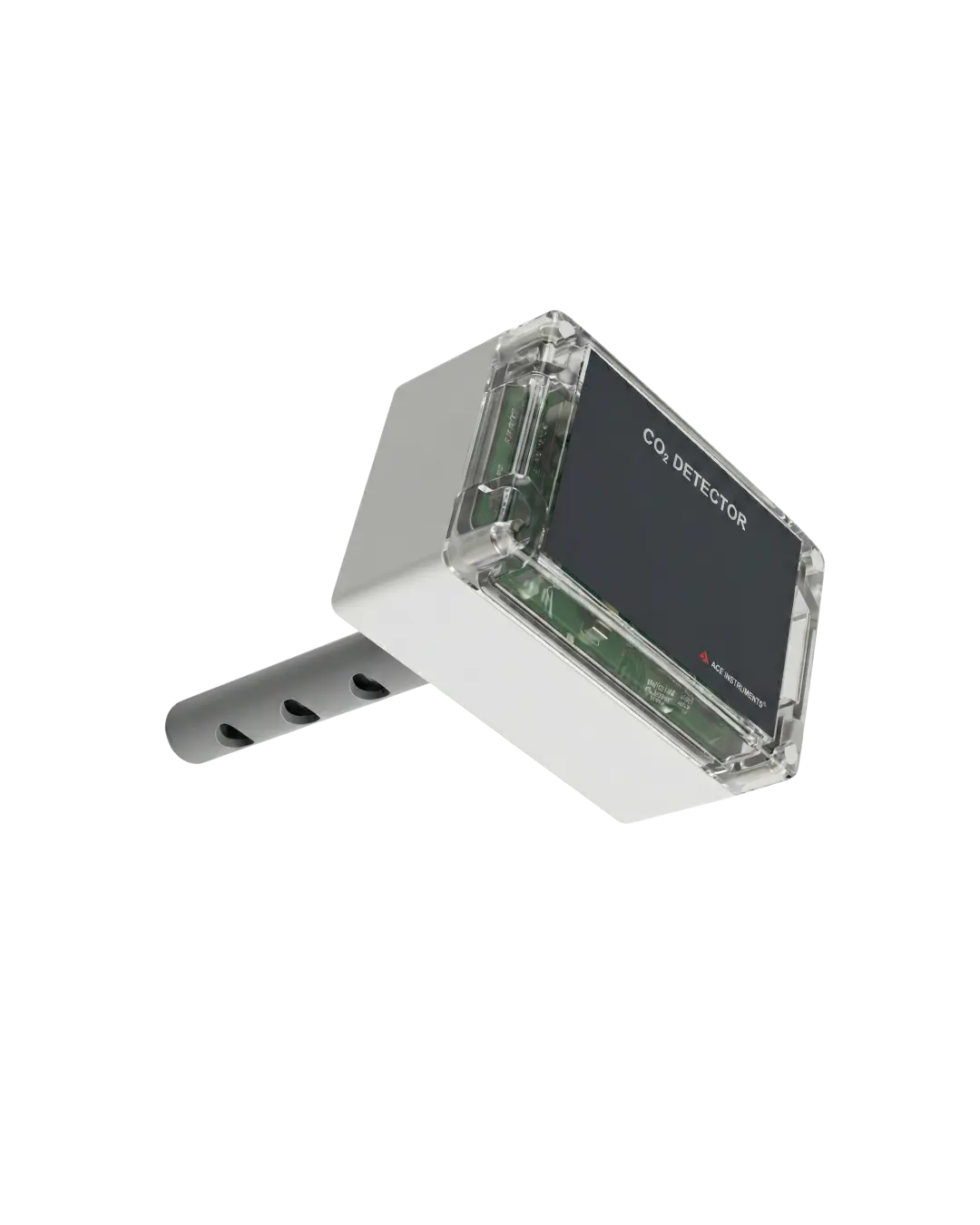
The Ace Instruments Duct CO2 Monitor is a durable solution for monitoring ventilation in HVAC ducts, ventilation systems, including cleanroom ventilation, and demand control ventilation systems. Designed to deliver uninterrupted ventilation insight, the AI-CO2-D is customizable to your requirements, with measuring ranges up to 10,000 ppm and optional RS485 Modbus communication. Users can select between 4-20 mA/0-10 VDC outputs.2 Iurable solution for ventilation monitoring in HVAC ducts, ventilation systems including cleanroom ventilation, and demand control ventilation systems. Designed to deliver uninterrupted ventilation insight, the AI-CO2-D is customizable to your requirements, with measuring ranges up to 10,000 ppm and optional RS485 Modbus communication. Users can select between 4-20 mA/0-10 VDC outputs
The AI-CO2-D is the ideal companion for demand controlled ventilation, enabling users to monitor the prevailing CO2 conditions via real-time measurements from the return air duct. This enables the new generation of green buildings to be alerted in case of rising CO2 levels and triggering fresh air intake as per occupancy levels. Occupants benefit from better indoor air quality as a result of proactive management via continuous monitoring of CO2 levels in HVAC ducts in a facility.
With the Ace Instruments duct mounting carbon dioxide detectors, facility managers can ensure compliance with leading international standards, including ASHRAE 62.1, OSHA, WELL, LEED, and GRIHA.
How Duct CO2 Monitoring Works
A duct CO2 monitor measures carbon dioxide concentration directly inside the HVAC ductwork, typically in the return air stream, rather than in the occupied space. Since exhaled CO2 from building occupants mixes into the return air, its concentration is a reliable proxy for how much fresh outdoor air is actually reaching a space relative to how many people are in it.
The AI-CO2-D uses a photoacoustic (PAS) sensor to detect CO2 levels with fast response time and long-term stability, a key requirement for duct-mounted sensors that operate continuously in air handling units and ventilation risers without regular access for recalibration. The sensor draws duct air across its detection chamber, converts the CO2 reading into a standard 4-20 mA or 0-10 VDC signal (or optional RS-485 Modbus output), and feeds that data straight to the Building Management System or AHU controller.
Because the transmitter reads air quality upstream in the duct rather than relying on a single wall-mounted point sensor, it captures a more representative, whole-zone CO2 profile, useful in large open floor plates, data centers, and multi-diffuser HVAC layouts where a room sensor alone can miss localized pockets of stale air.
Demand Controlled Ventilation (DCV) Explained
Demand Controlled Ventilation is an HVAC control strategy that adjusts the rate of outdoor air intake based on real-time occupancy, rather than running fresh air dampers at a fixed rate regardless of how many people are actually in the building. CO2 concentration is the most common trigger for DCV logic because it rises predictably with occupant density and exhaled breath, which is why DCV is explicitly recognized as an air quality procedure under ASHRAE 62.1 and referenced in ASHRAE 90.1 as an energy-efficiency compliance path for variable-occupancy spaces.
In practice, a duct-mounted CO2 transmitter like the AI-CO2-D continuously reports CO2 levels to the BMS or AHU controller. When levels climb, for example past the ASHRAE 62.1 guideline threshold of around 1,000 ppm, the controller opens the outdoor air damper further to bring in more fresh air. When occupancy drops and CO2 levels fall, the damper closes back down, reducing the volume of outside air that needs to be heated, cooled, or dehumidified. In industrial settings, the same duct sensor data supports compliance with the OSHA 5,000 ppm 8-hour TWA exposure limit, ensuring ventilation rates never fall below safe occupational thresholds even as they're optimized for energy use.
This closed-loop response is what allows DCV to cut HVAC energy consumption, since conditioning outdoor air is one of the most energy-intensive parts of running a building, while still meeting ventilation standards. DCV is also a recognized strategy for earning points under green building certifications including LEED (Indoor Environmental Quality credits), WELL Building Standard (Air concept), IGBC, and GRIHA, all of which reward measurable, sensor-verified indoor air quality management over fixed-rate ventilation. The AI-CO2-D supports this directly with a measuring range configurable up to 10,000 ppm, a fast-responding PAS sensor, and native RS485 Modbus or analog output for tight integration with AHU dampers and BMS logic, making it a drop-in sensing layer for any facility implementing or upgrading a DCV strategy in line with ASHRAE, OSHA, LEED, WELL, or GRIHA requirements.
Installation Guide
The AI-CO2-D is designed for straightforward duct mounting on new or retrofit HVAC systems. General installation steps:
- Select the mounting location. Install in the return air duct, ideally downstream of the occupied space and upstream of any outdoor air mixing point, so the reading reflects actual occupant-generated CO2 rather than diluted mixed air. Avoid locations near duct joints, dampers, or turns where airflow is turbulent.
- Cut the duct opening. Mark and cut a hole sized to the sampling probe using the supplied duct mounting bracket as a template. Deburr the edges to avoid damaging the probe or gasket.
- Mount the enclosure. Fix the ABS plastic duct enclosure to the duct wall using the bracket and screws provided, with the sampling tube inserted fully into the airstream. Confirm the gasket seals tightly to prevent air leakage or condensation ingress.
- Wire the power and output. Connect supply power per the wiring diagram in the datasheet, then wire the selected output, either 4-20 mA / 0-10 VDC analog or RS-485 Modbus, to the BMS, AHU controller, or PLC input terminals. Keep signal wiring separate from high-voltage power runs to avoid interference.
- Configure the range and address. For Modbus units, set the device address and confirm baud rate matches the BMS network. For analog units, verify the controller's input range is scaled to match the selected measuring range (0-2000 / 0-5000 / 0-10000 ppm).
- Power on and verify. Allow the sensor a brief warm-up period, then confirm live readings at the BMS or local display against expected ambient CO2 levels (typically 400-450 ppm in fresh outdoor air) to validate correct operation before commissioning the DCV sequence.
- Integrate with DCV logic. Once verified, link the transmitter's output to the AHU outdoor air damper control loop so ventilation rates respond automatically to the live CO2 signal.
For detailed wiring diagrams and terminal layouts, refer to the AI-CO2-D datasheet.
Applications
- Demand Controlled Ventilation
Facility managers can get 24x7 insight into air quality and alerts in case of deteriorating air quality as a result of rising CO2 levels. This enables teams in commercial buildings to benefit from increased productivity. Users in schools, offices, data centers, hotels and malls can benefit from increased energy efficiency and reduced wasted cooling.- Real-Time Alerts: Immediate notification if levels exceed ASHRAE or WELL standards (e.g., >1,000 ppm).
- Energy Precision: Ventilation scales down during low occupancy, slashing HVAC energy costs by up to 30% without sacrificing comfort.
- Data-Driven Maintenance: Trends in CO2 data can reveal underlying issues with air handling units (AHUs) before they lead to system failure.
- Industrial / Factory HVAC Systems
CO2 monitoring in industrial applications serves to ensure worker safety and maintain adequate ventilation in heavily occupied factory floors.- Safety in event of CO2 leakages: Facilities using CO2 for flash freezing, carbonation, or chemical inerting can use duct sensors to monitor exhaust air. If a leak occurs, the data gathered via the selected communication (Modbus) /data output (4-20 mA/0-10 VDC) will ensure that the ventilation system triggers high rate emergency ventilation.
- Monitor occupancy in factory floors: In large warehouses or factories, CO2 sensors in the return air ducts ensure that massive HVAC units aren't wasting energy "conditioning" empty zones, while still maintaining the OSHA-mandated 5,000 ppm 8-hour TWA (Time Weighted Average).
- Healthcare Facilities
Duct CO2 sensors ensure that there is adequate ventilation in healthcare facilities. This enhances patient experience & healthcare worker safety by ensuring that there is adequate fresh air in the facility.- Infection Control: High CO2 in a patient ward indicates stagnant air, which correlates with higher concentrations of airborne pathogens. Duct CO2 sensors allow the Building Management System (BMS) to maintain high air-exchange rates required by ASHRAE 170.
- Surgical Suites: In operating rooms, CO2 is often used during laparoscopic procedures. Duct sensors monitor the scavenging system to ensure that escaped medical gases do not reach levels that could cause fatigue or dizziness in the surgical team.
Features
- Fast response photoacoustic sensor
- Optional RS-485 communication
- ABS plastic duct enclosure with duct mounting bracket
- Analog output, 4-20 mA/0-10 VDC available
Frequently Asked Questions (FAQ)
1. What is the AI-CO2-D Duct Carbon Dioxide Transmitter?
The AI-CO2-D is a duct-mounted carbon dioxide transmitter designed to continuously measure CO₂ concentration in HVAC ductwork. It provides real-time CO₂ measurements to Building Management Systems (BMS), PLCs, and HVAC controllers, helping optimize ventilation, improve indoor air quality, and reduce energy consumption.
2. What does the AI-CO2-D measure?
The transmitter continuously measures carbon dioxide (CO₂) concentration in parts per million (ppm). The measured value helps building operators monitor ventilation effectiveness and maintain healthy indoor air quality.
3. Why is carbon dioxide monitoring important?
Carbon dioxide is a good indicator of occupancy and ventilation performance. Elevated CO₂ levels can indicate insufficient fresh air, which may lead to occupant discomfort, reduced concentration, drowsiness, and poor indoor air quality. Continuous CO₂ monitoring helps maintain a comfortable and healthy indoor environment.
4. Why install a CO₂ sensor in a duct rather than in the room?
A duct-mounted CO₂ transmitter measures the carbon dioxide concentration of the air flowing through the HVAC system, usually the return air collected from occupied spaces.
This allows one transmitter to monitor the overall air quality of multiple occupied areas and enables the HVAC system to adjust fresh air intake based on actual demand. Compared with installing individual sensors in every room, duct-mounted monitoring can simplify installation and improve energy efficiency in centralized HVAC systems.
5. What is demand-controlled ventilation (DCV)?
Demand-controlled ventilation (DCV) is an HVAC control strategy that adjusts the amount of fresh outdoor air supplied to a building based on actual occupancy.
As CO₂ levels increase due to higher occupancy, the Building Management System increases fresh air ventilation. When CO₂ levels decrease, ventilation is reduced to save energy. Typical CO₂ control setpoints range from 800 to 1,000 ppm, and DCV can significantly reduce HVAC energy consumption compared with constant fresh air ventilation.
6. Can this transmitter be installed in both supply and return ducts?
Yes. The AI-CO2-D can be installed in:
- Supply air ducts
- Return air ducts
- Mixed air ducts
Return air monitoring is the most common application for demand-controlled ventilation because it represents the overall occupancy of the building. Supply air monitoring is often used to verify the quality of conditioned air before it is distributed throughout the building.
7. Where should the duct CO₂ transmitter be installed?
For accurate measurements, the sensing probe should be installed in a straight section of duct where airflow is well mixed.
It is generally recommended to install the sensor:
- At least 10 duct diameters downstream from bends, dampers, or other airflow disturbances.
- In the main return air duct for demand-controlled ventilation.
- In the supply air duct when monitoring delivered air quality.
- In the mixed air section when evaluating outdoor and return air mixing.
Proper installation ensures representative CO₂ measurements.
8. Where is the AI-CO2-D commonly installed?
Typical applications include:
- Air Handling Units (AHUs)
- Supply air ducts
- Return air ducts
- Commercial office buildings
- Hospitals
- Schools and universities
- Hotels
- Shopping malls
- Airports
- Pharmaceutical facilities
- Industrial HVAC systems
- Data centers
9. What sensing technology does the AI-CO2-D use?
The AI-CO2-D uses a Non-Dispersive Infrared (NDIR) sensor, which is widely recognized for its accuracy, stability, and long service life. NDIR technology provides reliable CO₂ measurements with minimal maintenance and excellent long-term performance.
10. Can the AI-CO2-D be integrated with a Building Management System (BMS)?
Yes. The transmitter supports industry-standard communication options, including:
- RS485 Modbus communication
- 4 - 20 mA output
- 0 - 10 V output (depending on model)
These outputs allow seamless integration with Building Management Systems, PLCs, SCADA systems, and HVAC automation controllers.
11. Can the AI-CO2-D improve HVAC energy efficiency?
Yes. By continuously monitoring CO₂ levels, the Building Management System can provide only the amount of fresh air required to meet occupancy demands. This demand-controlled ventilation approach reduces heating and cooling loads while maintaining healthy indoor air quality.
12. Is the AI-CO2-D suitable for continuous monitoring?
Yes. The AI-CO2-D is designed for reliable 24×7 continuous operation in commercial, healthcare, educational, pharmaceutical, industrial, and institutional HVAC applications.
13. Does the transmitter require calibration?
The AI-CO2-D is factory calibrated before shipment. Periodic verification is recommended to maintain measurement accuracy, particularly in applications where indoor air quality is critical.
14. Is installation easy?
Yes. The duct-mounted probe is designed for simple installation through the duct wall, making it suitable for both new HVAC installations and retrofit projects. Once installed, it requires minimal maintenance.
15. What are the advantages of using the AI-CO2-D?
Key benefits include:
- Continuous duct CO₂ monitoring
- Supports demand-controlled ventilation
- Improves indoor air quality
- Reduces HVAC energy consumption
- High-accuracy NDIR sensing technology
- Easy BMS and PLC integration
- Multiple communication options
- Reliable industrial-grade performance
16. Who typically uses the AI-CO2-D?
The AI-CO2-D is widely used by:
- HVAC contractors
- Building automation integrators
- Facility managers
- Hospital engineering departments
- School administrators
- Commercial building operators
- Pharmaceutical manufacturers
- Industrial maintenance engineers
- Mechanical consultants
17. Why choose ACE Instruments?
ACE Instruments has over 30 years of experience in manufacturing HVAC and indoor air quality monitoring solutions. Customers choose our products for their high measurement accuracy, reliable NDIR sensing technology, industrial-grade construction, easy BMS integration, responsive technical support, and proven performance across commercial, healthcare, pharmaceutical, educational, and industrial applications.
18. How do I choose the right Duct Carbon Dioxide Transmitter?
Choosing the right AI-CO2-D depends on your HVAC system design, duct size, communication protocol, output signal, installation location, and ventilation control requirements. Our application engineers can help you select the most suitable duct CO₂ transmitter for demand-controlled ventilation, indoor air quality monitoring, and energy-efficient HVAC operation in commercial, healthcare, educational, pharmaceutical, and industrial facilities.
19. Is the AI-CO2-D a suitable alternative to Greystone, Honeywell, Siemens, or Belimo duct CO2 monitors?
Yes, the AI-CO2-D Duct Carbon Dioxide Transmitter is designed as a dependable alternative for duct-mounted CO2 and indoor air quality monitoring applications commonly handled by products such as:
- Greystone CEDT Series (CEDT-C2D-X, CEDT-C2W-X, CEDT-C2R-X)
- Honeywell C7232 Series (C7232B Series (C7232B1006))
- Honeywell TR42 IAQ Series (TR42, TR42A, TR42A-U)
- Siemens QPM Series (QPM2100, QPM2102, QPM2162)
- Belimo 22DC Series (22DC-51, 22DC-53, 22DTM-51)
The AI-CO2-D offers:
- Accurate NDIR carbon dioxide sensing
- Reliable duct-mounted monitoring for HVAC systems
- Stable long-term monitoring performance
- Analog and Modbus communication options
- Easy integration with BMS, PLC, and SCADA systems
- Suitable for AHUs, ventilation ducts, and commercial HVAC applications
- Compact industrial enclosure for easy duct installation
It is suitable for offices, hospitals, laboratories, schools, commercial buildings, pharmaceutical facilities, cleanrooms, and industrial ventilation systems.
It can be considered for projects where users are evaluating alternatives to comparable duct-mounted CO2 monitoring systems from these brands.
Greystone, Honeywell, Siemens, Belimo and other mentioned brands are trademarks of their respective owners. Ace Instruments is not affiliated with or endorsed by any of the aforementioned companies.
Technical Specifications
{{table-component}}
Gain insight into your IAQ solution and know technical specifications

