

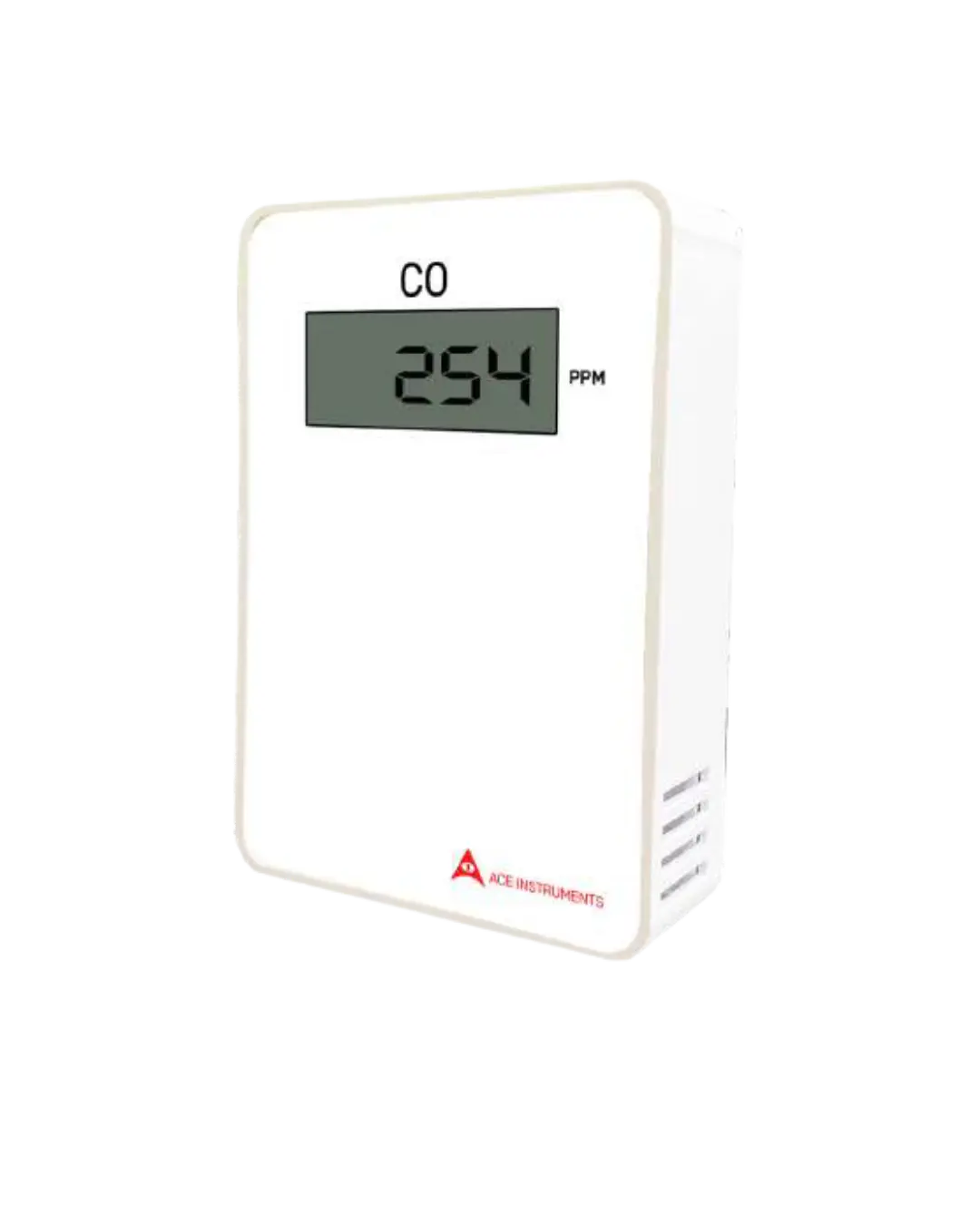
Product Description
Ace Instruments carbon monoxide (CO) transmitter is a high-accuracy electrochemical sensor based transmitter. Available with/without display in an IP54 rated plastic wall mounting enclosure. The CO transmitter provides a reliable solution to challenging applications across industries with a sensor life of over 10 years from leading Japanese manufacturers.
The transmitter supports monitoring in critical environments, for a range of industries: oil and gas, mines, semiconductor manufacturing, parking lots and marine applications. The transmitters can be used as a part of comprehensive indoor air quality monitoring solutions to ensure healthy levels in smart buildings and industrial spaces.
Electrochemical Sensing Explained
The transmitter uses electrochemical sensing technology to detect carbon monoxide with high accuracy. An electrochemical CO sensor passes air over two electrodes separated by an electrolyte. CO molecules are oxidised at the working electrode, generating a current proportional to CO concentration. This reaction produces a stable, linear signal that allows the transmitter to track even small changes in CO levels, making it well suited for safety-critical monitoring where early warning matters.
Alarm Thresholds
The transmitter features configurable relay alarm outputs, allowing thresholds to be set according to site requirements and applicable safety standards. Standard alarm thresholds include:
- 25 ppm - First alarm, signalling an early-stage CO presence
- 100 ppm - High alarm, indicating a dangerous concentration requiring immediate action
Applications
The Ace Instruments AI-CO sensor is a customizable, versatile monitoring solution designed for various applications, including:
- Parking lots & garages: Carbon monoxide emissions from vehicles can accumulate rapidly in parking structures, posing risks to occupants. The AI-CO transmitter is widely used in underground and multi-level parking areas to monitor CO levels effectively. It automates ventilation systems in shopping malls, airports, hotels, and office complexes based on real-time data, ensuring occupant safety while reducing energy costs by activating ventilation only when necessary.
- Industrial facilities: Industrial environments often involve processes that produce carbon monoxide as a byproduct. The AI-CO transmitter is ideal for oil and gas facilities where combustion processes generate CO. It is also highly effective in manufacturing plants that use boilers or equipment prone to incomplete combustion. Engine test rooms rely on this transmitter for precise monitoring of exhaust emissions, ensuring safe working conditions.
- Specialized applications: The versatility of the AI-CO transmitter extends to specialized environments across industries where poor ventilation increases CO risks. It is also used in marine vessels and boats with enclosed engine spaces that require constant air quality monitoring. Tunnels and other confined spaces benefit from its ability to measure CO levels accurately even in areas with restricted airflow.
- High-performance Japanese electrochemical sensor with > 10 year life
The Ace Instruments AI-CO Transmitter uses Japanese electrochemical sensors to deliver precise CO measurements. It offers detection ranges such as 0-100 ppm, 0-250 ppm, and up to 500 ppm. With a fast response time of less than 60 seconds, the transmitter ensures real-time alerts in critical situations. Its sensor lifespan exceeds ten years, making it a durable and cost-effective solution for long-term use.
- Flexible communication options
The AI-CO Carbon Monoxide transmitter provides versatile communication capabilities to suit different monitoring systems. It supports analog outputs like 0-10 VDC or 4-20 mA for basic integration. For advanced setups, RS-485 Modbus allows seamless integration with building management systems (BMS). Additionally, it offers relay outputs for direct control of alarms or ventilation systems, enabling automated responses to CO level changes.
- With/without display options available
The transmitter is designed to adapt to diverse installation requirements. Models are available with or without an LCD display for on-site monitoring convenience. The AI-CO Carbon Monoxide Transmitter's wide operating temperature range (-10°C to +60°C) ensures reliable performance in extreme conditions.
- Optimized energy utilization & control of ventilation systems
One of the standout features of the AI-CO transmitter is its ability to integrate with ventilation systems for demand-controlled operation. By activating ventilation only when CO levels exceed safe thresholds, the device helps optimize energy usage while maintaining air quality standards. Relay control & buzzer alarms alert users to changes in CO levels & trigger corrective action.
Compliance
- Indian Standards for carbon monoxide (CO) monitoring
- National Building Code (NBC) 2016 (Part 8) : Recommends demand control ventilation for enclosed parking lots and basements. By the use of CO sensors connected to variable frequency drives (VFD), in case of high levels fresh air can be triggered by VFD to ensure CO levels remain below 50 ppm (8-hour average). This results in enhanced energy efficiency and safety of occupants.
- ISHRAE Standard 10001:2016: Restricts CO exposure to less than 9 ppm as an 8-hour average in line with global regulations to ensure worker safety.
- GRIHA: Ensure continuous monitoring of carbon monoxide levels such that they meet the permissible thresholds as per Indian Society of Heating, Refrigerating and Air Conditioning Engineers (ISHRAE) standard 10001:2016.
- IGBC: Points are awarded under the health and well-being credit for installation of permanent CO sensors in potential source areas (e.g., cafeterias with gas stoves, parking basements) and linking them to the building management system for automatic ventilation.
- National Building Code (NBC) 2016 (Part 8) : Recommends demand control ventilation for enclosed parking lots and basements. By the use of CO sensors connected to variable frequency drives (VFD), in case of high levels fresh air can be triggered by VFD to ensure CO levels remain below 50 ppm (8-hour average). This results in enhanced energy efficiency and safety of occupants.
- Global standards for carbon monoxide (CO) monitoring
- Middle East
- Estidama (Pearl Rating System - UAE): Mandates compliance with ASHRAE 62.1, requiring CO monitoring to modulate ventilation in high-density zones or areas near combustion.
- Mostadam (Saudi Arabia): Encourages real-time monitoring of indoor pollutants, including CO, particularly in mixed-use buildings with attached parking.
- Japan
- CASBEE (Comprehensive Assessment System for Built Environment Efficiency): High scores require a Building Management System (BMS) that actively monitors pollutants, including carbon monoxide.
- Garage/Kitchens: Specific sub-credits for containment and exhaust control of combustion gases (CO) in service areas to prevent leakage into occupied zones.
- Europe
- BREEAM (Building Research Establishment Environmental Assessment Method): Hea 02 (Indoor Air Quality): Requires an Indoor Air Quality Plan that minimizes pollution. Credits are awarded for sensors that monitor CO (and NOx) to ensure levels stay within WHO guidelines (approx. 6 ppm for 24-hours or 9 ppm for 8-hours).
- HQE (Haute Qualité Environnementale - France): Target 13 (Sanitary Quality of Air): Prioritizes the monitoring of specific physico-chemical pollutants, including CO, especially in schools and offices.
- LEED v4.1 (Leadership in Energy and Environmental Design)
- EQ Credit: Enhanced Indoor Air Quality Strategies: Option 2 explicitly requires continuous monitoring of Carbon Monoxide in occupied spaces if combustion equipment is present.
- Alarm Threshold: Sensors must trigger an audible/visual alarm if levels exceed 10 ppm.
- Middle East
Specification
Frequently Asked Questions (FAQs)
1. What is the AI-CO Carbon Monoxide Transmitter?
The AI-CO is a wall-mounted carbon monoxide transmitter designed to continuously monitor CO concentration in indoor environments. It provides real-time CO measurements to Building Management Systems (BMS), PLCs, and HVAC controllers, helping protect occupants from carbon monoxide exposure and ensuring safe indoor air quality.
2. What does the AI-CO measure?
The transmitter continuously measures carbon monoxide (CO) concentration in parts per million (ppm). The measured value is transmitted to monitoring and control systems for alarm generation, ventilation control, and safety management.
3. Why is carbon monoxide monitoring important?
Carbon monoxide is a colorless, odorless, and toxic gas produced by incomplete combustion of fuels such as gasoline, diesel, natural gas, LPG, wood, and coal. Because it cannot be seen or smelled, continuous monitoring is essential to detect dangerous concentrations early and protect people from CO poisoning.
4. How does an electrochemical CO sensor work?
The AI-CO uses an electrochemical sensing element to detect carbon monoxide.
When carbon monoxide enters the sensor, it reacts at the sensing electrode and produces a very small electrical current. The strength of this current is directly proportional to the CO concentration in the air. The transmitter converts this signal into an accurate carbon monoxide reading in parts per million (ppm).
Electrochemical sensors are highly selective for carbon monoxide and are designed to minimize interference from other gases such as carbon dioxide.
5. At what height should a CO transmitter be installed?
For most occupied indoor spaces, the transmitter should be installed at approximately 1.5 metres above the floor, which represents the typical breathing zone.
Avoid installing the transmitter:
- Near windows
- Close to doors
- Directly beside supply air diffusers
- Near exhaust vents
- In areas with stagnant airflow
In car parks, loading bays, and large open areas, sensors should be installed where carbon monoxide is most likely to accumulate based on vehicle movement and ventilation patterns.
6. What is the operational lifespan of an electrochemical CO sensor?
The electrochemical sensing element typically has a service life of approximately 2 to 5 years, depending on operating conditions, carbon monoxide exposure, temperature, and humidity.
The AI-CO provides sensor status information to indicate when the sensing element is approaching the end of its service life. Replacement sensor modules are available, allowing the transmitter to continue operating without replacing the entire unit.
7. Where is the AI-CO commonly installed?
Typical applications include:
- Underground car parks
- Basement parking areas
- Boiler rooms
- Generator rooms
- Loading bays
- Commercial kitchens
- Mechanical rooms
- Warehouses
- Industrial facilities
- Hospitals
- Schools
- Commercial buildings
8. What CO concentration is considered unsafe?
Carbon monoxide becomes hazardous as its concentration and exposure time increase.
Continuous monitoring allows facility managers to detect rising CO levels early and activate ventilation or alarms before concentrations become dangerous. Alarm limits are typically configured according to local regulations and project specifications.
9. Can the AI-CO control ventilation systems?
Yes. The AI-CO communicates with the Building Management System through RS485 Modbus communication.
When carbon monoxide levels exceed the configured setpoint, the Building Management System can automatically:
- Start exhaust fans
- Increase ventilation rates
- Open fresh air dampers
- Activate warning alarms
- Notify facility personnel
This helps maintain safe indoor air quality while minimizing unnecessary fan operation.
10. Can the AI-CO be integrated with a Building Management System (BMS)?
Yes. The transmitter supports industry-standard communication options, including:
- RS485 Modbus communication
- 4 - 20 mA output
- 0 - 10 V output (depending on model)
These outputs enable seamless integration with Building Management Systems, PLCs, SCADA systems, and HVAC automation controllers.
11. Is the AI-CO suitable for continuous monitoring?
Yes. The AI-CO is designed for reliable 24×7 continuous operation in commercial, industrial, healthcare, parking, and institutional applications where continuous carbon monoxide monitoring is essential.
12. Does the transmitter require calibration?
The AI-CO is factory calibrated before shipment. Periodic calibration or verification is recommended to maintain measurement accuracy, particularly in life safety applications such as car parks, boiler rooms, and industrial facilities.
13. Is installation easy?
Yes. The compact wall-mounted design allows quick installation and easy integration with existing HVAC systems and Building Management Systems. It is suitable for both new installations and retrofit projects.
14. What are the advantages of using the AI-CO?
Key benefits include:
- Continuous carbon monoxide monitoring
- High-accuracy electrochemical sensing technology
- Early warning of hazardous CO levels
- Supports automatic ventilation control
- Easy BMS and PLC integration
- Multiple communication options
- Reliable industrial-grade performance
- Replaceable sensor element
- Low maintenance
15. Who typically uses the AI-CO?
The AI-CO is widely used by:
- Facility managers
- HVAC contractors
- Building automation integrators
- Parking facility operators
- Hospital engineering departments
- Industrial maintenance engineers
- Commercial building operators
- Mechanical consultants
- Warehouse managers
16. Why choose ACE Instruments?
ACE Instruments has over 30 years of experience in manufacturing gas detection and indoor air quality monitoring solutions. Customers choose our products for their accurate electrochemical sensing technology, industrial-grade reliability, easy BMS integration, calibration support, responsive technical assistance, and proven performance across commercial, healthcare, parking, pharmaceutical, and industrial applications.
17. How do I choose the right Carbon Monoxide Transmitter?
Choosing the right AI-CO depends on your application, CO measurement range, communication requirements, output signal, installation location, and ventilation control strategy. Our application engineers can help you select the most suitable carbon monoxide transmitter for car parks, boiler rooms, commercial buildings, hospitals, industrial facilities, warehouses, and other applications where continuous CO monitoring is critical.
18. Is the AI-CO a suitable alternative to Greystone CMD5B1, Q5C, Honeywell GSTC, Resideo 5800CO, or Siemens CO monitors?
Yes, the AI-CO Carbon Monoxide Transmitter is designed as a dependable alternative for commercial and industrial CO monitoring applications commonly handled by products such as:
- Greystone CMD5B1 Series (CMD5B1000, CMD5B1000-010, CMD5B1100, CMD5B1000-MOD)
- Greystone Q5C Series (Q5C-CO-250P-O-X, Q5C-CO-500P-O-X)
- Greystone GDT Series (GDTCOXSMCIR1XXX, GDTCOXSMCVXXXXX, GDTCOXSMCMXXXXX, GDTCOXSMVBR1AXX)
- Honeywell GSTC Series (GSTC-C, GSTC-N)
- Resideo 5800CO (5800CO, 5800COV, 5800COA)
The AI-CO offers:
- Accurate carbon monoxide sensing
- Stable long-term performance
- Easy wall-mount installation
- Analog and Modbus output options for BMS and HVAC systems
- Reliable indoor air quality monitoring for commercial and industrial environments
It can be considered for projects where users are evaluating alternatives to comparable CO monitoring systems from these brands. Greystone, Honeywell, Resideo, Siemens and other mentioned brands are trademarks of their respective owners. Ace Instruments is not affiliated with or endorsed by any of the aforementioned companies.
Gain insight into your IAQ solution and know technical specifications

