


Product Description
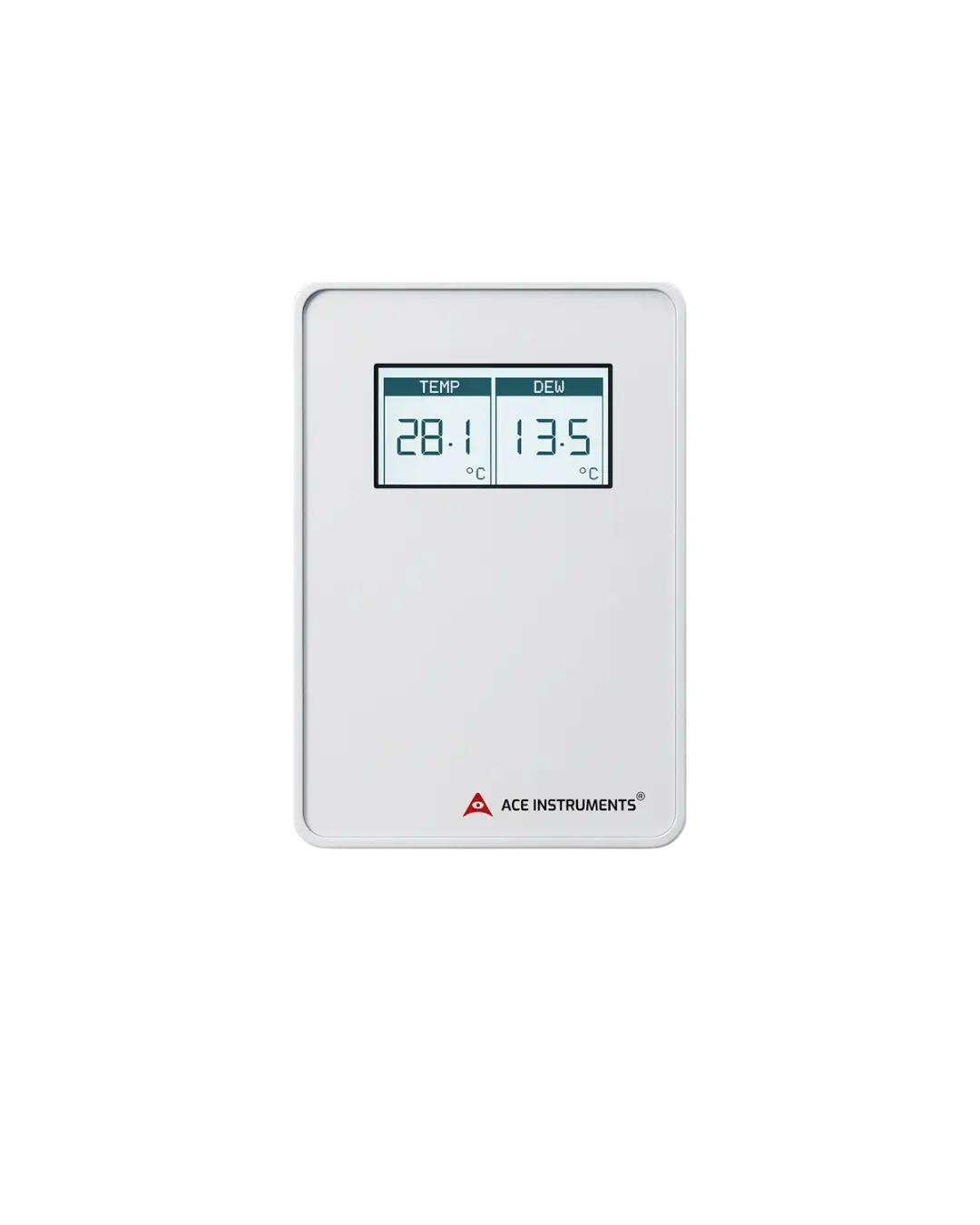
The Model AI-DEW-TRH is an advanced, high-performance monitoring solution engineered to accurately measure and display Temperature, Relative Humidity (RH), and Dew Point (calculated). Housed in an ABS plastic enclosure, the device is suited for room mounting in offices, data centers, cleanrooms, server rooms and battery manufacturing units. The device offers a clear graphic LCD display with readouts of temperature, humidity and dew point (calculated). The AI-DEW-TRH is designed to integrate with your systems via two 4-20 mA analog outputs (for temperature and dew point). For efficient BMS integration, RS-485 Modbus communication is also available.
What Is Dew Point?
Dew point is the temperature at which air becomes saturated with moisture and condensation begins to form. Unlike relative humidity, which describes moisture content as a percentage relative to what the air can hold at a given temperature, dew point is expressed as an absolute temperature value, telling you exactly when and where condensation will occur on any surface at or below that temperature.
Why Dew Point Matters More Than RH
Relative humidity is temperature-dependent, 60% RH at 20°C and 60% RH at 5°C represent very different moisture levels. Dew point is absolute: it directly tells you the temperature at which condensation will occur. This makes dew point the critical parameter for condensation control, not RH alone. A facility relying only on RH readings can miss the fact that a cold surface, a chilled pipe, a server rack, or a refrigerated wall, has dropped below the dew point and is actively condensing moisture, even while the room's RH reading looks unremarkable.
Condensation Prevention
Because dew point tells you the exact temperature at which moisture will condense on any surface, it allows facility teams to compare dew point readings directly against known surface temperatures, pipes, equipment casings, walls, or windows, and identify condensation risk before it happens. This proactive approach supports better HVAC control, insulation decisions, and equipment placement, addressing the actual physical condition that causes condensation rather than relying on relative humidity figures that can look normal even as condensation risk rises.
Key Features & Benefits
- Comprehensive Multi-Parameter Readout: Simultaneously monitors and displays Temperature, Relative Humidity, and calculated Dew Point in real-time.
- High-Visibility Display: Features a crisp, built-in 128x64 Graphic LCD display for clear, at-a-glance localized readings.
- Seamless System Integration: Easily integrates with existing PLC and SCADA systems utilizing optional 4-20 mA analog outputs.
- Advanced Data Transmission: Equipped with built-in RS-485 Modbus communication (optional) to continuously monitor, record, and transmit live environmental data directly to your Building Management System (BMS).
- Robust Enclosure: Housed in a durable, room-type ABS plastic wall-mounting enclosure that blends perfectly into professional environments.
Applications
The AI-DEW-TRH is the ideal companion for real-time monitoring of critical dew point levels across a variety of sensitive industries. By delivering precise data on temperature, relative humidity (RH), and dew point, this transmitter empowers facility managers to proactively protect assets, optimize production yields, and ensure strict regulatory compliance.
Data Centers & Server Rooms: Maximizing Uptime and Asset Protection
Environmental fluctuations are a primary cause of unplanned downtime in critical environments like data centers and server rooms.
- Condensation Prevention: When warm air meets cooled server racks, condensation can form, leading to short circuits on delicate motherboards. By monitoring the exact dew point, the AI-DEW-TRH allows HVAC systems to adjust cooling before the air reaches the saturation point.
- Mitigating Electrostatic Discharge (ESD): Conversely, if the air becomes too dry, the risk of ESD increases exponentially, which can cause issues.
- Automated BMS Integration: The transmitter continuously feeds live environmental data to your Building Management System (BMS). This enables automated adjustments to Computer Room Air Conditioning (CRAC) units, optimizing energy usage while keeping the environment in the perfect safe zone.
Cleanrooms (Pharma & Semiconductors): Ensuring Compliance and Yield Rates
Cleanrooms demand hyper-controlled environments where even minor deviations in air quality can ruin entire production batches. The AI-DEW-TRH provides the localized, accurate data necessary to maintain these strict standards.
- Pharmaceutical Manufacturing: In pharma cleanrooms, stringent humidity control is mandated by GMP regulations to prevent microbial growth and ensure the chemical stability and proper flowability of active pharmaceutical ingredients (APIs) during tableting and packaging. The AI-DEW-TRH provides the auditable data needed for continuous quality assurance.
- Semiconductor Fabrication: Semiconductor cleanrooms are incredibly sensitive to moisture. Excess humidity can cause microscopic corrosion on silicon wafers, while temperature fluctuations cause thermal expansion that disrupts nanoscale photolithography processes. The AI-DEW-TRH helps tightly control these variables, directly protecting product yield rates and preventing millions of dollars in scrapped materials.
Battery Manufacturing & Dry Rooms: Critical Moisture Control
The production of lithium-ion batteries requires uniquely rigorous environmental conditions, specifically ultra-low moisture environments.
- Preventing Volatile Reactions: Lithium is highly reactive to water. Even trace amounts of airborne moisture in a manufacturing facility can compromise battery performance, reduce lifespan, or cause severe safety hazards, including fires.
- Ultra-Low Dew Point Monitoring: Standard humidity sensors cannot operate effectively in these extreme environments. The AI-DEW-TRH is specifically engineered for this challenge, capable of measuring dew points down to a staggering -50°C. This makes it an indispensable tool for battery dry rooms, ensuring the manufacturing environment remains safely within the stringent ultra-low moisture parameters required for next-generation energy storage production
Specifications
Gain insight into your IAQ solution and know technical specifications
Frequently Asked Questions
1. What is the AI-DEW-TRH Room Type Dew Point Transmitter?
The AI-DEW-TRH is a wall-mounted transmitter that continuously measures dew point, temperature, and relative humidity. It helps monitor moisture levels in indoor environments where condensation control is critical. The transmitter provides real-time data to Building Management Systems (BMS), PLCs, and HVAC controllers for precise environmental monitoring and control.
2. What parameters does the AI-DEW-TRH measure?
The transmitter continuously measures:
- Dew Point
- Temperature
- Relative Humidity (RH)
These measurements provide a complete understanding of the moisture content and environmental conditions within a room.
3. What is dew point and how does it differ from relative humidity?
Relative humidity indicates how much moisture is present in the air compared to the maximum amount the air can hold at a given temperature. Because it depends on temperature, the relative humidity changes whenever the temperature changes, even if the actual amount of moisture remains the same.
Dew point is the temperature at which moisture in the air begins to condense into water droplets. Unlike relative humidity, dew point represents the actual moisture content in the air and is a more reliable indicator for preventing condensation. If any surface temperature falls to or below the dew point, condensation will occur.
4. Why is dew point monitoring important?
Dew point monitoring helps prevent condensation on equipment, walls, ceilings, pipes, and other surfaces. Condensation can lead to corrosion, mold growth, product damage, electrical failures, and reduced equipment life. Monitoring dew point allows facility managers to maintain safe environmental conditions before condensation occurs.
5. Why is dew point monitoring critical in server rooms?
Condensation on electronic equipment such as circuit boards, connectors, storage devices, and communication hardware can cause short circuits, corrosion, and unexpected system failures.
If the dew point of the room air rises above the surface temperature of the equipment, condensation can form during rapid changes in temperature or humidity. ASHRAE recommends maintaining server room dew points below approximately 17°C to help protect critical IT equipment and ensure reliable operation.
6. What industries commonly use dew point transmitters?
Dew point monitoring is widely used in industries where condensation control is essential, including:
- Pharmaceutical manufacturing
- Cleanrooms
- Cold storage facilities
- Food processing plants
- Data centers
- Museums and archives
- Electronics manufacturing
- HVAC systems
- Research laboratories
- Warehouses
- Industrial manufacturing
7. Where is the AI-DEW-TRH commonly installed?
Typical installation locations include:
- Data centers
- Server rooms
- Pharmaceutical facilities
- Cleanrooms
- Laboratories
- Hospitals
- Museums
- Archives
- HVAC control rooms
- Electronics manufacturing plants
- Food processing facilities
8. Can the AI-DEW-TRH be integrated with a Building Management System (BMS)?
Yes. The transmitter supports industry-standard communication options, including:
- RS485 Modbus communication
- 4 - 20 mA output
- 0 - 10 V output (depending on model)
These outputs enable seamless integration with Building Management Systems, PLCs, SCADA systems, and HVAC automation controllers.
9. How can dew point monitoring improve HVAC performance?
Continuous dew point monitoring allows the Building Management System to optimize heating, cooling, humidification, and dehumidification before condensation occurs. This improves indoor air quality, protects equipment, and reduces unnecessary HVAC energy consumption.
10. What accuracy can I expect from the sensors?
The AI-DEW-TRH uses high-quality factory-calibrated sensors for reliable long-term performance.
Typical performance includes:
- Relative Humidity Accuracy: ±3% RH
- Temperature Accuracy: ±0.3°C
- Accurate dew point calculation based on measured temperature and humidity
The sensors are factory calibrated against traceable standards.
11. Is the AI-DEW-TRH suitable for continuous monitoring?
Yes. The transmitter is designed for reliable 24×7 continuous monitoring in commercial, industrial, pharmaceutical, healthcare, and critical environmental applications.
12. Does the transmitter require calibration?
The AI-DEW-TRH is factory calibrated before shipment. Periodic verification is recommended for applications requiring high measurement accuracy, especially in pharmaceutical manufacturing, laboratories, data centers, and regulated environments.
13. Is installation easy?
Yes. The compact wall-mounted design allows quick installation and easy integration into existing HVAC systems and Building Management Systems. The transmitter requires minimal maintenance after installation.
14. What are the advantages of using the AI-DEW-TRH?
Key benefits include:
- Simultaneous measurement of dew point, temperature, and relative humidity
- Early detection of condensation risk
- Improved HVAC control
- Protection of sensitive equipment and products
- Easy BMS and PLC integration
- Reliable industrial-grade performance
- Low maintenance
- Continuous environmental monitoring
15. Who typically uses the AI-DEW-TRH?
The AI-DEW-TRH is widely used by:
- Facility managers
- HVAC contractors
- Building automation integrators
- Data center operators
- Pharmaceutical manufacturers
- Hospital engineering departments
- Laboratory managers
- Cleanroom consultants
- Museum conservators
- Industrial maintenance engineers
16. Why choose ACE Instruments?
ACE Instruments has over 30 years of experience in manufacturing environmental monitoring solutions. Customers choose our products for their high measurement accuracy, industrial-grade reliability, easy BMS integration, multiple communication options, calibration support, responsive technical assistance, and proven performance across commercial, healthcare, pharmaceutical, industrial, and data center applications.
17. How do I choose the right Room Type Dew Point Transmitter?
Choosing the right AI-DEW-TRH depends on your application, communication protocol, output signal, environmental conditions, and monitoring requirements. Our application engineers can help you select the most suitable transmitter for data centers, cleanrooms, pharmaceutical facilities, HVAC systems, museums, laboratories, and other applications where accurate dew point monitoring is essential.
Learn more
Know the capabilities of the latest in IAQ monitoring technology, watch or download PDF for insight
Check our YoutubeDownload Brochure (PDF)

