

Description
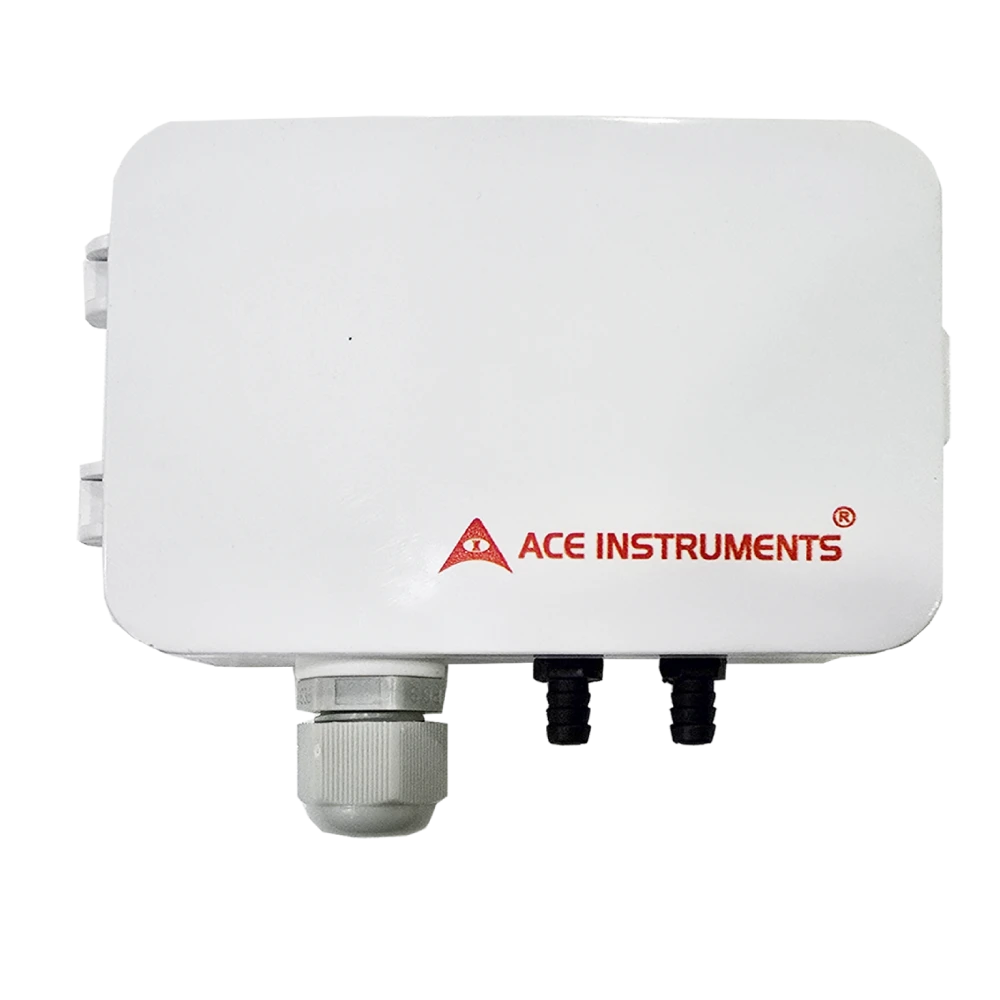
The Ace Instruments AI-DPTx is a high-accuracy differential pressure transmitter, meticulously designed for seamless integration with world-class HVAC, cleanroom, and industrial automation systems. Built for precision and reliability, it offers the flexibility of jumper-selectable positive and negative pressure ranges up to ±1000 Pa (customizable as per user requirements).
Engineered to meet the demands of modern building automation, the AI-DPTx ensures smooth connectivity with PLC, BMS, and SCADA systems through field-selectable 0-10 VDC and 4-20 mA outputs. Housed in a robust, compact ABS plastic enclosure with a hinged cover, it is designed for easy installation, durability, and long-term performance.
This CE-certified differential pressure transmitter is proudly Made in India, ensuring superior quality and compliance with international standards. Ideal for HVAC pressure monitoring, data centers, air filtration control, and industrial applications, the AI-DPTx delivers exceptional accuracy, stability, and efficiency in every environment.
4-20mA vs RS485 Output
Choosing the right output depends on how the transmitter will connect into the broader control system:
- 4 to 20 mA: Best suited for direct input into analog controllers, PLCs, or legacy BMS panels that read continuous current signals. This option is simple, widely compatible, and doesn't require network configuration.
- RS485 Modbus: Best suited for integration into a Building Management System over a Modbus network, allowing multiple parameters and diagnostic data to be read digitally, along with easier multi-device wiring on a shared bus.
Many projects choose based on what the existing controller or BMS already supports, rather than picking one output as universally superior.
HVAC Filter Monitoring
The transmitter can be installed across an HVAC filter bank to continuously measure the pressure differential between the upstream and downstream sides of the filter. As a filter loads with dust and debris, differential pressure rises steadily, giving the BMS a real-time indicator of filter condition. Transmitting this DP reading continuously supports predictive maintenance, allowing facility teams to schedule filter replacement based on actual loading rather than a fixed calendar interval, and to trigger an alarm if pressure exceeds a safe operating threshold.
Cleanroom Pressure Monitoring
For cleanroom applications, the transmitter provides continuous DP transmission between adjoining spaces of different cleanliness classifications, supporting ongoing compliance monitoring against standards such as ISO 14644-4 and EU GMP. Continuous transmission to the BMS, rather than local display alone, allows facilities to log pressurisation history for audit purposes and to receive immediate notification if differential pressure drifts outside the required range.
Pressure Range Selection Guide
Selecting the correct pressure range depends on the specific monitoring application:
- 0 to 50 Pa: Suited for room-level pressure monitoring, such as cleanrooms, isolation rooms, and pharmacy compounding areas, where differentials are typically small and precision at low pressure matters most
- 0 to 250 Pa: Suited for HVAC filter monitoring, where differential pressure across a filter bank typically falls within this range as the filter loads over its service life
- 0 to 1,000 Pa: Suited for high-DP applications, such as industrial ductwork or systems with higher static pressure requirements
Applications
The AI-DPTx is engineered for versatility offering optimal performance in a variety of applications.
- Air Filters: Monitoring air filter status through differential pressure measurement is crucial for ensuring efficient air filtration in cleanrooms, data centers, commercial buildings, and industrial facilities. By continuously tracking pressure differences across HEPA filters and industrial filtration units, users receive real-time alerts for filter maintenance or replacement, preventing airflow issues and maintaining air quality. This proactive approach enhances energy efficiency, system performance, and air purity in critical applications where clean air is essential.
- Data Centers: The AI-DPTx finds applicability by measuring differential pressure in data centers. The AI-DPTx helps maintain optimal airflow by detecting filter clogs, airflow blockages, and cooling inefficiencies. By measuring pressure differences across air handling units (AHUs) and raised floors, it ensures efficient cooling distribution and prevents hotspots. This ensures reliable performance and protects critical IT infrastructure.
- Hospitals & Pharmaceuticals: Differential pressure monitoring is essential for maintaining isolation room pressure control, cleanroom integrity, and sterile environments in hospitals and pharmaceutical settings. It ensures proper airflow in fume hoods, biosafety cabinets, and ventilation systems, and can detect blockages or leaks that may impact performance. Additionally, it helps maintain stable pressure conditions in pharmaceutical storage areas and ensures precise delivery of medical gases, like oxygen and nitrogen. Maintaining differential pressure helps these facilities comply with FDA, GMP, and ISO standards, safeguarding patient health, product quality, and facility efficiency.
- Commercial Buildings & Offices: Differential pressure (DP) monitoring in commercial buildings and offices ensures optimal indoor air quality, energy efficiency, and HVAC performance. It helps maintain proper airflow balance, preventing pressure imbalances that can cause drafts, odors, or inefficient temperature control. DP monitoring also detects duct leaks, clogged filters, and ventilation issues, ensuring a comfortable and healthy indoor environment. Additionally, it supports building automation systems in optimizing energy consumption, reducing operational costs, and enhancing occupant comfort.
Features:
- Field Selectable Measuring Range
The AI-DPTx features a field selectable measuring range, offering users the flexibility to configure the transmitter to suit their needs. The standard available measuring ranges are:- 0 to 100 Pa / -100 to +100 Pa (Jumper Selectable)
- 0 to 250 Pa / -250 to +250 Pa (Jumper Selectable)
- 0 to 500 Pa / -500 to +500 Pa (Jumper Selectable)
- 0 to 1000 Pa / -1000 to +1000 Pa (Jumper Selectable)
For customized ranges, contact our team today.
- Field Selectable Output
Jumper selectable outputs can be switched between 4-20 mA/ 0-10 VDC for ease of integration with standard industrial controllers.
- Robust & Compact - ABS Plastic Enclosure
The AI-DPTx features a durable, hinged ABS plastic enclosure, designed for robust performance and user convenience. Its compact form factor ensures easy installation, while on-field jumper selection allows for quick configuration, making it an ideal choice for various applications.
- Industry Leading Accuracy
The AI-DPTx is equipped with industry leading differential pressure sensing elements, offering an accuracy of ± 0.5% of full scale.
Specifications
Gain insight into your IAQ solution and know technical specifications
FAQS
1. What is the AI-DPTx Differential Pressure Transmitter?
The AI-DPTx is a high-accuracy differential pressure transmitter designed to continuously measure pressure differences between two points. It is widely used for cleanroom pressurization, HVAC systems, air filter monitoring, isolation rooms, laboratories, and industrial process applications. The transmitter provides reliable pressure measurements for Building Management Systems (BMS), PLCs, and SCADA systems.
2. What is differential pressure?
Differential pressure is the difference in pressure between two locations. By continuously measuring this pressure difference, the transmitter helps verify airflow direction, monitor filter condition, maintain room pressurization, and ensure proper HVAC system performance.
3. Why is differential pressure monitoring important?
Differential pressure monitoring helps maintain controlled environments by ensuring proper airflow between adjacent spaces. It also helps detect clogged filters, monitor fan performance, improve energy efficiency, and maintain compliance with cleanroom, laboratory, and healthcare standards.
4. Where is the Differential Pressure Transmitter commonly installed?
Typical applications include:
- Pharmaceutical cleanrooms
- Hospital isolation rooms
- Operation theatres
- Biotechnology laboratories
- HVAC systems
- Air Handling Units (AHUs)
- HEPA filter monitoring
- Industrial ventilation systems
- Semiconductor manufacturing
- Research laboratories
- Food processing facilities
5. What does the Differential Pressure Transmitter measure?
The transmitter continuously measures the pressure difference between two pressure ports. The measured value can be used to monitor room pressurization, airflow, filter condition, or process pressure depending on the application.
6. What pressure ranges are available for the Differential Pressure Transmitter?
The transmitter is available in multiple pressure ranges to suit different applications, including:
- 0 - 50 Pa for room pressurization monitoring in cleanrooms and isolation rooms
- 0 - 250 Pa for HVAC filter monitoring
- 0 - 1000 Pa for higher-pressure industrial applications
Other pressure ranges are also available on request. The appropriate measuring range should be specified at the time of ordering to ensure the best accuracy for your application.
7. Can the transmitter be used for both positive and negative pressure measurement?
Yes. By selecting which pressure port (High or Low) is connected to each measurement point, the transmitter can measure both positive and negative pressure differentials.
For example:
- Positive pressure monitoring where the room pressure is higher than the reference area.
- Negative pressure monitoring where the room pressure is lower than the surrounding area.
The display clearly indicates the direction of the pressure difference.
8. How is the Differential Pressure Transmitter installed?
The transmitter is wall mounted and connected to the two measurement points using flexible pressure tubing. Proper installation ensures accurate and stable pressure measurements for continuous monitoring.
9. Can the transmitter monitor HEPA filter performance?
Yes. Differential pressure measurement across HEPA filters helps determine filter loading and airflow resistance. A gradual increase in pressure drop indicates that the filter is becoming clogged and may require replacement, enabling predictive maintenance.
10. What is a 4–20 mA output and how does it connect to a Building Management System (BMS)?
A 4-20 mA output converts the measured pressure into an analog current signal.
- 4 mA represents the minimum pressure (0 Pa).
- 20 mA represents the full-scale pressure of the selected range.
This industry-standard signal is compatible with most Building Management Systems (BMS), PLCs, and SCADA systems. It provides excellent noise immunity over long cable runs and can also indicate wiring faults if the current falls below 4 mA.
For applications requiring digital communication, the transmitter also supports RS485 Modbus, allowing multiple devices to communicate over a single network with built-in error checking.
11. Is the AI-DPTx a suitable alternative to Greystone PWC/PDT, Honeywell TruStability, Siemens QBM, Setra, or Dwyer differential pressure transmitters?
Yes, the AI-DPTx Differential Pressure Transmitter is designed as a dependable alternative for HVAC, cleanroom, and industrial differential pressure monitoring applications commonly handled by products such as:
- Greystone PDT Series (PDT2X0-05-A, PDT2X0-10-A, PDT2X0-25-A)
- Greystone PWC Series (PWC2X0-05-A, PWC2X0-10-A, PWC2X0-25-A)
- Honeywell TruStability Series (HSC Series, SSC Series, NSC Series)
- Siemens QBM Series (QBM81-3, QBM2030-1U, QBM2100 Series)
- Setra Model 264 Series (2641005WD2EE11, 2642502WD2EE11)
- Dwyer MS2 Magnesense Series (MS2-W101, MS2-W111, MS2-LCD)
The AI-DPTx offers:
- High-accuracy differential pressure sensing
- Fast response monitoring for critical environments
- Suitable for air and non-corrosive gas applications
- Analog output options including 4-20 mA and 0-10 VDC
- RS-485 Modbus communication for BMS/SCADA integration
- Reliable monitoring for cleanrooms, AHUs, HVAC systems, and pharmaceutical environments
- Compact wall-mount enclosure for easy installation
It can be considered for projects where users are evaluating alternatives to comparable differential pressure monitoring systems from these brands.
Greystone, Honeywell, Siemens, Setra, Dwyer and other mentioned brands are trademarks of their respective owners. Ace Instruments is not affiliated with or endorsed by any of the aforementioned companies.
12. Is the AI-DPTx suitable for continuous monitoring?
Yes. The AI-DPTx is designed for reliable 24×7 continuous operation in commercial, pharmaceutical, healthcare, industrial, and research facilities.
13. Does the transmitter require calibration?
The transmitter is factory calibrated before shipment to ensure accurate measurements. Periodic verification is recommended for applications requiring high measurement accuracy, particularly in pharmaceutical manufacturing, healthcare, and cleanroom environments.
14. What are the advantages of using the AI-DPTx?
Key benefits include:
- High-accuracy differential pressure measurement
- Multiple pressure ranges
- Positive and negative pressure monitoring
- Easy BMS and PLC integration
- Analog and digital communication options
- Reliable industrial-grade performance
- Continuous 24×7 operation
- Supports predictive maintenance
15. Who typically uses the AI-DPTx Differential Pressure Transmitter?
The AI-DPTx is widely used by:
- Pharmaceutical manufacturers
- Hospital engineering departments
- HVAC contractors
- Building automation integrators
- Facility managers
- Biotechnology laboratories
- Semiconductor manufacturers
- Industrial maintenance teams
- Research laboratories
- Food processing facilities
16. Why choose ACE Instruments?
ACE Instruments has over 30 years of experience in designing and manufacturing differential pressure monitoring solutions. Customers trust our products for their measurement accuracy, industrial-grade reliability, easy BMS integration, multiple communication options, calibration support, responsive technical assistance, and proven performance across pharmaceutical, healthcare, commercial, and industrial applications.
17. How do I choose the right Differential Pressure Transmitter?
Selecting the right transmitter depends on several factors, including the required pressure range, application, output signal, communication protocol, installation environment, and system compatibility.
Our application engineers can help you choose the most suitable AI-DPTx model for your specific monitoring requirements, ensuring accurate measurements and long-term reliable performance.

