

.webp)
Description
The Ace Instruments Carbon Dioxide Transmitter (AI-CO2) sensor leverages the latest in sensing technology to delivery a flexible, feature-packed room CO2 level monitor. The AI-CO2 series is equipped to measure a wide range of readings, up to 20,000 ppm (customizable ranges as per user requirement available in 0-2000 ppm, 0-5000 ppm, 0-10000 ppm & 0-20000 ppm). As a result, the AI-CO2 is the ideal partner for a wide variety of applications & suited to serve commercial & industrial applications. The transmitter supports applications to monitor levels of carbon dioxide across smart agriculture and smart buildings, including: greenhouses, hospital laboratories, cold storage monitoring, retail spaces, offices and educational institutions.
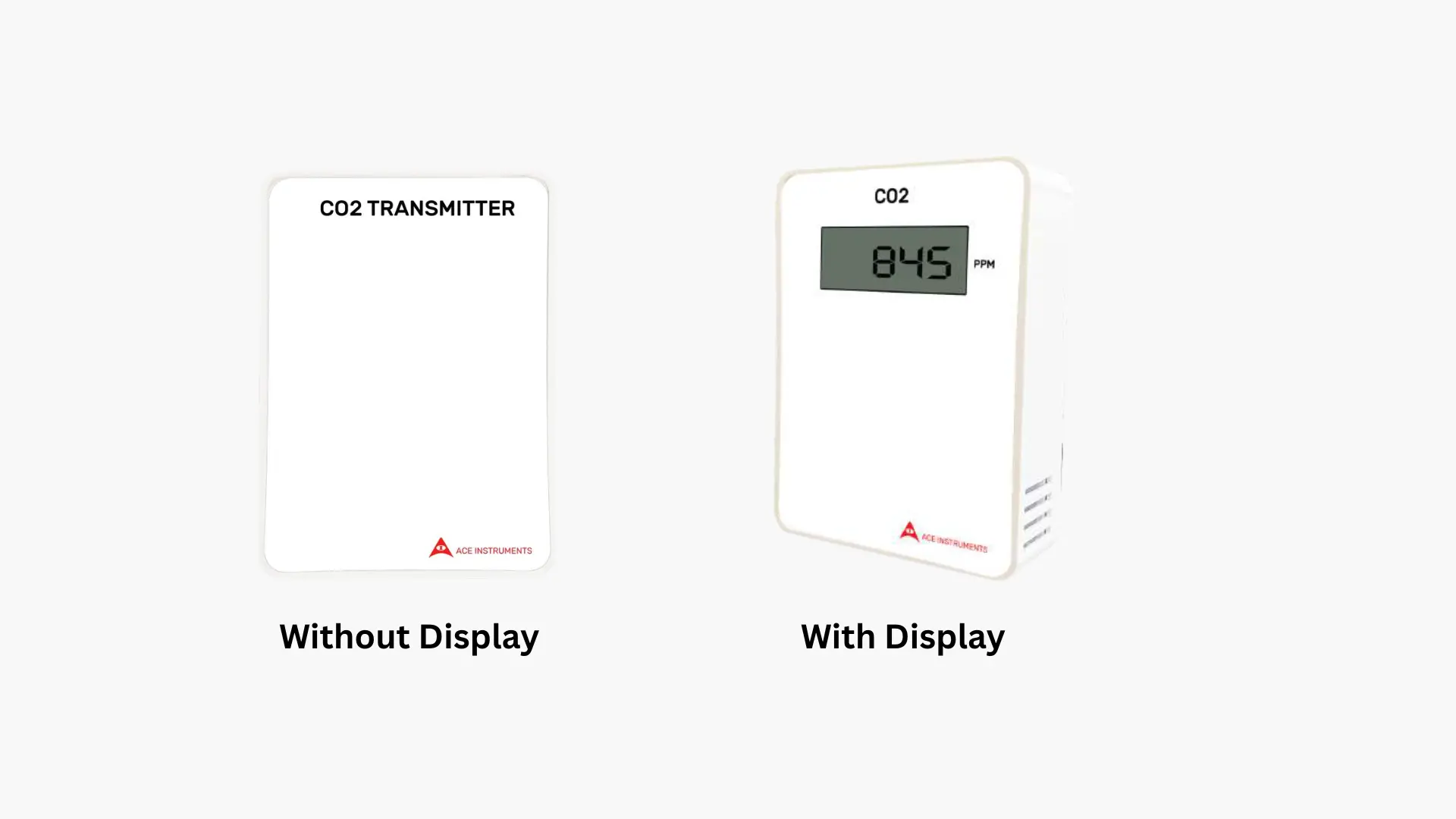
The AI-CO2 is available with an option of LCD display readout or blind transmitter (no display). The monitor brings an array of communication options & features, designed for the discerning user, including: RS485 Modbus, 4-20 mA output, 0-10 VDC output along with the option of relay output to ensure elite indoor ventilation control.
Ensure healthy CO2 levels and optimize indoor air quality by co-developing your solution with us. Choose from display options, including a duct mounting option and optional relay and buzzer alarms for timely alerts in case of threshold violations to ensure optimal environment for your specific application.
How It Works
Installed at breathing height (1.0 to 1.5 m) in occupied rooms, this transmitter feeds real-time CO₂ data to the HVAC control system, enabling demand-controlled ventilation. Rather than ventilating on a fixed schedule, the BMS can adjust fresh air supply based on actual CO₂ concentration, increasing ventilation as occupancy rises and reducing it during low-occupancy periods, balancing air quality with energy efficiency.
NDIR Technology Explained
NDIR sensors shine infrared light through air, CO₂ molecules absorb specific infrared wavelengths, allowing precise concentration measurement without consumable parts. This optical measurement principle gives NDIR sensors excellent long-term stability and accuracy, since there's no chemical reaction or consumable element to degrade over time, unlike some other gas sensing technologies. This makes NDIR the preferred sensing method for continuous, long-service CO₂ monitoring in occupied building spaces.
Features
- New generation photoacoustic (PAS) sensor
The AI-CO2 features advanced PAS (Photoacoustic Spectroscopy) sensors, representing the latest in carbon dioxide sensing technology. PAS sensing enables highly accurate CO₂ measurements, resulting in enhanced reliability and exceptional long-term stability, making it ideal for real-time monitoring & demand controlled ventilation applications.
- RS-485 Modbus communication
The carbon dioxide transmitter integrates with building management systems (BMS) via RS485 Modbus communication. This enables users to maintain records & take corrective actions in case of any deviations.
- With/without display options available
The Ace Instruments carbon dioxide transmitter is a flexible solution, designed to meet user requirements. The display on the device is optional, allowing for a blind transmitter application (communicating directly with PLC) as well.
- Optional relay output (CO/NO/NC)
The AI-CO2 is designed to integrate with ventilation systems with the flexibility of an optional relay output (CO/NO/NC), allowing for control functionality by triggering exhaust fans/ventilation systems.
Applications
- Demand Controlled Ventilation
Adjusts ventilation rates based on real-time CO₂ levels to optimize indoor air quality.Helps reduce energy costs by avoiding over-ventilation during low occupancy.
- Commercial Buildings
Used in offices, malls, and hospitality spaces to maintain healthy air quality. Supports smart HVAC control and regulatory compliance for commercial establishments by ensuring workplace regulations for ventilation are met.
- Educational Institutions
Monitors CO₂ in classrooms to ensure a conducive learning environment. Prevents drowsiness and improves focus by maintaining fresh air.
- Healthcare Facilities
Ensures optimal air exchange in patient rooms and operation theaters. Vital for infection control and maintaining sterile conditions.
- Green Buildings
Integrated into sustainable designs for energy-efficient ventilation. Helps achieve LEED/BREEAM certifications by improving IAQ metrics.
- Residential Complexes
Enhances smart home systems with real-time air quality monitoring. Improves comfort and health for families in enclosed spaces.
- Industrial Facilities
Monitors CO₂ levels in confined workspaces and production areas. Protects workers from poor air quality and ensures regulatory compliance.
- Public Transport Hubs
Maintains safe ventilation levels in crowded spaces like stations and airports. Improves comfort and reduces transmission risks in high-footfall areas.
- Laboratories & Cleanrooms
Supports controlled environments where precision is critical. Prevents contamination and protects sensitive equipment or experiments.
Compliance
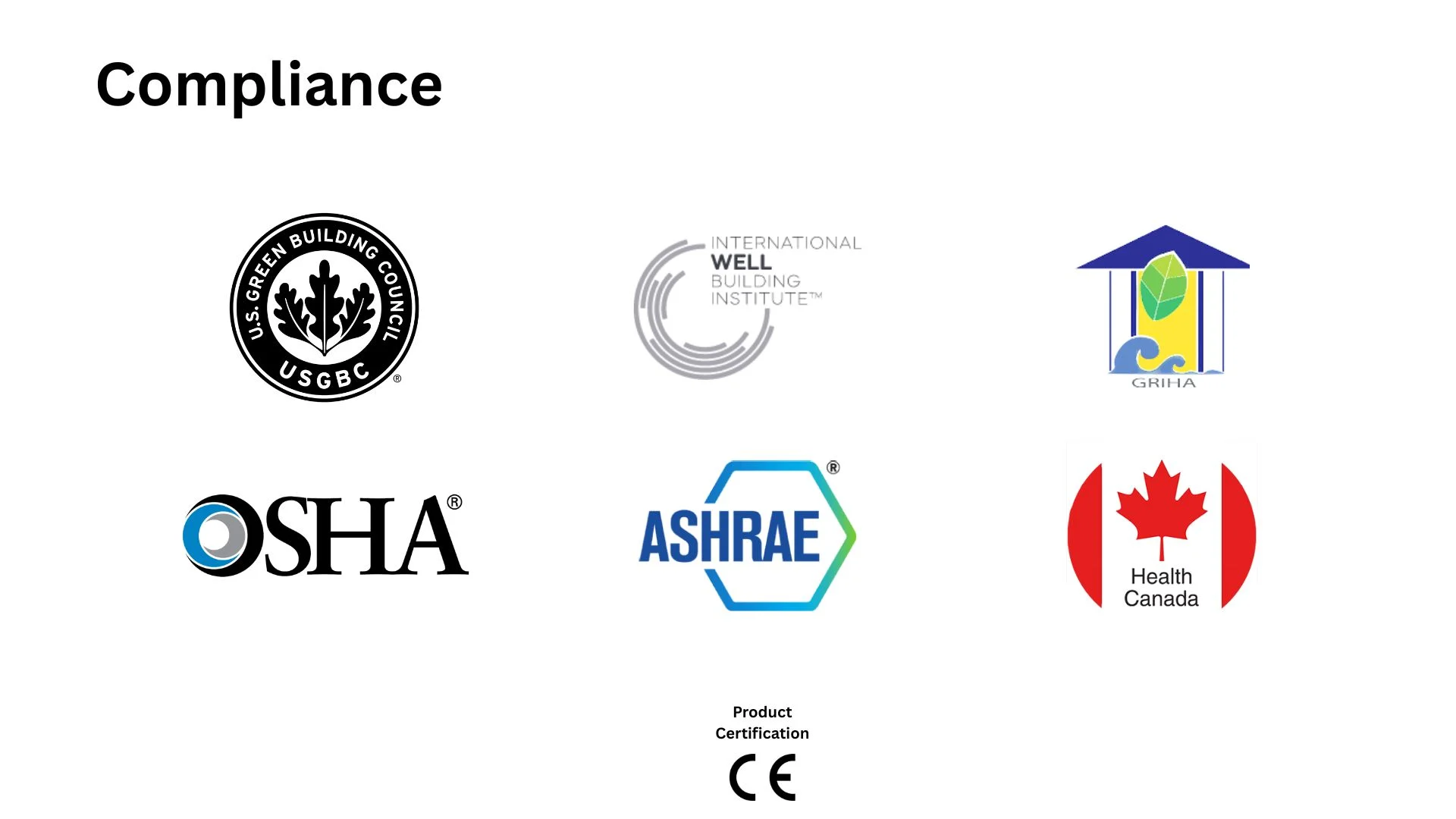
- ASHRAE (American Society of Heating, Refrigerating & Air Conditioning Engineers): Ensure compliance with ASHRAE Standard 62.1, by maintaining CO2 levels within acceptable range of no more than 700 ppm higher compared to outdoor CO2 levels
- OSHA (Occupational Safety and Health Administration): Ensure exposure to remain under permissible exposure limit (PEL) as per OSHA standards to maintain workplace safety
- LEED (Leadership in Energy & Environmental Design): Prioritize CO2 monitoring to ensure compliance with the new LEED v5 regulations as part of continuous indoor air quality monitoring
- GRIHA (Green Rating for Integrated Habitat Assessment): Leverage the latest CO2 sensing technology to ensure compliance with GRIHA 2019
- WELL (Set by the International WELL Building Institute): Ensure ventilation effectiveness by ensuring integration with WELL-mandated demand controlled ventilation systems
- Health Canada: Follow recommended indoor CO2 exposure guideline as set by Health Canada with ease & multiple integration options
- Additional compliances:
Government of Dubai, Health and Safety Department
BMS Integration
With RS485 Modbus communication and optional Wi-Fi connectivity, the transmitter feeds real-time CO₂ data directly into a Building Management System or cloud dashboard, enabling automated ventilation control, centralized monitoring across multiple rooms, and demand-controlled ventilation strategies that adjust fresh air supply based on actual, measured occupancy-driven CO₂ levels rather than fixed schedules.
FAQs
1. What is the AI-CO2 Carbon Dioxide Transmitter?
The AI-CO2 is a wall-mounted carbon dioxide transmitter designed to continuously measure indoor CO₂ concentration. It provides accurate real-time CO₂ data to Building Management Systems (BMS), PLCs, HVAC controllers, and cloud monitoring platforms to help maintain healthy indoor air quality and energy-efficient ventilation.
2. What does the AI-CO2 measure?
The transmitter continuously measures carbon dioxide (CO₂) concentration in parts per million (ppm). The measured value helps building operators evaluate ventilation effectiveness and maintain a comfortable indoor environment.
3. Why is carbon dioxide monitoring important?
Carbon dioxide is an excellent indicator of indoor air quality and occupancy. As more people occupy a space, CO₂ levels increase. Elevated CO₂ levels may indicate inadequate ventilation, leading to drowsiness, reduced concentration, discomfort, and poor indoor air quality. Continuous monitoring helps ensure sufficient fresh air is supplied to occupied spaces.
4. What does an NDIR CO₂ transmitter measure?
An NDIR (Non-Dispersive Infrared) CO₂ transmitter measures the concentration of carbon dioxide in the air by detecting how much infrared light is absorbed by CO₂ molecules.
The AI-CO2 uses infrared sensing technology to provide accurate CO₂ measurements in parts per million (ppm). The measured values are displayed locally and transmitted to the Building Management System through Modbus RS485 for monitoring and control.
5. What is NDIR sensing technology?
NDIR (Non-Dispersive Infrared) technology is one of the most accurate and reliable methods for measuring carbon dioxide. It offers excellent long-term stability, high measurement accuracy, minimal maintenance, and is widely used in commercial buildings, hospitals, schools, laboratories, and HVAC applications.
6. Where should a wall-mounted CO₂ transmitter be installed?
For accurate measurements, the transmitter should be installed at breathing height, typically between 1.0 and 1.5 metres above the floor.
Avoid installing the transmitter:
- Near windows
- Close to doors
- Directly below air supply diffusers
- Near exhaust vents
- In dead air spaces
The ideal location is the area with the highest expected occupancy so that the measured CO₂ level accurately represents the indoor environment.
7. Where is the AI-CO2 commonly installed?
Typical applications include:
- Office buildings
- Schools and universities
- Hospitals
- Conference rooms
- Classrooms
- Hotels
- Shopping malls
- Airports
- Laboratories
- Commercial buildings
- Government buildings
- Healthcare facilities
8. How does this transmitter connect to a Building Management System (BMS)?
The AI-CO2 communicates with Building Management Systems using Modbus RTU over a standard 2-wire RS485 communication network.
Multiple transmitters can be connected on the same RS485 communication bus, making installation simple and cost-effective. Models with the optional Wi-Fi feature can also transmit data to cloud-based monitoring platforms for remote access and monitoring.
9. Can the AI-CO2 improve HVAC energy efficiency?
Yes. The AI-CO2 supports demand-controlled ventilation by allowing the Building Management System to adjust fresh air supply according to actual occupancy. This helps maintain healthy indoor air quality while reducing heating and cooling energy consumption.
10. What CO₂ level is considered acceptable indoors?
Although recommended limits vary by application, many commercial buildings aim to maintain indoor CO₂ levels below 800 to 1,000 ppm. Maintaining CO₂ within this range generally indicates adequate ventilation and helps improve occupant comfort and productivity.
11. Can the AI-CO2 be integrated with a Building Management System (BMS)?
Yes. The transmitter supports industry-standard communication options, including:
- RS485 Modbus communication
- 4 - 20 mA output
- 0 - 10 V output (depending on model)
- Optional Wi-Fi connectivity
These communication options allow seamless integration with Building Management Systems, PLCs, SCADA systems, and cloud-based monitoring platforms.
12. Is the AI-CO2 suitable for continuous monitoring?
Yes. The AI-CO2 is designed for reliable 24×7 continuous operation in commercial, educational, healthcare, pharmaceutical, and industrial applications.
13. Does the transmitter require calibration?
The AI-CO2 is factory calibrated before shipment. Periodic verification is recommended to maintain long-term measurement accuracy, particularly in critical indoor air quality monitoring applications.
14. Is installation easy?
Yes. The compact wall-mounted design allows quick installation and simple integration with HVAC systems and Building Management Systems. It is suitable for both new buildings and retrofit projects.
15. What are the advantages of using the AI-CO2?
Key benefits include:
- Continuous CO₂ monitoring
- High-accuracy NDIR sensing technology
- Supports demand-controlled ventilation
- Improves indoor air quality
- Easy BMS and PLC integration
- Multiple communication options
- Optional Wi-Fi connectivity
- Reliable industrial-grade performance
- Low maintenance
16. Who typically uses the AI-CO2?
The AI-CO2 is widely used by:
- Facility managers
- HVAC contractors
- Building automation integrators
- Hospital engineering departments
- School administrators
- Commercial building operators
- Laboratory managers
- Pharmaceutical manufacturers
- Industrial maintenance engineers
- Green building consultants
17. Why choose ACE Instruments?
ACE Instruments has over 30 years of experience in manufacturing indoor air quality and HVAC monitoring solutions. Customers choose our products for their high measurement accuracy, reliable NDIR sensing technology, industrial-grade construction, easy BMS integration, optional cloud connectivity, responsive technical support, and proven performance across commercial, healthcare, educational, pharmaceutical, and industrial applications.
18. How do I choose the right Carbon Dioxide Transmitter?
Choosing the right AI-CO2 depends on your application, communication requirements, output signal, installation location, and monitoring objectives. Our application engineers can help you select the most suitable carbon dioxide transmitter for offices, schools, hospitals, laboratories, commercial buildings, healthcare facilities, and other environments where continuous CO₂ monitoring and energy-efficient ventilation are essential.
19. Is the AI-CO2 a suitable alternative to Greystone CD2RMC, Honeywell C7232, Siemens QPA, or Belimo CO2 monitors?
Yes, the AI-CO2 Carbon Dioxide Transmitter is designed as a dependable alternative for indoor air quality and HVAC CO2 monitoring applications commonly handled by products such as:The AI-CO2 offers:
- Greystone CD2RMC Series (CD2RMC, CD2RMC-24, CD2RMC-A, CD2RMC-D)
- Greystone CEDT Series (CEDT-C2D-X, CEDT-C2W-X, CEDT-C2R-X)
- Honeywell C7232 Series (C7232A1008, C7232B1006, C7232A1040)
- Honeywell TR42 IAQ Series (TR42, TR42A, TR42A-U)
- Siemens QPA Series (QPA2000, QPA2002, QPA2062)
- Belimo 22RC Series (2RC-51, 22RCM-51, 22RTM-59)
The AI-CO2 offers:
- Accurate Photoacoustic/NDIR carbon dioxide sensing (customizable)
- Stable long-term monitoring performance
- Analog and Modbus communication options
- Easy integration with BMS, PLC, and HVAC systems
- Reliable indoor air quality monitoring for commercial and industrial environments
- Compact wall-mount enclosure for easy installation
It is suitable for offices, hospitals, laboratories, schools, commercial buildings, pharmaceutical facilities, cleanrooms, and industrial HVAC applications.It can be considered for projects where users are evaluating alternatives to comparable CO2 monitoring systems from these brands.
Greystone, Honeywell, Siemens, Belimo and other mentioned brands are trademarks of their respective owners. Ace Instruments is not affiliated with or endorsed by any of the aforementioned companies.
Specifications
{{table-component}}
Gain insight into your IAQ solution and know technical specifications

