

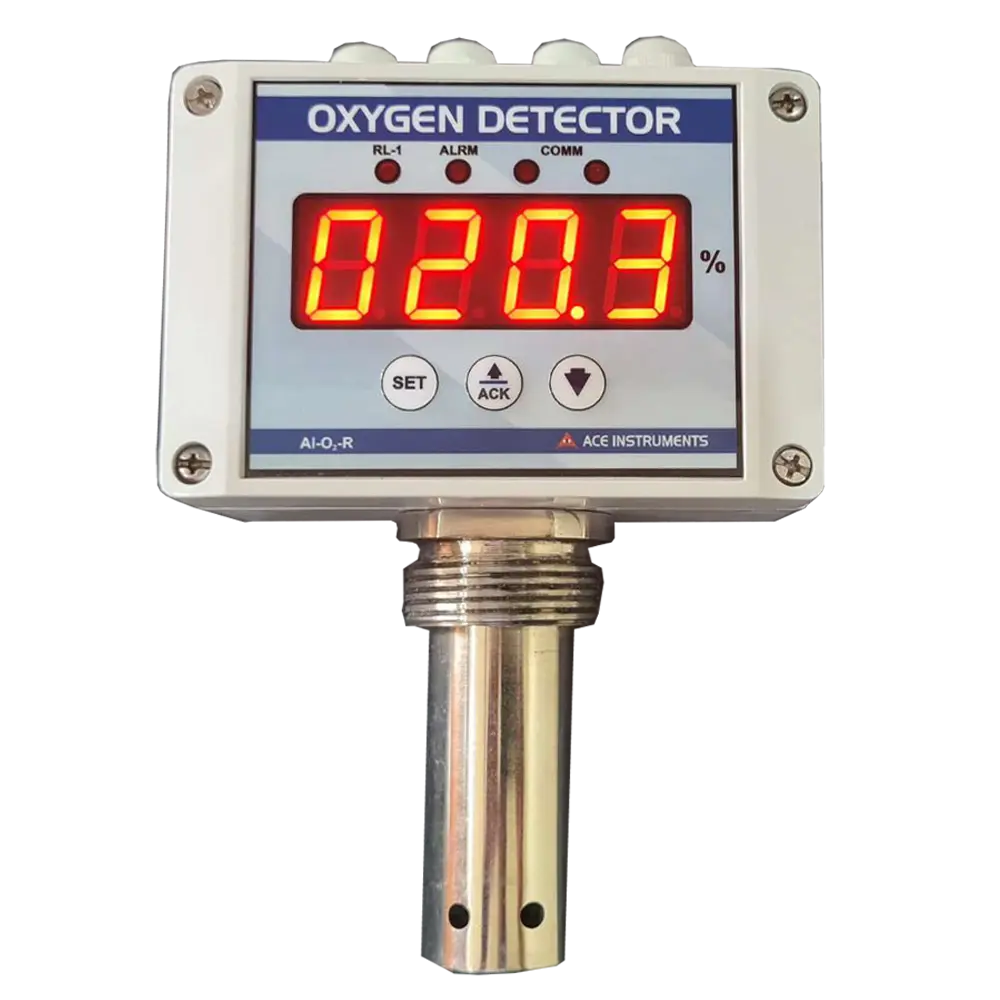
Description
The Ace Instruments Oxygen Detector (AI-O₂-Tx) is a weatherproof oxygen detector. Housed in an IP65 ABS plastic enclosure, it finds applicability in oxygen depletion monitoring, food industry (refrigeration, greenhouses), biotechnology, flue gas monitoring as well as in oxygen generation plants and oxygen concentrators. The instrument features a Japanese oxygen sensor with a long life (>5 years), with galvanic cell sensing and quick response time. The oxygen detector also provides reliable readings of indoor (enclosed room) environments to alert users when oxygen levels fall to dangerous levels and increase risk of oxygen deficiency for occupants.
Alarm Setpoints
The detector uses two standard alarm setpoints aligned with recognized oxygen safety thresholds:
- 19.5% O₂ (First Alarm): A warning-level alarm marking the OSHA-recognized minimum safe oxygen concentration, signaling that oxygen levels have begun to drop below normal
- 18.0% O₂ (Second Alarm): A danger-level alarm indicating oxygen depletion has reached a level requiring immediate evacuation
This two-stage approach gives personnel an early warning before conditions become critical, followed by a clear signal to evacuate if depletion continues.
Electrochemical Galvanic Sensing
The detector uses a galvanic cell sensor, an electrochemical technology that generates a current proportional to the oxygen concentration in the surrounding air. This sensing method is well suited to continuous fixed monitoring, offering stable, dependable readings over the sensor's service life without requiring external power to drive the chemical reaction itself.
Installation Requirements
Because O₂-depleting gases such as CO₂ and nitrogen are often heavier than air and concentrate low, the detector should be mounted at breathing height in the lowest point of the monitored area. This positioning ensures the sensor detects oxygen depletion where it accumulates first, rather than at ceiling height where displaced oxygen-rich air may linger longer.
Features
- IP65 ABS plastic enclosure
- Japanese galvanic cell type sensor
- Reliable room oxygen depletion monitoring for enclosed space personnel safety
- Optional RS485 Modbus communication
- Optional relay output
Applications
Nitrogen Storage
Monitors oxygen displacement in areas storing or using nitrogen, protecting personnel from asphyxiation risk in enclosed storage spaces.
CO₂ Cylinder Rooms
Detects oxygen depletion from CO₂ leaks or venting, critical in rooms housing bulk CO₂ cylinders or storage tanks.
Cold Storage (Dry Ice)
Protects workers in cold storage facilities where dry ice sublimation releases CO₂ and displaces breathable oxygen.
Inert Gas Purging
Monitors areas where inert gases like nitrogen or argon are used for purging processes, reducing risk during and after purging operations.
Confined Space Monitoring
Provides continuous oxygen level verification in tanks, vessels, and other confined spaces before and during occupied work.
Maintenance & Sensor Replacement
The galvanic O₂ sensor has a typical service life of 2 to 3 years and is fully replaceable without needing to replace the entire transmitter unit. This design keeps long-term maintenance costs down, since facility teams only need to swap the sensor element on schedule rather than reinstalling a new detector, minimizing downtime and simplifying ongoing calibration and upkeep.
Frequently Asked Questions
1. What is the AI-O₂-Tx Oxygen Deficiency Detector?
The AI-O₂-Tx is a fixed oxygen monitoring system designed to continuously measure oxygen concentration in enclosed or confined spaces. It provides early warning of oxygen-deficient or oxygen-enriched atmospheres, helping protect personnel from asphyxiation hazards and ensuring compliance with workplace safety requirements.
2. Why should oxygen levels be monitored?
Oxygen cannot be seen or smelled, and a reduction in oxygen concentration can occur without warning. Oxygen-deficient atmospheres may lead to dizziness, unconsciousness, or even death. Continuous monitoring allows personnel to respond before conditions become dangerous.
3. Where is the AI-O₂-Tx commonly installed?
The detector is ideal for:
- Confined spaces
- Laboratories
- Nitrogen storage rooms
- Cryogenic facilities
- Hospitals
- Pharmaceutical plants
- Industrial gas storage areas
- Food and beverage processing plants
- Semiconductor manufacturing
- Data centers
- Cold storage facilities
- Research laboratories
4. What causes oxygen deficiency?
Oxygen deficiency can occur when inert gases such as nitrogen, argon, helium, or carbon dioxide displace oxygen in an enclosed space. Common causes include gas leaks, cryogenic storage systems, welding operations, and confined space work.
5. What are the standard oxygen alarm levels?
Typical alarm settings are:
- 19.5% O₂ - First Alarm (Warning): Matches the OSHA 1910.146 definition of an oxygen-deficient atmosphere and alerts personnel to investigate the cause.
- 18.0% O₂ - Second Alarm (Danger): Indicates a hazardous atmosphere requiring immediate evacuation.
Both alarm thresholds are fully user-configurable within the detector's measurement range to meet site-specific safety requirements.
6. Where should an oxygen detector be installed?
For most applications, the detector should be installed at breathing height, approximately 1.5 meters above floor level, in areas where personnel are normally present and where oxygen depletion is most likely to occur.
However, gases that displace oxygen behave differently:
- Carbon dioxide (CO₂) and other gases heavier than air may accumulate near the floor
- Nitrogen may also collect in low-lying or poorly ventilated areas depending on airflow patterns
For these applications, additional detectors at lower elevations may be recommended as part of a comprehensive gas detection system.
7. How does the AI-O₂-Tx improve workplace safety?
The detector continuously measures oxygen concentration and provides early warning before oxygen levels become hazardous. This enables personnel to investigate leaks, improve ventilation, and safely evacuate if required.
8. What happens when oxygen falls below the alarm level?
Depending on the system configuration, the detector can:
- Activate audible and visual alarms
- Start emergency ventilation systems
- Send alarms to Building Management Systems (BMS)
- Notify PLC or SCADA systems
- Trigger emergency shutdown or evacuation procedures
9. What type of oxygen sensor does the AI-O₂-Tx use?
The AI-O₂-Tx uses a high-quality electrochemical galvanic oxygen sensor that provides accurate, stable, and continuous oxygen measurements with excellent long-term reliability.
10. How long does the oxygen sensor last?
The electrochemical galvanic sensor typically has an operational lifespan of 2 to 3 years, depending on the operating environment. The detector provides a sensor status indication through the RS-485 Modbus interface, allowing maintenance teams to identify end-of-life conditions before measurement performance is affected. Replacement sensor cartridges are available, allowing the existing transmitter housing and electronics to remain in service.
11. Can the detector be integrated with a Building Management System (BMS)?
Yes. Depending on the selected configuration, the AI-O₂-Tx supports:
- 4 to 20 mA output
- RS-485 Modbus communication
- Relay outputs
This enables seamless integration with BMS, PLCs, SCADA systems, and industrial automation platforms.
12. Can the detector automatically control ventilation?
Yes. Relay outputs can be configured to activate ventilation systems, exhaust fans, alarms, or other safety equipment whenever oxygen concentration falls below preset alarm thresholds.
13. Is the detector suitable for continuous monitoring?
Yes. The AI-O₂-Tx is designed for reliable 24/7 continuous operation in industrial, commercial, healthcare, laboratory, and research environments.
14. Does the detector require regular calibration?
Periodic calibration is recommended to maintain measurement accuracy and ensure compliance with site safety procedures. ACE Instruments also provides calibration services and calibration certificates upon request.
15. Is installation complicated?
No. The detector is designed for easy wall mounting and straightforward integration with existing safety systems, ventilation controls, and Building Management Systems.
16. What are the advantages of using the AI-O₂-Tx Oxygen Deficiency Detector?
Key benefits include:
- Continuous oxygen monitoring
- Early warning of oxygen-deficient atmospheres
- Improved personnel safety
- Automatic alarm and ventilation control
- Easy BMS and PLC integration
- Reliable industrial-grade performance
- Reduced risk during confined space operations
- Support for workplace safety compliance
17. Who typically uses the AI-O₂-Tx?
The detector is widely used by:
- Facility managers
- Industrial safety officers
- EHS professionals
- Laboratory managers
- Pharmaceutical manufacturers
- Semiconductor facilities
- Cryogenic gas suppliers
- Food processing plants
- Hospitals
- Industrial maintenance engineers
18. Why choose ACE Instruments?
ACE Instruments has over three decades of experience in industrial gas detection and environmental monitoring. Customers trust ACE for:
- Reliable oxygen sensing technology
- Industrial-grade products
- Easy BMS and PLC integration
- Customizable alarm configurations
- Calibration support
- Responsive technical assistance
- Proven installations across healthcare, pharmaceutical, industrial, research, and commercial facilities
19. Can the AI-O₂-Tx be customized?
Yes. Depending on project requirements, the detector can be configured with:
- Adjustable alarm setpoints
- Relay outputs
- 4 to 20 mA output
- RS-485 Modbus communication
- Audible and visual alarms
- Application-specific configurations
20. How do I choose the right oxygen deficiency detector?
Our application engineers can recommend the appropriate AI-O₂-Tx configuration based on:
- Facility type
- Gas hazards present
- Room size and ventilation
- Communication requirements
- Safety standards
- Alarm strategy
- Integration with existing monitoring systems
Specifications
Gain insight into your IAQ solution and know technical specifications

