
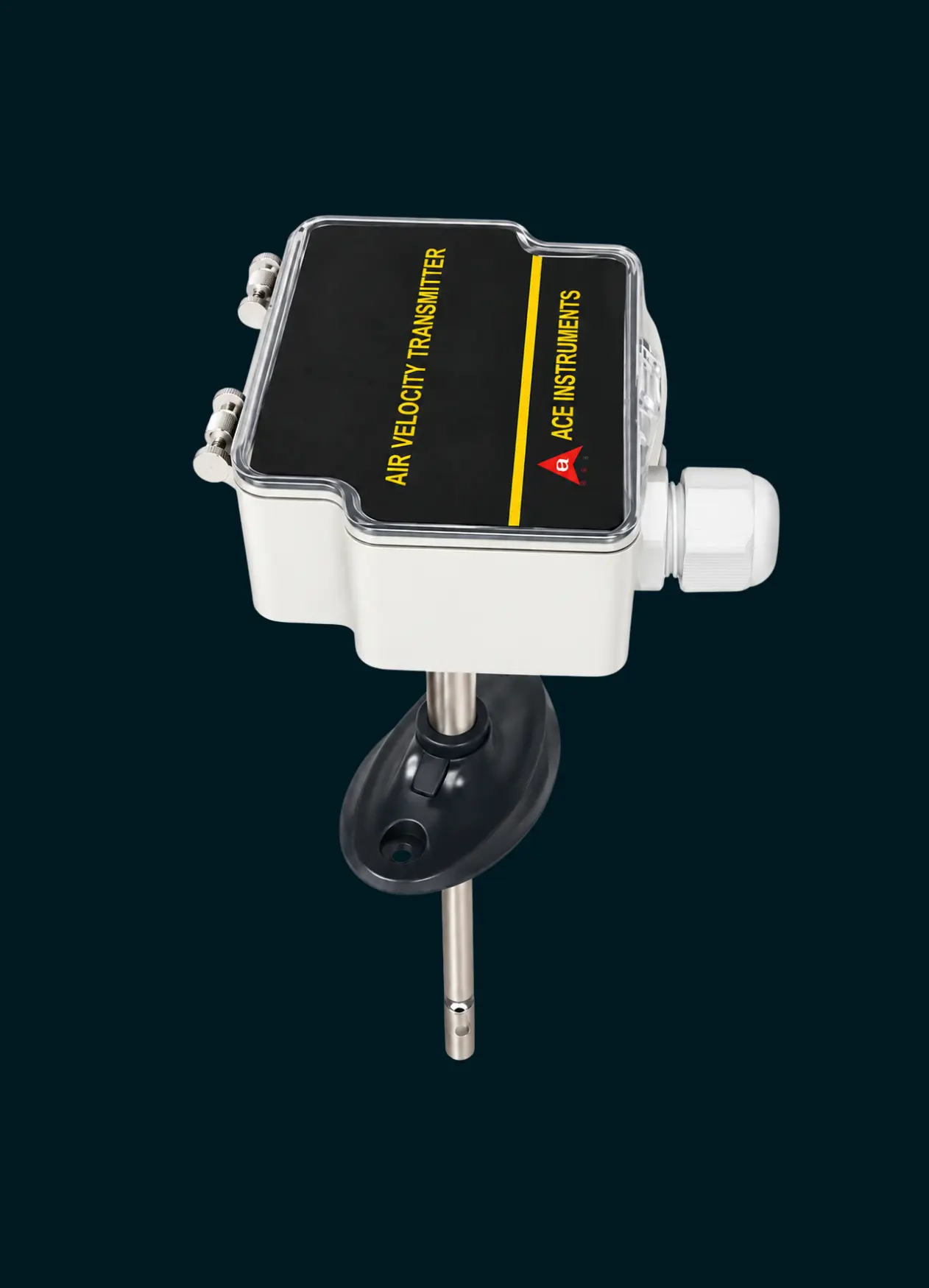
Monitor and control airflow across environments, no matter how demanding the application. The AI-AVT-Tx transmitter is built for HVAC ducts and process chambers, measuring both air velocity and CFM airflow rate with a thin-film sensing element and adjustable probe insertion.
Product Overview
The Ace Instruments Air Velocity Transmitter (AI-AVT-Tx) is designed with a thin-film detecting component and a unique, sleek housing that guarantees long service life and the highest accuracy.
Beyond air velocity, the transmitter also provides an airflow reading in CFM (cubic feet per minute), giving facility teams a direct volumetric airflow figure rather than only a velocity value.
The AI-AVT-Tx is designed for HVAC/R applications, including in-duct air flow and velocity monitoring, temperature monitoring and suitable for usage in VAV applications.
How It Works
The transmitter uses a thin-film detecting component to sense airflow conditions and convert the measurement into a standard electrical output for monitoring and control systems.
It provides a field-selectable 4 to 20 mA or 0 to 10 VDC output, so the appropriate signal can be chosen according to the requirements of the connected monitoring or control system.
Alongside air velocity, the transmitter measures airflow in CFM, using the duct's cross-sectional dimensions to convert the sensed velocity into a volumetric flow rate, giving both a speed reading and a direct airflow quantity from the same instrument.
The probe extends into the duct through an adjustable mounting flange, allowing the installer to vary the insertion length between 50 and 180 mm depending on the specific duct configuration and where the sensing element needs to sit within the airflow.
The 4 to 20 mA output can be connected directly to compatible Ace Instruments monitoring equipment, including the Ace Instruments ACH Monitor, giving facility teams a straightforward path from raw air velocity and CFM measurement to a displayed, alarmed air changes per hour reading.
Features
- Thin-Film Detecting Component:
Sensing element built for long-term accuracy and reliable service life. - Air Velocity and CFM Measurement:
Provides both air velocity and volumetric airflow (CFM) readings from the same sensing element. - Field-Selectable 4-20 mA / 0-10 VDC Output:
Choose the signal type to match your monitoring or control system. - Adjustable Probe Insertion Depth:
50 to 180 mm adjustable immersion length via the mounting flange, suited to different duct configurations. - Direct ACH Monitor Compatibility:
4-20 mA output connects directly to compatible Ace Instruments monitoring equipment, including the ACH Monitor. - BMS/SCADA/PLC Integration:
Standard electrical outputs support incorporation into HVAC monitoring and control systems. - IP54 Rated Electronic Enclosure:
Rugged construction for reliable operation in demanding environments.
Applications
- VAV Applications:
The AI-AVT-Tx supplies the air velocity and CFM readings that variable air volume systems rely on to modulate terminal unit dampers and hold design airflow at each zone. - Cleanroom LAF:
In laminar airflow zones, the transmitter confirms that the air velocity delivered across the workspace stays within the uniform range cleanroom protocols call for.
- Tunnel and Car Park Ventilation:
The transmitter monitors airflow in tunnel and car park ventilation systems, supporting jet fan control and smoke extraction sequencing based on measured air velocity. - HEPA Filter Face Velocity and Filter Loading Checks:
The transmitter measures face velocity across HEPA filters to confirm the design airflow is being delivered. For tracking filter loading over time, the Ace Instruments AI-DPTX Differential Pressure Transmitter is another compatible solution, measuring the pressure drop across the filter as it loads. - Hospital OT and Isolation Room:
The transmitter supports the airflow verification required in operating theatres and isolation rooms, where holding a specified air velocity and air change rate is critical to infection control. - Data Center Hot/Cold Aisle and CRAC Airflow:
The transmitter monitors airflow across hot and cold aisle containment and CRAC units, helping facility teams confirm cooling airflow matches the data center's design requirements.
Why CFM Matters Alongside Air Velocity
Air velocity tells you how fast air is moving at a single point in the duct, but CFM (cubic feet per minute) tells you the actual volume of air being delivered, the figure most HVAC design and balancing work is actually specified against. By measuring both from the same sensing element, the AI-AVT-Tx lets facility teams verify airflow directly against a design CFM target, rather than converting a velocity reading manually using duct dimensions every time a check is needed. This is particularly useful for commissioning, airflow balancing, and ongoing verification that a duct or terminal is delivering the volume of air its design calls for.
Powering Air Changes Per Hour (ACH) Monitoring
Air velocity and CFM are the raw measurements behind Air Changes per Hour, so the AI-AVT-Tx's ability to connect directly to a compatible Ace Instruments ACH Monitor makes it a natural front-end sensor for hospital and cleanroom ventilation verification. Rather than sourcing a separate third-party velocity sensor and reconciling its output signal with the ACH Monitor's expected input, this transmitter is designed to connect directly, giving facility teams a matched sensor-and-display pairing from a single manufacturer.
AI-AVT-Tx vs Duct Static Pressure Transmitter
Both instruments feed VAV and HVAC control strategies, but they measure different things and often work best together rather than as alternatives to one another:
- AI-AVT-Tx (this model):
Measures air velocity and CFM directly within the duct, the actual speed and volume of air movement, feeding directly into ACH calculations and airflow monitoring or control sequences. - Duct Static Pressure Transmitter:
Measures the resistance to airflow within the ductwork, used primarily to control fan speed via a VSD in variable air volume (VAV) systems, maintaining a constant design duct pressure as terminal unit dampers open and close.
Specifications
Gain insight into your IAQ solution and know technical specifications
Compliance
The AI-AVT-Tx conforms to CE marking requirements, meeting the EMC Directive 2004/108/EC, RoHS Directive 2002/95/EC, LVD Directive 2006/95/EC, and WEEE Directive 2002/96/EC. The IP54-rated electronic enclosure and flameproof configuration support installation in explosion-proof areas where hazardous-area equipment standards apply.
Frequently Asked Questions
What is the AI-AVT-Tx Air Velocity Transmitter?
The AI-AVT-Tx is an air velocity transmitter designed to monitor and control airflow in air ducts and conduits. It's suitable for HVAC ducts and process chambers where continuous air velocity monitoring is required. The transmitter is also designed for applications requiring a flameproof transmitter configuration.
What type of applications is the AI-AVT-Tx suitable for?
The transmitter is designed for airflow monitoring and control in HVAC ducts, air conduits, and process chambers.
What type of media can the AI-AVT-Tx measure?
The AI-AVT-Tx is suitable for air and non-corrosive gases. This makes it appropriate for HVAC airflow monitoring and other compatible air-handling applications.
Does the AI-AVT-Tx measure CFM as well as air velocity?
Yes. In addition to air velocity, the transmitter provides an airflow reading in CFM (cubic feet per minute), giving a direct volumetric airflow figure alongside the velocity measurement.
How does the AI-AVT-Tx measure air velocity?
The transmitter uses a thin-film detecting component to sense airflow conditions and convert the measurement into a standard electrical output for monitoring and control systems.
What output signals are available?
The AI-AVT-Tx provides a field-selectable 4-20 mA or 0-10 VDC output. The appropriate signal can be selected according to the requirements of the connected monitoring or control system.
Can the AI-AVT-Tx be connected to a BMS or SCADA system?
Yes. The transmitter is designed for integration with BMS, SCADA, and PLC systems. Its standard electrical outputs allow the measured airflow signal to be incorporated into HVAC monitoring and control systems.
Can the AI-AVT-Tx be connected directly to an Ace Instruments monitor?
Yes. The 4-20 mA output can be connected directly to compatible Ace Instruments monitoring equipment, including the Ace Instruments ACH Monitor.
What supply voltage does the transmitter require?
The AI-AVT-Tx operates on 24 VDC or 24 VAC with a tolerance of ±10%.
Can the probe insertion depth be adjusted?
Yes. The mounting flange allows the probe insertion length to be adjusted. The specified adjustable immersion length is 50-180 mm, allowing the installer to position the probe appropriately within the duct.
Why is an adjustable probe insertion length useful?
Different duct configurations can require different probe positions. The adjustable mounting flange allows the installer to vary the probe insertion depth so that the sensing element can be positioned appropriately within the duct airflow.
What protection rating does the transmitter enclosure have?
The electronic enclosure has an IP54 protection rating. The construction is intended for reliable operation in the specified environmental conditions.
How is the AI-AVT-Tx installed in an air duct?
The transmitter is installed with its probe extending into the duct. The mounting flange is used to secure the assembly and adjust the probe insertion length according to the installation requirement.
Can the AI-AVT-Tx be used for airflow control?
Yes. The product is designed to monitor and control airflow in air ducts and conduits. Its 4-20 mA or 0-10 VDC output can be connected to a compatible control system for airflow monitoring and control.
Is the AI-AVT-Tx suitable for process chambers?
Yes. Process chambers are specifically included among the applications for the transmitter, particularly where airflow monitoring is required and the specified transmitter configuration is suitable.
What certifications or compliance information is specified for the AI-AVT-Tx?
The product documentation states conformity with requirements associated with the CE marking and lists the EMC Directive 2004/108/EC, RoHS Directive 2002/95/EC, LVD Directive 2006/95/EC, and WEEE Directive 2002/96/EC.
How do I choose the right air velocity transmitter for my application?
Selection should consider the application environment, suitable medium, duct or conduit installation, required output signal, supply voltage, probe insertion depth, and environmental conditions. For applications involving specific hazardous-area or flameproof requirements, the installation conditions should also be confirmed before selecting the transmitter configuration.

