
What Parameters Affect Indoor Air Quality
Indoor air quality is affected by six measurable parameters — CO2, volatile organic compounds (VOC), PM2.5, PM10, temperature and relative humidity — each driven by a different source inside a building. Occupant density raises CO2, finishes and cleaning products raise VOC, and outdoor infiltration or indoor combustion raises particulate matter.
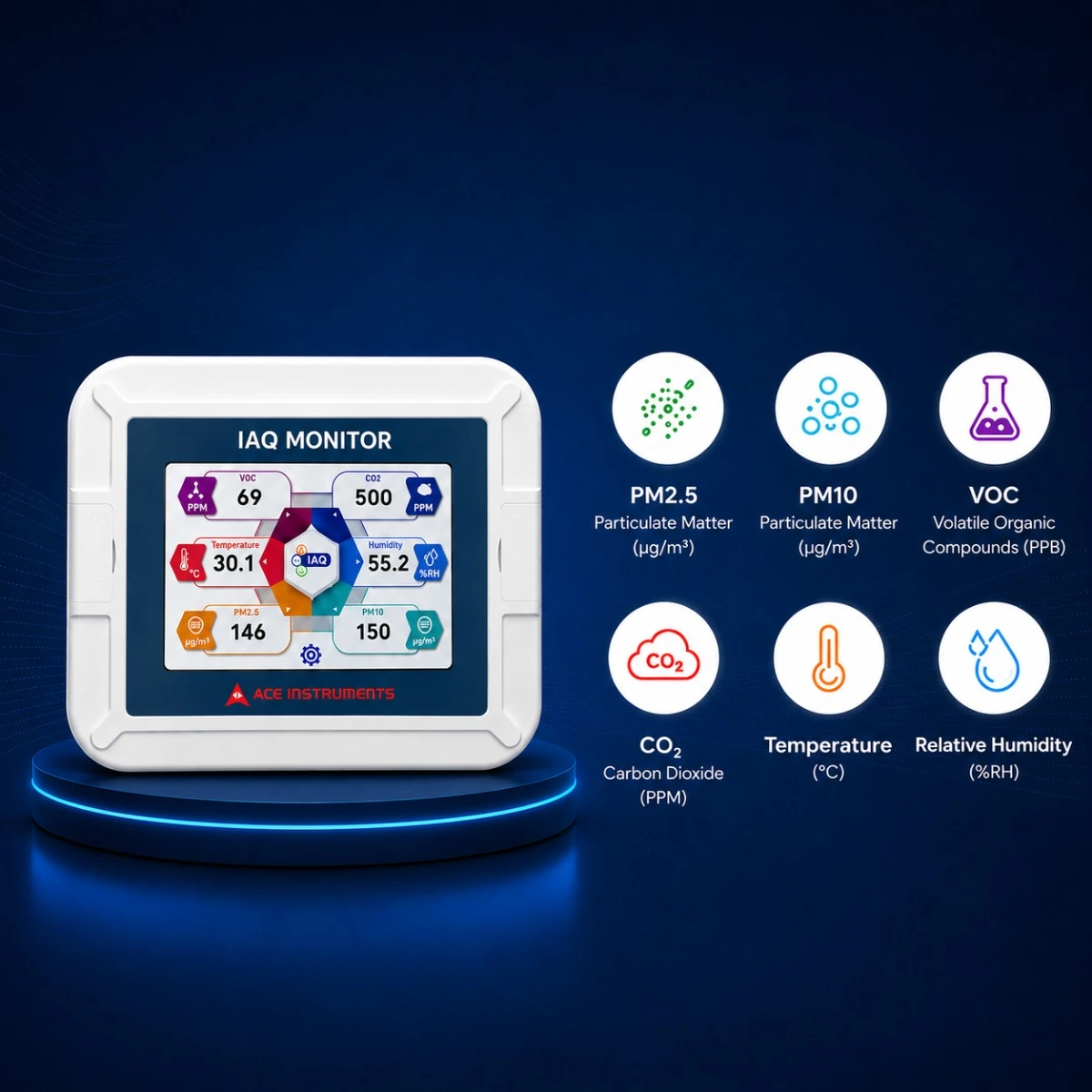
Indoor air quality is affected by six measurable parameters — CO2, volatile organic compounds (VOC), PM2.5, PM10, temperature and relative humidity — each driven by a different source inside a building. Occupant density raises CO2, finishes and cleaning products raise VOC, and outdoor infiltration or indoor combustion raises particulate matter.
Occupant-Driven Parameters
CO2 is the clearest occupant-driven parameter: every person exhales CO2 continuously, so concentration in an enclosed space rises in direct proportion to occupancy and falls as ventilation dilutes it. This is the basis for using CO2 as a proxy for ventilation adequacy under ASHRAE 62.1-2022.
Recognising which parameter is driving a complaint matters operationally: a stuffy, drowsy-feeling room with normal VOC and PM readings points to a CO2/ventilation problem, while a room that smells of fresh paint or cleaning product with normal CO2 points to a VOC source — a distinction that is only possible with multi-parameter monitoring rather than a single combined "air quality index" reading.
Material and Product-Driven Parameters
VOC is driven primarily by materials and products inside the space — paints, adhesives, furnishings, cleaning agents and even some office equipment off-gas VOCs, often most strongly when new or recently applied, tapering over weeks to months.
Outdoor and Mechanical-Driven Parameters
PM2.5 and PM10 most often enter a building through outdoor air infiltration during high-pollution periods, though indoor sources — printing, cooking, candle or incense burning — contribute as well. HVAC filtration grade determines how much outdoor particulate actually reaches the occupied space.
Comfort Parameters
Temperature and relative humidity affect comfort directly and air quality indirectly: humidity above roughly 60% RH sustained over time raises mould risk, while very low humidity can increase static and respiratory irritation, per the ranges in ASHRAE 55-2023.
Why Ace Instruments
Ace Instruments has manufactured air quality and environmental monitoring instruments from its 10,000 sq.ft Hyderabad facility since 1991, with more than 1,000 installations worldwide. Every IAQ Detectors instrument referenced in this article is CE certified and produced under an ISO 9001:2015 quality system.
FAQ
Q: What are the six main parameters of indoor air quality?
The six main parameters of indoor air quality are CO2, volatile organic compounds (VOC), PM2.5, PM10, temperature and relative humidity.
Q: What causes high indoor VOC levels?
High indoor VOC levels are most often caused by paints, adhesives, furnishings and cleaning products off-gassing into the space, particularly when materials are new.
Q: How does outdoor air affect indoor PM2.5?
Outdoor air affects indoor PM2.5 through infiltration during high-pollution periods, with HVAC filtration grade determining how much of that outdoor particulate reaches the occupied space.
Know the latest trends in IAQ solutions from the Ace Instruments team


Get inspired and learn more
Instruments that exceed your technical expectations
Comprehensive and customized IAQ solutions for all applications

