
EN 50545-1 Explained: Carbon Monoxide Detection Requirements for Car Parks and Tunnels
EN 50545-1 is the European standard governing electrical apparatus for the detection and measurement of toxic and combustible gases in car parks and tunnels. Part 1 sets out general performance requirements and test methods for apparatus measuring carbon monoxide and nitrogen oxides, whether that apparatus controls a ventilation system or simply raises an alarm.
It is the most frequently named and least frequently understood standard in car park gas detection specification. This guide sets out what it actually covers, what it deliberately leaves to others, and how a specifier in India or elsewhere outside Europe should treat it.
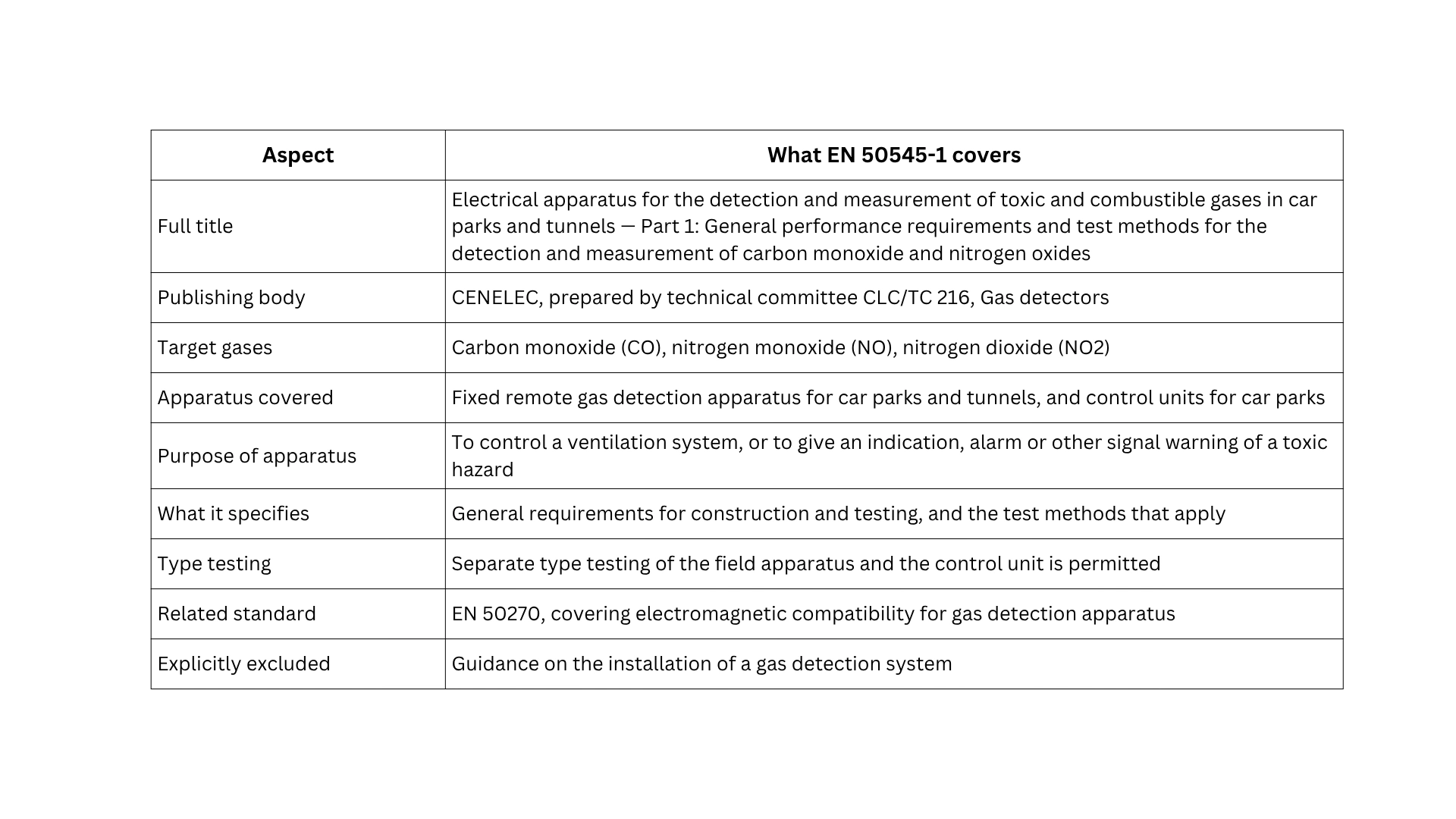
Scope and application at a glance
What the standard is actually for
EN 50545-1 is a performance and test standard for equipment. It answers one question: does this apparatus measure what it claims to measure, reliably, under the environmental conditions a car park or tunnel imposes?
That framing explains most of what people find confusing about it. A specifier looking for guidance on how many detectors a car park needs, at what height they should be mounted, or what concentration should start the extract fans, will not find those answers here. The standard states plainly that it does not give guidance on the installation of a gas detection system. Those decisions belong to national and local codes, to the fire authority, and to the design engineer.
What the standard does establish is a common basis for comparing apparatus. Before a common test regime existed, two devices could both claim to measure carbon monoxide in a car park while behaving very differently under temperature swing, humidity change, air velocity or electrical interference. EN 50545-1 defines the tests that expose those differences.
The requirement areas
The standard addresses several categories of requirement, each with an associated test method.
Construction and marking. Requirements covering how the apparatus is built and how it must be identified, so that a device in service can be traced to its type approval.
Measurement performance. Whether the apparatus reads accurately across its stated range, and whether that accuracy holds as conditions vary. This is the core of the standard.
Environmental influence. Behaviour under variation in temperature, humidity, pressure and air velocity. Air velocity matters more than it might appear: a car park under mechanical extract is not still air, and a device that reads differently in moving air will misreport exactly when ventilation is running. The A1:2016 amendment specifically revised the nitrogen oxides air velocity test so that it could be performed practically for both diffusion-type and aspirated apparatus.
Alarm behaviour. How and when the apparatus signals, and how alarm states are handled.
Electromagnetic compatibility. Addressed by reference to EN 50270, which matters in a car park where variable-speed drives and jet fans generate substantial electrical noise.
Control unit requirements. For car parks, the standard extends to the control unit as well as the field apparatus, and permits the two to be type tested separately.
The alarm level question
This is the most common misreading of EN 50545-1, and it is worth stating directly: the standard specifies ranges and alarm levels for type testing purposes, establishing minimum requirements, and states that all alarm levels are variable and may be adapted to national and local regulations.
In other words, the levels in the standard exist so that apparatus can be tested consistently. They are not a specification for how a particular car park should be configured. A supplier who claims that a fixed setpoint is required by EN 50545-1 has misunderstood the document.
Project setpoints derive instead from the applicable exposure limits, the ventilation design and the approving authority. The reasoning behind typical staging is set out in the carbon monoxide exposure reference and applied in the basement car park design guide. In India, the values that will actually be approved are governed by the National Building Code 2016 and state fire service conditions.
EN 50545-1 and EN 50291 are not interchangeable
A recurring specification error is treating a device certified to EN 50291 as suitable for a commercial car park. EN 50291 addresses carbon monoxide alarm devices for domestic premises. EN 50545-1 addresses fixed apparatus in car parks and tunnels, generally driving ventilation plant.
The applications differ in nearly every respect that matters: environmental severity, expected air velocity, integration with control systems, service and calibration regime, and the consequence of a missed detection. A device designed for a dwelling is not a lower-cost equivalent of car park apparatus. It is a different product for a different purpose.
How to treat EN 50545-1 in India
There is no Indian performance standard directly equivalent to EN 50545-1 for car park gas detection apparatus. The National Building Code 2016 and state fire service requirements address ventilation provision, not the metrological performance of the instruments that control it.
That gap is why the European standard is so frequently named in Indian tender documents. Used correctly, it is a useful procurement filter: it lets a consultant require that apparatus has been tested to a recognised regime, without having to write a test specification from scratch.
Used incorrectly, it becomes a box-ticking exercise in which a supplier asserts compliance without evidence. A specifier relying on EN 50545-1 should ask which edition and amendment the apparatus was tested against, whether the field apparatus and control unit were both covered, and whether documentation is available. CE certification is a related but distinct claim, and the two should be evidenced separately.
Specifying apparatus for car parks and tunnels
The practical value of the standard for a project is that it narrows attention to the things that determine whether a system works: measurement stability across the environmental range the space actually experiences, tolerance of air velocity under mechanical extract, and reliable integration with the control unit driving the fans.
Ace Instruments manufactures fixed carbon monoxide instrumentation under the IAQ Detectors brand for enclosed car parks, tunnels and plant rooms. The AI-CO Carbon Monoxide Transmitter is the standard field device for car park zones, with the duct-mounted AI-CO-D available where measurement in an air stream is required. Output options for connection to a ventilation control unit are covered in the guidance on BMS integration, and placement in the guidance on mounting height and coverage.
Ace Instruments has designed and manufactured indoor air quality instrumentation from its Hyderabad facility since 1991, with over 1,000 installations worldwide. The IAQ Detectors range is CE certified and manufactured under an ISO 9001:2015 registered quality system. The complete carbon monoxide range is available in the carbon monoxide category.
Frequently asked questions
What is EN 50545-1?
EN 50545-1 is the European standard covering electrical apparatus for the detection and measurement of toxic and combustible gases in car parks and tunnels. Part 1 sets general performance requirements and test methods for detecting carbon monoxide and nitrogen oxides. It applies to fixed apparatus intended to control a ventilation system or to give an indication, alarm or other signal warning of a toxic hazard.
Does EN 50545-1 apply to carbon monoxide detectors in India?
EN 50545-1 is a European standard and is not mandatory in India, where the National Building Code 2016 and state fire service conditions govern car park ventilation. It is nonetheless widely referenced by Indian consultants and specifiers as a performance benchmark, because no equivalent Indian performance standard for car park gas detection apparatus exists. Compliance with it is a supplier quality signal rather than a legal requirement.
What is the difference between EN 50545-1 and EN 50291?
EN 50545-1 covers fixed apparatus in car parks and tunnels, typically driving ventilation control in commercial and industrial settings. EN 50291 covers carbon monoxide alarm devices for domestic premises. They address different applications, different device types and different performance expectations, and a device certified to one is not thereby compliant with the other.
Does EN 50545-1 specify the alarm setpoints for a car park?
No. EN 50545-1 specifies ranges and alarm levels for the purpose of type testing, establishing minimum performance requirements. The standard states that alarm levels are variable and may be adapted to national and local regulations. It also does not give guidance on the installation of a gas detection system, so detector placement, spacing and project setpoints are determined by other codes and by the design engineer.
Know the latest trends in IAQ solutions from the Ace Instruments team


Get inspired and learn more
Instruments that exceed your technical expectations
Comprehensive and customized IAQ solutions for all applications

