
ASHRAE 62.1-2022 and Carbon Monoxide: Ventilation Rates and Demand Controlled Operation
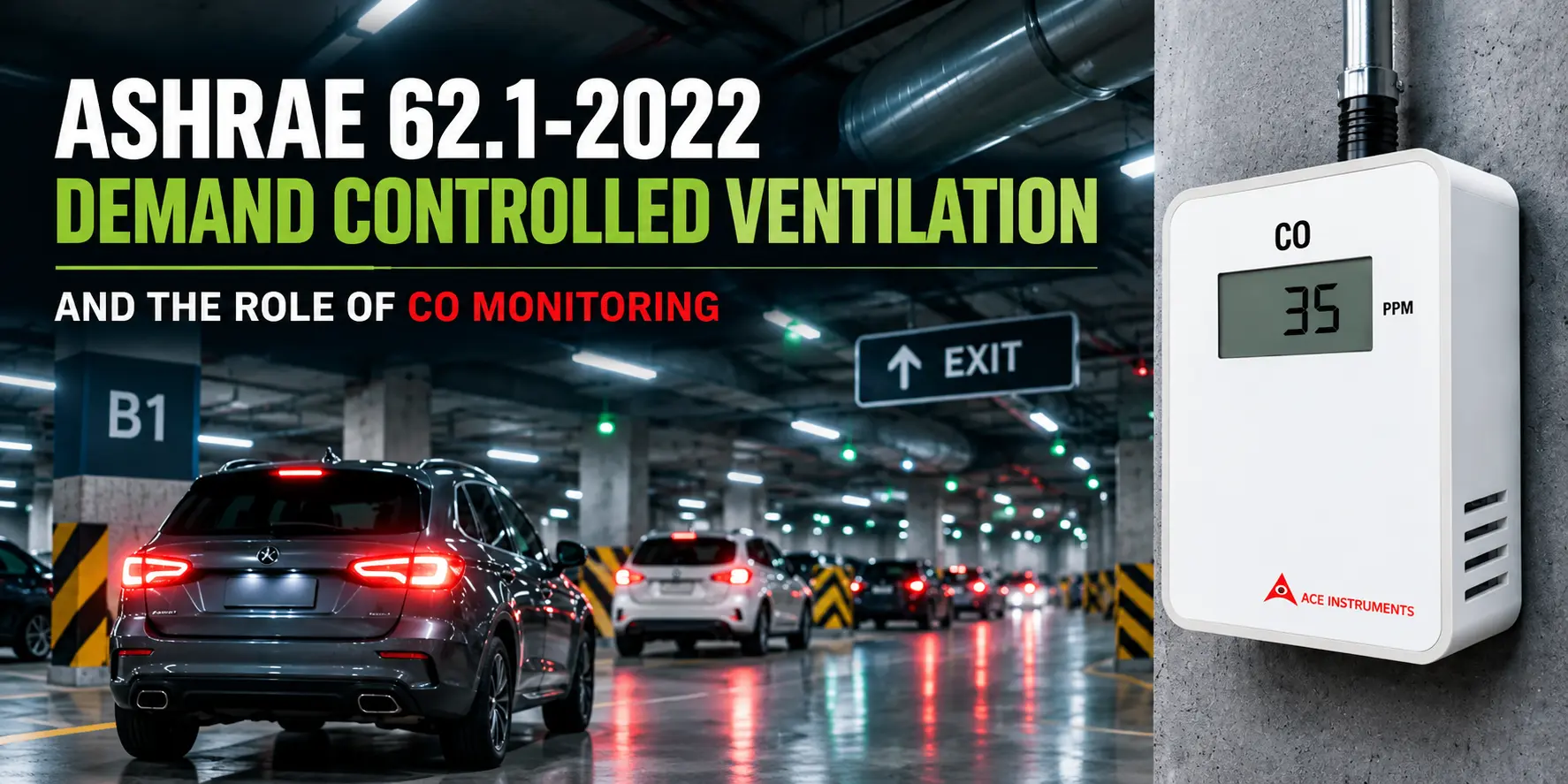
ASHRAE 62.1-2022 does not mandate carbon monoxide monitoring outright. It sets minimum ventilation and exhaust rates, and then permits those rates to be reduced in enclosed parking areas where contaminant concentration is continuously monitored and used to control the ventilation system. Carbon monoxide monitoring is the enabling condition for that reduction.
That structure is what makes carbon monoxide instrumentation an energy investment rather than a safety cost. This guide covers the ventilation requirement, the demand controlled provision that relaxes it, and the control logic that satisfies both.
Ventilation requirements relevant to carbon monoxide
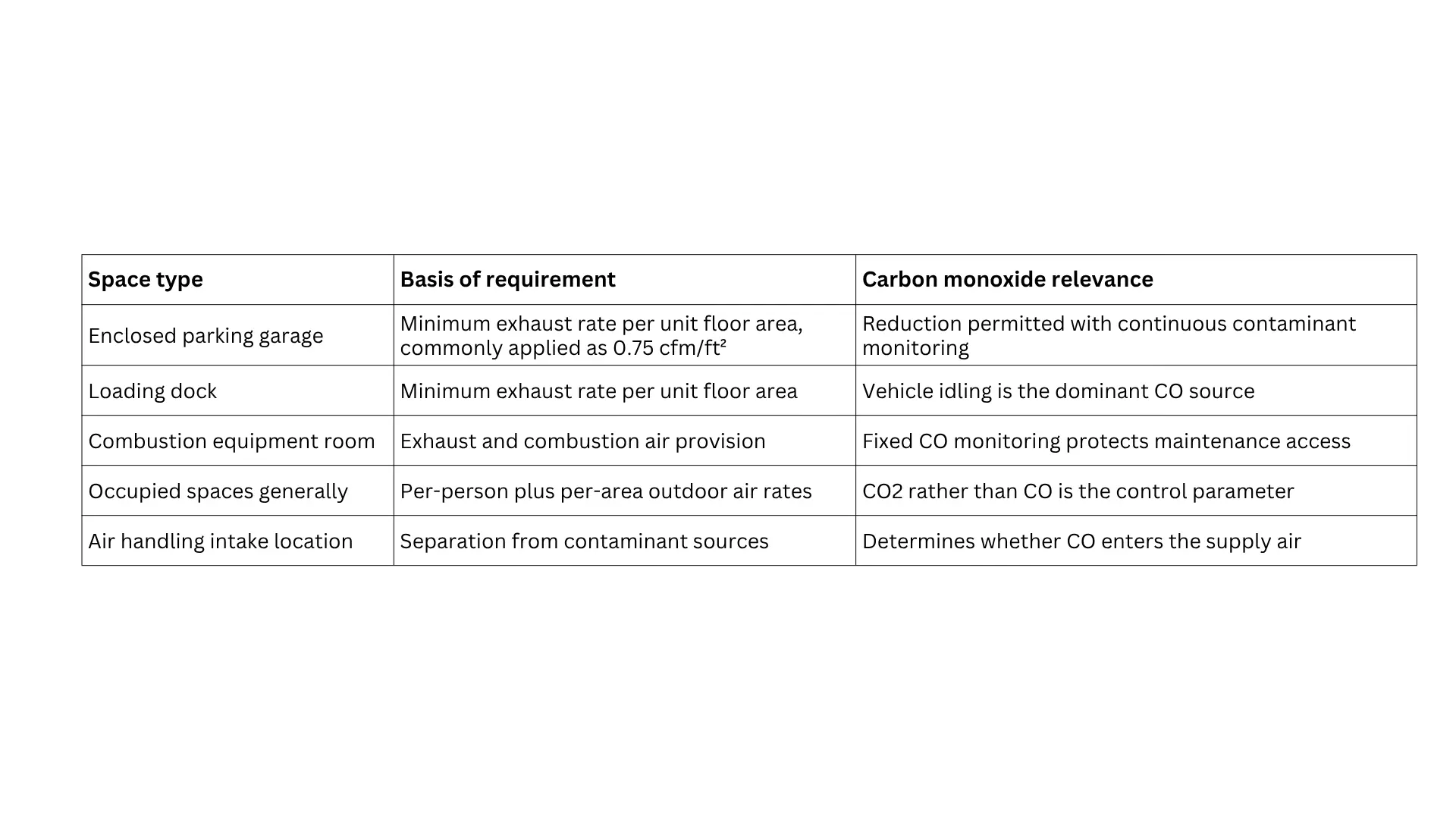
The last row is the one most often overlooked in ventilation compliance. ASHRAE 62.1 addresses the siting of outdoor air intakes relative to contaminant sources precisely because an intake near a generator exhaust, flue termination or service road distributes combustion products to every zone the unit serves. Where separation cannot be achieved, duct-mounted carbon monoxide monitoring is the practical mitigation.
The demand controlled provision
The reasoning behind the standard’s allowance is straightforward once stated. A ventilation rate expressed per unit floor area assumes a design condition: a garage with vehicles moving and starting. That condition holds for a small fraction of operating hours. For the rest, the space is largely static and the design rate is enormously in excess of requirement.
Rather than requiring that excess be delivered continuously, the standard allows the actual contaminant concentration to govern, provided it is measured continuously and drives the system.
For carbon monoxide this is a good match to physics. The contaminant is directly measurable at the concentrations of interest, it responds quickly to ventilation, and it correlates closely with the activity that generates the hazard. A carbon monoxide reading is a genuine measure of whether the space needs air, in a way that an occupancy count or a timer does not.
The energy case
Fan power varies approximately with the cube of volumetric flow. Reducing a fan to half speed reduces its power draw to roughly an eighth. This relationship is what makes demand controlled ventilation in car parks unusually attractive compared with other energy conservation measures.
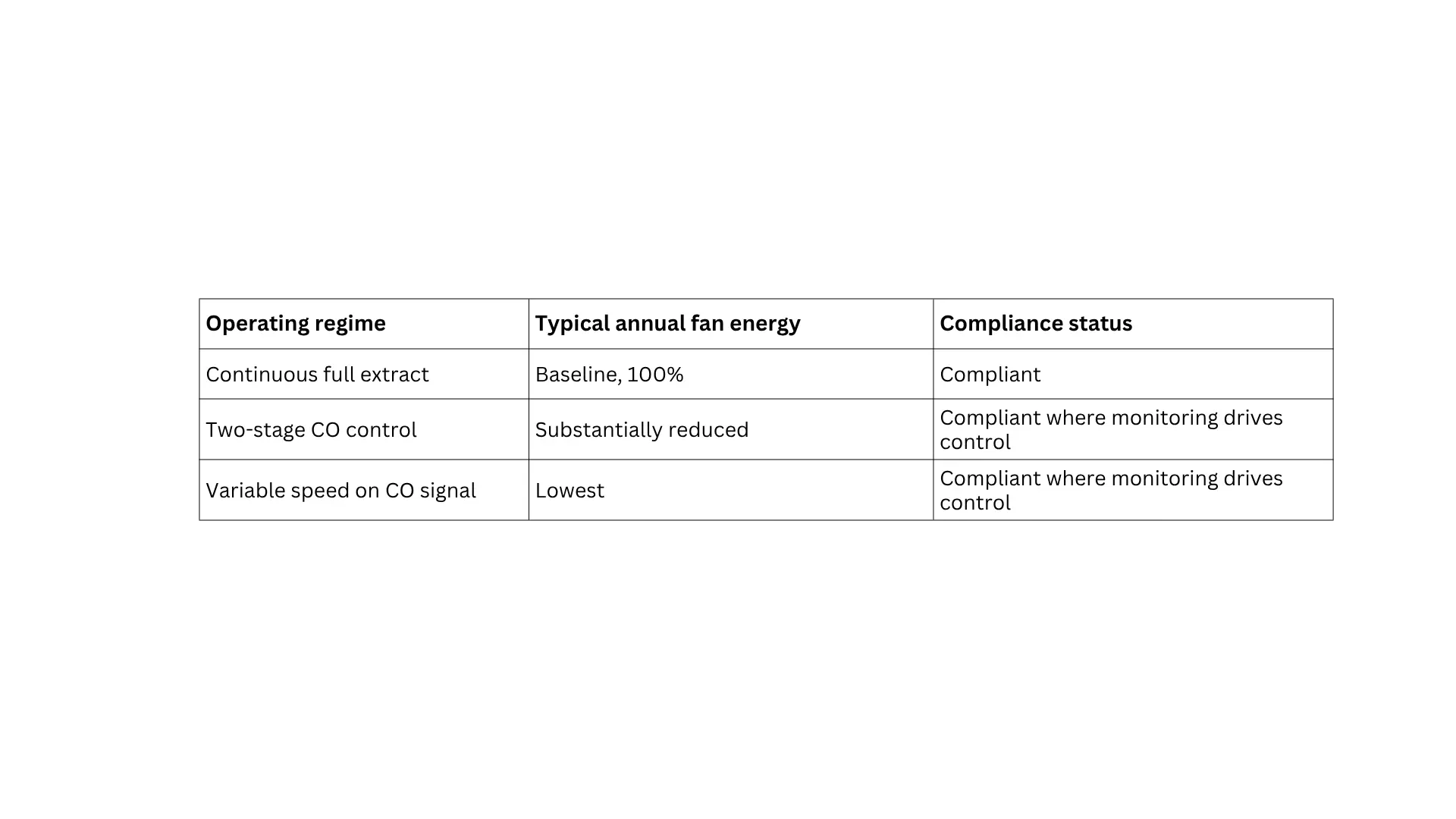
The saving is realised without any reduction in the ventilation delivered when it is actually needed, because the design rate is still met whenever concentration calls for it. In the Indian context this aligns with the Bureau of Energy Efficiency ECBC framework and is treated favourably under GRIHA 2019, alongside the National Building Code 2016 requirements that govern the underlying provision.
Control logic that satisfies both duties
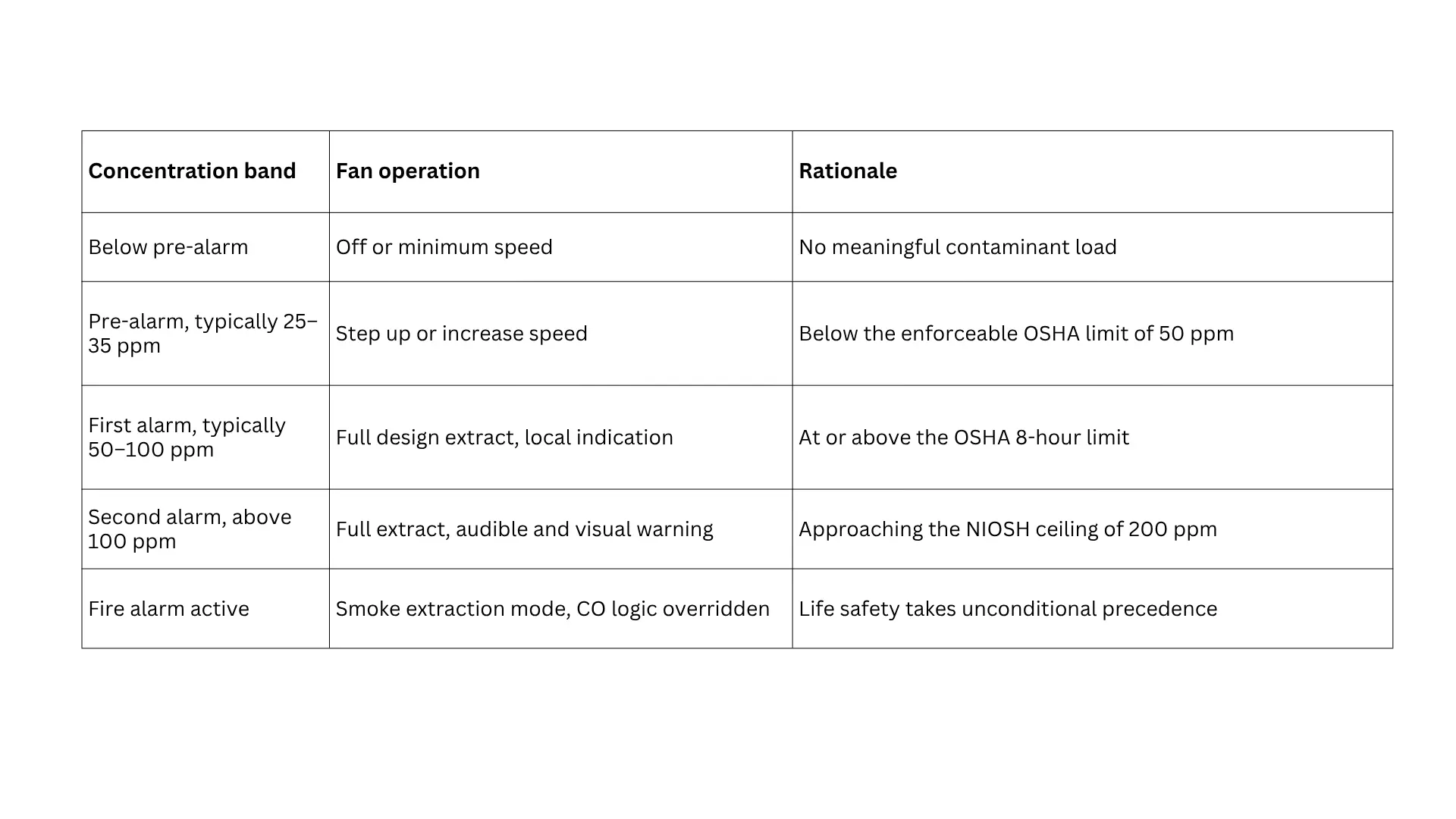
Three design rules follow from this table and are worth stating explicitly.
Fire mode overrides everything. A control philosophy in which a low carbon monoxide reading can hold fans down during a fire event is unsafe and will not be approved.
Minimum speed is not always zero. Where a car park has no natural ventilation path, holding fans fully off between events allows stagnant zones to form that the instruments may not represent. A trickle rate is usually specified.
Zone the instruments to the fans, not the architecture. The reading exists to control a specific fan set, so a detector must measure the volume that fan set serves. Detector count and position follow from placement and coverage principles.
Where carbon monoxide is the wrong parameter
ASHRAE 62.1-2022 governs ventilation for acceptable indoor air quality generally, and most of it has nothing to do with carbon monoxide. In occupied spaces such as offices, classrooms and auditoriums, the controlling parameter is outdoor air per person and per unit area, and the practical monitoring proxy is carbon dioxide rather than carbon monoxide.
Specifying the wrong gas for the zone is a common and consequential error. The distinction between carbon monoxide and carbon dioxide monitoring is worth settling before instruments are selected, because a carbon dioxide instrument in a car park provides no protection and a carbon monoxide instrument in an office provides no useful control signal.
Instrumentation for demand controlled ventilation
An instrument driving ventilation plant has a different requirement profile from one that simply alarms. It must produce a continuous, stable, linear signal across the control range rather than a threshold contact, hold calibration between service intervals, and interface cleanly with the fan controller.
Ace Instruments manufactures fixed carbon monoxide instrumentation under the IAQ Detectors brand for demand controlled ventilation applications. The AI-CO Carbon Monoxide Transmitter provides a continuous proportional output suited to variable speed control, and the AI-CO-D Duct Carbon Monoxide Transmitter covers measurement within air handling systems. Output selection for fan controllers and building management systems is covered in the guidance on 4-20mA, 0-10V and RS-485 Modbus RTU integration. Where carbon dioxide-based demand controlled ventilation is required for occupied zones, the carbon dioxide range addresses that duty.
Ace Instruments has designed and manufactured indoor air quality instrumentation in Hyderabad since 1991, with over 1,000 installations worldwide. The IAQ Detectors range is CE certified and manufactured under an ISO 9001:2015 registered quality system. The complete range is available in the carbon monoxide category.
Frequently asked questions
Does ASHRAE 62.1 require carbon monoxide monitoring?
ASHRAE 62.1-2022 does not mandate carbon monoxide monitoring as a blanket requirement. It sets minimum ventilation and exhaust rates, and permits reduced rates in enclosed parking areas where contaminant concentration is continuously monitored and used to control the ventilation system. Carbon monoxide monitoring is therefore the enabling condition for demand controlled operation rather than a standalone obligation.
What ventilation rate does ASHRAE 62.1-2022 specify for enclosed parking?
ASHRAE 62.1 specifies a minimum exhaust rate for enclosed parking garages on a per unit floor area basis, commonly applied as 0.75 cfm per square foot. The standard allows this rate to be reduced where contaminant concentration is monitored and drives the ventilation system, which is the basis of carbon monoxide-driven demand controlled ventilation in car parks.
Can carbon monoxide monitoring reduce ventilation energy use?
Yes, substantially. Enclosed car park extract systems sized for peak occupancy run far above requirement for most operating hours. Monitoring carbon monoxide concentration and modulating fan operation against it allows the system to meet its ventilation obligation on demand rather than continuously. Fan power varies with the cube of flow rate, so even modest speed reductions produce disproportionate energy savings.
How does demand controlled ventilation work with carbon monoxide?
Fixed carbon monoxide instruments measure concentration in each ventilation zone and pass the value to the fan control system as an analogue or digital signal. The control logic holds fans at minimum or off at low concentration, steps them up through defined bands as concentration rises, and runs at full extract above the upper setpoint. Fire mode always overrides the carbon monoxide-based logic.
Know the latest trends in IAQ solutions from the Ace Instruments team


Get inspired and learn more
Instruments that exceed your technical expectations
Comprehensive and customized IAQ solutions for all applications

