


Product Description
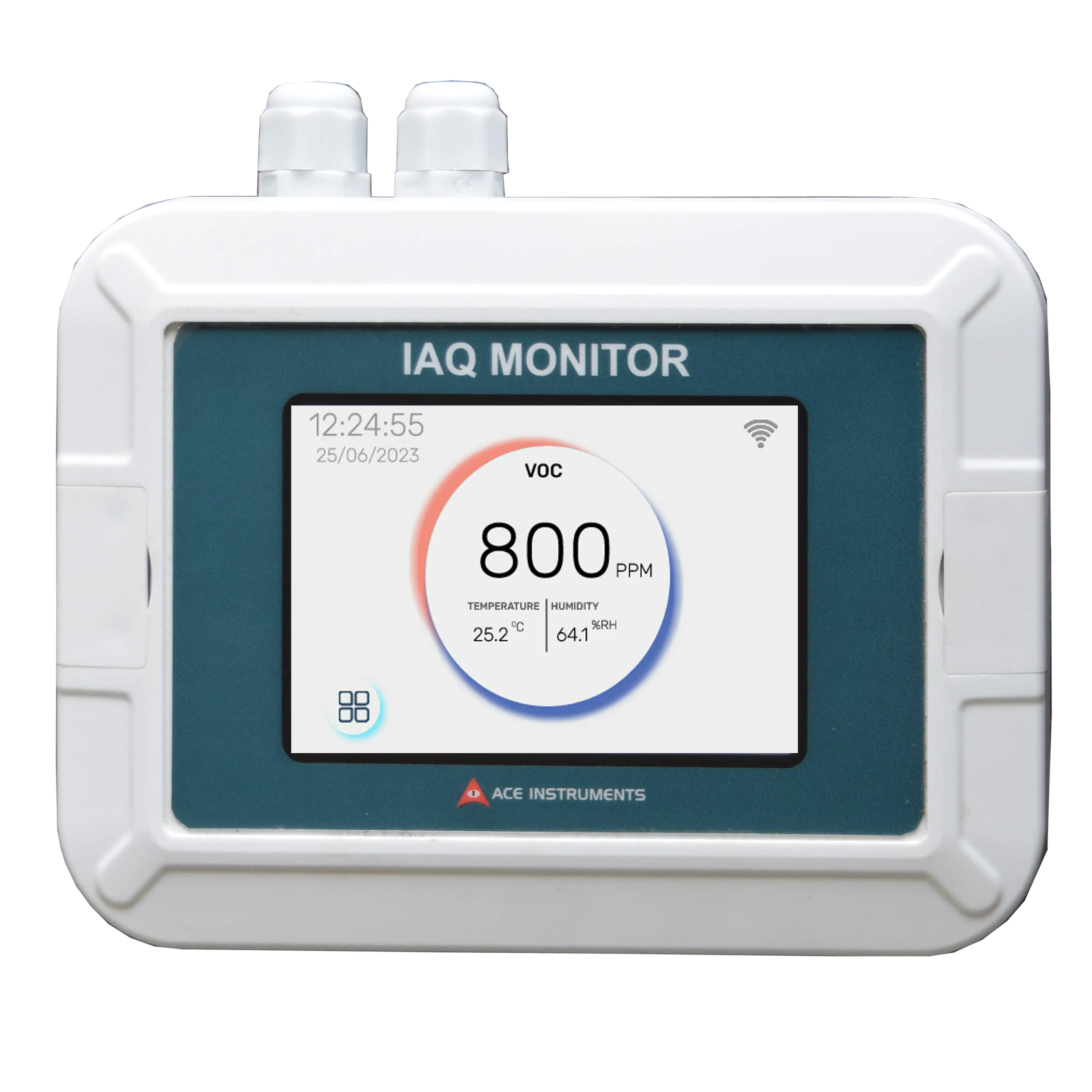
The AI-VOC-TRH is a comprehensive IAQ solution focused on monitoring the critical parameters of Volatile Organic Compounds (VOC), Temperature (T) and Humidity (RH). The solution is suited for the measurement of VOC in controlled IVF lab environments. The sensor boasts measurement in parts per billion (ppb), allowing users to further control VOC in IVF lab environments. The sensor boasts a fast warm-up time and high accuracy.
Ensure the success of your IVF lab with a VOC (Volatile Organic Compounds) monitor. IVF labs are dependent on precise air quality to protect critical processes. The Ace Instruments VOC monitor is the ideal companion, with constant assessments and reports of any threshold violations. It helps maintain the ideal environment for successful IVF procedures.
The instrument, manufactured by Ace Instruments, features a MOX-based sensor suited to measure VOC levels. The parameters are visible on a vibrant touchscreen display, with communication options of RS-485 Modbus or Wi-Fi with dashboard access. Enhance your IVF lab's environment with our cutting-edge solutions. From monitoring VOC levels to maintaining precise temperature and humidity, our technology ensures optimal air quality for your most critical work. Trust us as your partner in creating the ideal IVF laboratory conditions.
Why IVF Labs Require Specialist Air Quality Monitoring
Embryos are among the most chemically sensitive biological systems. Airborne VOCs, from cleaning agents, laboratory materials, and building off-gassing, penetrate culture media and can arrest embryo development, damage DNA, and reduce blastocyst formation rates. Standard building air quality monitoring, designed around human occupant comfort thresholds, isn't sensitive enough to protect an embryo culture environment. IVF labs need monitoring calibrated to a far stricter chemical exposure standard, with continuous local visibility so lab staff can act immediately rather than waiting on a BMS alert.
Embryo Sensitivity to VOCs
Even trace formaldehyde at 10 ppb has been shown to affect embryo development, according to ESHRE guidelines, a concentration far below what would register as a concern in almost any other indoor environment. This extreme sensitivity is why embryology labs require dedicated, high-sensitivity monitoring rather than general-purpose building VOC sensors: a device calibrated for office air quality thresholds would show no alarm at concentrations already capable of affecting culture outcomes.
Features
- MOX Sensing Technology
The AI-VOC-TRH VOC monitor utilizes MOX (Metal Oxide) sensing technology. MOX sensors are known for their high sensitivity and accuracy in detecting a wide range of VOCs. This technology ensures reliable and precise measurements of VOC levels in IVF lab environments, helping maintain optimal air quality conditions for successful procedures.
- Communication Options
Wi-Fi with dashboard access: The VOC monitor offers Wi-Fi connectivity, allowing seamless integration with the lab's network infrastructure. It enables easy access to a dedicated dashboard that provides real-time data visualization and monitoring of VOC levels, temperature, and humidity. This feature provides convenience and flexibility for lab personnel to monitor and analyze air quality parameters remotely.
RS-485 Modbus Communication: With the RS-485 Modbus communication option, the VOC monitor can seamlessly integrate into existing systems or building automation systems that support the Modbus protocol. This allows for straightforward integration and data exchange with other devices or control systems within the IVF lab setup.
- Vibrant Touchscreen Display
The VOC monitor is equipped with a vibrant touchscreen display, offering a user-friendly interface for easy readout of VOC levels, temperature, and humidity. The touchscreen display provides clear and intuitive visualization of the parameters, making it effortless for lab personnel to monitor and assess the air quality conditions at a glance. This feature enhances user experience and ensures quick access to vital information.
- Easy Installation
The AI-VOC-TRH VOC monitor is designed for easy installation within IVF lab environments. It features a convenient wall mounting capability, allowing for flexible placement and optimal positioning. Lab personnel can securely mount the monitor on the desired wall location, ensuring accurate measurements without taking up valuable workspace. The ease of installation streamlines the setup process, minimizing disruptions in the lab operations.
Applications
- IVF Laboratories:
Provides continuous VOC, temperature, and humidity monitoring within embryo culture and handling areas, supporting the strict air quality conditions embryo development requires - Embryology Labs:
Monitors laboratory air quality against ESHRE/ALPHA thresholds, supporting quality assurance protocols and lab accreditation requirements - Gamete Storage Facilities:
Tracks air quality conditions around sperm and oocyte storage areas, where chemical exposure can similarly affect cell viability and integrity
Dashboard
Unlock the potential of the AI-VOC-TRH with the Wi-Fi connectivity to a web-based dashboard, enabling you to gain an overview of your devices in a building and generation of reports for audit purposes. The data is accessible via web browser from a device of your choice, choose to view it from mobiles, tablets or cast onto any smart TV for a bigger parameter display.
View Current Data
The dashboard offers a view of live data of each IAQ device with a parameter-wise assessment to enable accurate tracking of real-time changes of indoor air quality.
Graphical Trend View
A trend view of the data in graphical format is included to provide a detailed analysis of changes of each parameter. Select custom date and times for a comprehensive chart view of any parameters from: temperature, humidity, VOC, CO2, PM2.5 and PM10. The trend view enables informed decision making regarding IAQ levels with easy to interpret visual trends to monitor effectiveness of IAQ strategies and potential concerns.
Custom Reports
Know your air with custom report generation, selectable by device, by parameter customized to the duration required. Custom reports enable maintenance of logs for compliance and insight into the prevailing IAQ conditions.
Unlock the potential of indoor air quality monitoring with our feature-packed dashboard for seamless display onto device of user’s choice and powerful report and insight generation.
ESHRE & ALPHA VOC Guidelines
ESHRE and ALPHA recommend maintaining TVOC concentrations below 500 µg/m³ in embryo culture rooms. This threshold sits well below levels considered acceptable in general office or residential settings, reflecting how much more sensitive embryo development is to airborne chemical exposure than typical human occupant comfort. Continuous monitoring against this benchmark supports both day-to-day lab quality control and compliance documentation for accreditation and audit purposes.
Frequently Asked Questions (FAQs)
1. What is the AI-VOC-TRH IVF Lab VOC Monitor?
The AI-VOC-TRH is a touchscreen indoor air quality monitor designed specifically for IVF laboratories and assisted reproductive technology (ART) facilities. It continuously measures Total Volatile Organic Compounds (TVOC), temperature, and relative humidity, helping embryologists maintain a stable laboratory environment that supports embryo development and improves quality control.
2. What parameters does the AI-VOC-TRH measure?
The monitor continuously measures:
- Total Volatile Organic Compounds (TVOC)
- Temperature
- Relative Humidity (RH)
These three parameters are displayed in real time and can also be transmitted to a Building Management System (BMS) or laboratory monitoring system.
3. Why is VOC monitoring important in IVF laboratories?
Human embryos are extremely sensitive to airborne chemical contaminants. VOCs released from cleaning products, furniture, laboratory materials, paints, adhesives, and building finishes can dissolve into embryo culture media and negatively affect embryo development.
Continuous VOC monitoring helps IVF laboratories detect air quality issues early, maintain a cleaner environment, and support consistent laboratory performance.
4. Why do IVF laboratories need VOC monitoring?
Embryo development can be affected by even low concentrations of airborne chemical contaminants.
Volatile Organic Compounds generated from cleaning chemicals, laboratory materials, furnishings, and building off-gassing may reduce embryo development, interfere with cell division, and decrease blastocyst formation. Continuous monitoring allows laboratory staff to identify air quality changes quickly and maintain conditions that support successful IVF procedures.
5. What TVOC level is considered safe for IVF laboratories?
Guidelines from organizations such as the European Society of Human Reproduction and Embryology (ESHRE) and the Association of Laboratory Scientists in Human Reproduction (ALPHA) recommend maintaining TVOC concentrations below approximately 500 µg/m³ in embryo culture laboratories, with lower concentrations preferred whenever possible.
Continuous monitoring helps laboratories verify that air quality remains within acceptable limits and supports quality management documentation.
6. Why are temperature and humidity also monitored?
Temperature and relative humidity directly influence embryo culture conditions, laboratory comfort, and the performance of sensitive laboratory equipment.
Monitoring these parameters together with TVOC provides a more complete picture of laboratory environmental conditions and helps identify changes that could affect embryo handling and laboratory performance.
7. How does the touchscreen display benefit IVF laboratory staff?
The large touchscreen display provides continuous, easy-to-read information without requiring staff to access a separate computer or Building Management System.
Embryologists can quickly view current TVOC, temperature, and humidity values while working in the laboratory. If an alarm condition occurs, it is displayed clearly along with the date and time, helping support laboratory quality management and operational records.
8. Where is the AI-VOC-TRH commonly installed?
Typical installation locations include:
- IVF laboratories
- Embryology laboratories
- Embryo culture rooms
- Procedure rooms
- Cryopreservation laboratories
- Andrology laboratories
- Assisted Reproductive Technology (ART) laboratories
- Fertility clinics
- Research laboratories
- Clean laboratory environments
9. Can the AI-VOC-TRH be integrated with a Building Management System (BMS)?
Yes. The monitor supports industry-standard communication options, including:
- RS485 Modbus communication
- 4 - 20 mA output
- 0 - 10 V output (depending on model)
These outputs enable integration with Building Management Systems, PLCs, SCADA systems, and laboratory monitoring software.
10. Can the monitor help control laboratory ventilation?
Yes. The measured TVOC values can be used by the Building Management System to automatically adjust fresh air ventilation, operate air handling units, or activate air purification systems whenever indoor air quality changes.
11. Can alarm limits be configured?
Yes. TVOC, temperature, and humidity alarm limits can be configured according to your laboratory requirements. When any parameter exceeds its preset limit, the monitor can generate local alarms and communicate the event to the Building Management System.
12. Is the AI-VOC-TRH suitable for continuous monitoring?
Yes. The monitor is designed for reliable 24×7 continuous operation, making it suitable for IVF laboratories where environmental stability is essential throughout the day and night.
13. Does the monitor require calibration?
The AI-VOC-TRH is factory calibrated before shipment. Periodic verification is recommended as part of routine laboratory quality assurance to maintain long-term measurement accuracy.
14. Is installation easy?
Yes. The wall-mounted touchscreen monitor is designed for simple installation and can be integrated into both new laboratory projects and existing IVF facilities with minimal disruption.
15. What are the advantages of using the AI-VOC-TRH in IVF laboratories?
Key benefits include:
- Continuous monitoring of TVOC, temperature, and humidity
- Large touchscreen display for easy viewing
- Early detection of indoor air quality changes
- Supports embryo culture laboratory environmental control
- Configurable alarms
- Easy BMS and PLC integration
- Reliable industrial-grade performance
- Low maintenance
16. Who typically uses the AI-VOC-TRH?
The AI-VOC-TRH is widely used by:
- IVF clinics
- Fertility centers
- Embryologists
- Assisted Reproductive Technology (ART) laboratories
- Laboratory managers
- Hospital engineering departments
- Facility managers
- Building automation integrators
- Research laboratories
17. Why choose ACE Instruments?
ACE Instruments has over 30 years of experience in manufacturing environmental and indoor air quality monitoring solutions. Customers choose our products for their high measurement accuracy, industrial-grade reliability, easy BMS integration, touchscreen monitoring, responsive technical support, and proven performance in IVF laboratories, healthcare facilities, pharmaceutical environments, and other critical applications.
18. How do I choose the right IVF Laboratory VOC Monitor?
Choosing the right AI-VOC-TRH depends on your laboratory size, monitoring requirements, communication protocol, alarm configuration, and quality management needs. Our application engineers can help you select the most suitable solution for IVF laboratories, embryo culture rooms, fertility clinics, and Assisted Reproductive Technology (ART) facilities where continuous monitoring of TVOC, temperature, and humidity is critical.
Specifications
Gain insight into your IAQ solution and know technical specifications

