

Description
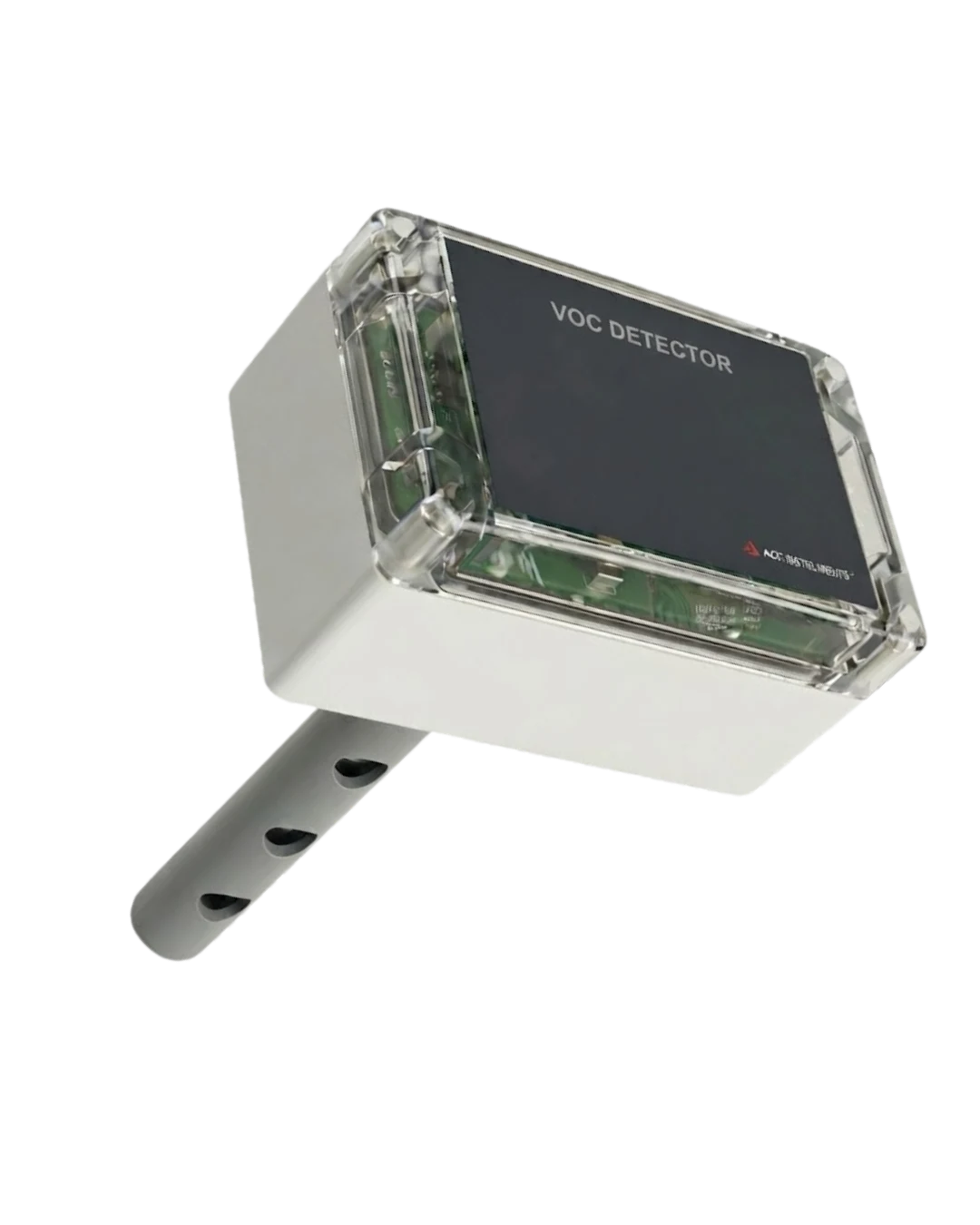
The duct volatile organic compound (VOC) detector manufactured by Ace Instruments allows for greater control over indoor air quality via VOC and temperature measurement in one solution. It is ideal for VOC and temperature monitoring in HVAC ducts in schools, offices, hotels, and public assembly areas.
The MOX-based (Switzerland) sensor VOC reliably measures both VOC and temperature to ensure occupant health, comfort and high indoor air quality levels. The transmitter is sensitive to most indoor environment VOC gases. Optional RS-485 Modbus communication provided for BMS/EMS connection.
How Duct VOC Monitoring Protects Buildings
VOC contamination in supply air, from industrial neighbours, garages, chemical stores, or adjacent spaces, can be detected in ductwork before it distributes throughout the building. The BMS can close fresh air dampers or switch to recirculation mode to protect occupants. By monitoring at the duct level rather than only in occupied rooms, the system catches contamination at the point of entry, giving the BMS time to act before affected air reaches desks, wards, or workstations.
Contamination Source Detection
Because the sensor sits directly in the airstream, it can distinguish between VOC events originating outside the building, entering through fresh air intake, and those generated inside occupied spaces. This distinction matters operationally: a fresh air intake VOC spike calls for damper closure or recirculation, while a return air VOC rise points to an internal source and calls for increased ventilation instead. Positioning the sensor at the right point in the ductwork determines which of these responses the BMS can trigger accurately.
Features
- Duct-Insertion Probe Design: Sensor probe mounted directly within the ventilation airstream for accurate in-duct VOC measurement
- RS485 Modbus Output: Enables seamless integration with Building Management Systems for automated response and centralized monitoring
- Contamination Detection at the Source: Identifies VOC ingress from fresh air intake before it distributes throughout occupied spaces
- Supports Demand-Controlled Ventilation: Enables fresh air rate adjustment based on real-time VOC levels in return air, matching ventilation to actual occupancy and air quality conditions
- Automated BMS Response: Supports triggering damper closure, recirculation mode, or increased fresh air supply based on configured VOC thresholds
- Broad VOC Detection Range: Captures a wide range of volatile organic compounds relevant to industrial, chemical, and occupancy-driven sources
- Continuous Monitoring: Designed for reliable, uninterrupted operation, supporting real-time air quality decisions across ductwork serving multiple building zones
Applications
- Multi-Tenant Commercial Buildings: Detects VOC contamination entering from neighbouring units, shared parking garages, or nearby industrial activity before it spreads across tenant spaces
- Laboratories: Monitors for chemical VOC events in ventilation systems serving lab spaces where fume sources and containment are safety-critical
- Manufacturing Adjacent to Offices: Protects office air quality where shared or nearby ventilation systems could otherwise carry manufacturing VOCs into administrative spaces
- Healthcare Facilities with Chemical Use: Monitors ductwork serving areas where disinfectants, sterilants, or other chemicals are used, supporting occupant protection in clinical and support spaces
BMS Integration
With RS485 Modbus communication, the detector feeds real-time VOC data directly into the BMS, enabling automated responses such as damper closure, recirculation switching, or fresh air rate adjustment. This also supports VOC-based demand-controlled ventilation: as occupancy increases and VOC levels rise in return air, fresh air supply increases accordingly, matching ventilation rates to actual air quality conditions rather than a fixed schedule.
Frequently Asked Questions (FAQs)
1. What is the AI-VOC-DT Duct Volatile Organic Compound Detector?
The AI-VOC-DT is a duct-mounted detector designed to continuously monitor Total Volatile Organic Compounds (TVOC) in HVAC ducts. It measures the concentration of airborne chemical pollutants within supply or return air and provides real-time data to Building Management Systems (BMS), PLCs, and HVAC controllers to improve indoor air quality and ventilation control.
2. What are Volatile Organic Compounds (VOCs)?
Volatile Organic Compounds (VOCs) are carbon-based chemicals that easily evaporate into the air. They are commonly released from paints, adhesives, cleaning agents, furniture, carpets, solvents, office equipment, and building materials. High VOC levels can reduce indoor air quality and affect occupant health and comfort.
3. What does the AI-VOC-DT measure?
The AI-VOC-DT continuously measures Total Volatile Organic Compounds (TVOC) present in the air flowing through HVAC ducts, providing an overall indication of indoor chemical pollution.
4. Why is VOC monitoring important in HVAC ductwork?
Monitoring VOC levels in HVAC ducts helps building operators identify airborne chemical pollutants before they spread throughout the building. Continuous monitoring supports better indoor air quality, improves occupant comfort, optimizes ventilation, and enables early detection of contamination within the HVAC system.
5. What types of VOC contamination can appear in HVAC ductwork?
HVAC systems can carry VOC contamination from several different sources, including:
- Outdoor air entering through fresh air intakes near busy roads, industrial areas, or parking garages.
- Return air from spaces with high VOC generation such as printing rooms, chemical storage areas, laboratories, or cleaning rooms.
- Off-gassing from duct insulation, adhesives, sealants, or other construction materials.
- Biological VOCs produced by mold or microbial growth inside Air Handling Units (AHUs) or ductwork.
Monitoring duct VOC levels helps identify these contamination sources before they affect the entire building.
6. How does the duct VOC detector support demand-controlled ventilation?
The AI-VOC-DT continuously measures TVOC levels in return or supply air ducts.
When VOC concentrations increase due to occupancy, office activities, cleaning chemicals, or other pollution sources, the Building Management System can automatically increase fresh air ventilation. As VOC levels decrease, ventilation can be reduced to save energy.
This demand-controlled ventilation strategy improves indoor air quality while reducing HVAC operating costs.
7. Can the duct VOC sensor detect a chemical spill in an adjacent area?
Yes. If a significant chemical release occurs in an area connected to the same HVAC system, VOC levels in the return air duct can increase rapidly.
The AI-VOC-DT detects this increase and alerts the Building Management System, allowing it to automatically switch the Air Handling Unit to fresh air mode, activate exhaust ventilation, or isolate contaminated recirculated air. This is particularly valuable in large commercial buildings, laboratories, hospitals, and multi-tenant facilities.
8. Where is the AI-VOC-DT commonly installed?
Typical applications include:
- Air Handling Units (AHUs)
- Supply air ducts
- Return air ducts
- Commercial office buildings
- Hospitals
- Laboratories
- Pharmaceutical manufacturing facilities
- Educational institutions
- Shopping malls
- Airports
- Hotels
- Industrial HVAC systems
9. How does the VOC sensing technology work?
The AI-VOC-DT uses a Metal Oxide Semiconductor (MOS) sensor to detect Total Volatile Organic Compounds.
VOC molecules interact with the heated sensing element, causing a change in its electrical resistance. The detector converts this resistance change into a TVOC concentration, providing a reliable indication of overall chemical pollution in the air.
10. Can the AI-VOC-DT be integrated with a Building Management System (BMS)?
Yes. The detector supports industry-standard communication options, including:
- RS485 Modbus communication
- 4 - 20 mA output
- 0 - 10 V output (depending on model)
These outputs allow seamless integration with Building Management Systems, PLCs, SCADA systems, and HVAC automation controllers.
11. Can the AI-VOC-DT improve HVAC energy efficiency?
Yes. By monitoring actual VOC levels, the Building Management System can adjust ventilation only when needed. This demand-controlled ventilation approach reduces unnecessary fresh air intake, lowers heating and cooling loads, and improves overall HVAC energy efficiency.
12. Is the AI-VOC-DT suitable for continuous monitoring?
Yes. The AI-VOC-DT is designed for reliable 24×7 continuous operation in commercial, healthcare, pharmaceutical, industrial, and institutional HVAC systems.
13. Does the detector require calibration?
The AI-VOC-DT is factory calibrated before shipment. Periodic verification is recommended to ensure continued measurement accuracy, particularly in applications where maintaining indoor air quality is critical.
14. Is installation easy?
Yes. The duct-mounted probe is designed for straightforward installation through the duct wall, making it suitable for both new HVAC systems and retrofit projects. Once installed, it requires minimal maintenance.
15. What are the advantages of using the AI-VOC-DT?
Key benefits include:
- Continuous duct TVOC monitoring
- Early detection of airborne chemical pollutants
- Supports demand-controlled ventilation
- Improves indoor air quality
- Reduces HVAC energy consumption
- Easy BMS and PLC integration
- Multiple communication options
- Reliable industrial-grade performance
16. Who typically uses the AI-VOC-DT?
The AI-VOC-DT is widely used by:
- HVAC contractors
- Building automation integrators
- Facility managers
- Hospital engineering departments
- Pharmaceutical manufacturers
- Laboratory managers
- Commercial building operators
- Industrial maintenance engineers
- Environmental consultants
17. Why choose ACE Instruments?
ACE Instruments has over 30 years of experience in manufacturing indoor air quality and HVAC monitoring solutions. Customers choose our products for their high measurement accuracy, industrial-grade reliability, easy BMS integration, calibration support, responsive technical assistance, and proven performance across commercial, healthcare, pharmaceutical, educational, and industrial applications.
18. How do I choose the right Duct Volatile Organic Compound Detector?
Choosing the right AI-VOC-DT depends on your HVAC system design, duct size, communication requirements, output signal, installation location, and indoor air quality objectives. Our application engineers can help you select the most suitable duct VOC monitoring solution for commercial buildings, hospitals, laboratories, pharmaceutical facilities, educational institutions, and industrial HVAC applications.
19. Is the AI-VOC-DT a suitable alternative to Greystone VOC, Honeywell VOC, Siemens QPA, or Belimo duct VOC transmitters?
Yes, the AI-VOC-DT Duct Volatile Organic Compound Detector is designed as a dependable alternative for duct-mounted VOC and indoor air quality monitoring applications commonly handled by products such as:
- Greystone VOCDT Series (VOCDTBXX, VOCDTFXX)
- Honeywell C7355 Series (C7355A1050, C7355B1052)
- Siemens QPM Series (QPM2102)
- Belimo 22DC Series (22DCK-11, 22DCV-51, 22DCK-51)
The AI-VOC-DT offers:
- Accurate duct-mounted VOC monitoring
- Real-time indoor air quality sensing for HVAC systems
- High sensitivity detection for volatile organic compounds
- Analog and Modbus communication options
- Easy integration with BMS, PLC, and SCADA systems
- Reliable long-term monitoring performance for commercial and industrial ventilation systems
- Compact industrial enclosure suitable for AHUs and duct installations
It is suitable for commercial buildings, hospitals, pharmaceutical facilities, laboratories, cleanrooms, educational institutions, and industrial HVAC environments.
It can be considered for projects where users are evaluating alternatives to comparable duct VOC monitoring systems from these brands.
Greystone, Honeywell, Siemens, Belimo and other mentioned brands are trademarks of their respective owners. Ace Instruments is not affiliated with or endorsed by any of the aforementioned companies.
Specifications
{{table-component}}
Gain insight into your IAQ solution and know technical specifications

