

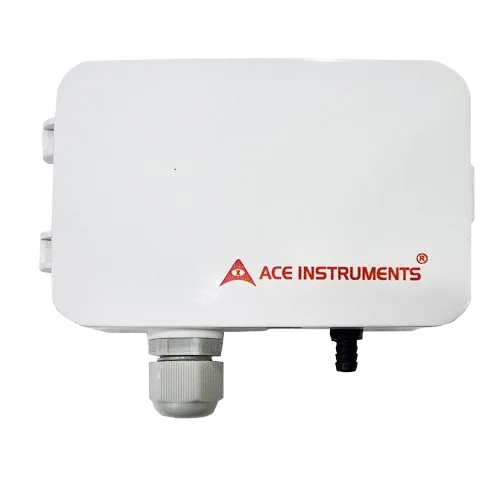
High-Accuracy Duct Static Pressure Sensor for HVAC & BMS Applications
The Ace Instruments Duct Static Pressure Sensor is designed to maintain optimal airflow and maximize the effectiveness of HVAC systems. The AI-DP-S is designed specifically for monitoring static pressure in air and non-corrosive gases, the transmitter delivers real-time, highly accurate differential (opt for AI-DPTx) and static pressure readings essential for Building Management Systems (BMS), VAV boxes, and industrial ventilation control.
Whether you are upgrading an existing HVAC network or designing a new cleanroom facility, this sensor combines industrial-grade durability with seamless integration capabilities. For flexibility, users can reach us with the required range and field select choice of analog outputs between 4-20 ma/0-10 VDC.
Key Features & Benefits
- Accuracy: With a 0.5% Full Scale (FS) accuracy and 250 ms response time, the Ace Instruments Duct Static Pressure Sensor ensures users are alerted instantly to minor pressure fluctuations, resulting in maximized energy efficiency and maintenance of optimal environmental conditions.
- Versatile Output Options: The AI-DP-S is available with jumper-selectable outputs designed to enable users to switch between industry-standard 4-20 mA and 0-10 VDC effortlessly for integration with industry standard PLC/BMS/SCADA systems.
- Customizable Range: The base measuring range covers 0 to 400 Pa, making it ideal for standard low-pressure duct applications. Need something specific? The range is fully customizable to meet the unique demands of your project.
- Complete Installation Kit: Every AI-DP-S sensor comes standard with a static pressure probe and 2 meters of premium silicon tubing for a fast, hassle-free duct installation.
Product Specifications
Gain insight into your IAQ solution and know technical specifications
Static Pressure in HVAC Explained
Static pressure refers to the force air exerts against duct walls as it moves through an HVAC system, distinct from the velocity pressure driving airflow forward. You can think of it as the "blood pressure" of an HVAC system: if it's too high or too low, the system cannot function properly. Maintaining the correct static pressure ensures air is delivered consistently to terminal units throughout a building, regardless of how many zones are calling for airflow at any given moment. Without accurate static pressure measurement, fan speed control becomes guesswork, risking either insufficient airflow to some zones or excessive energy use from running fans harder than necessary.
Monitoring static pressure matters for three key reasons:
- Energy Efficiency: A system fighting high resistance draws significantly more power
- Equipment Protection: Excessive static pressure can cause blower motors to overheat and fail prematurely, or cause evaporator coils to freeze
- Occupant Comfort: Proper pressure ensures balanced airflow, preventing hot or cold spots across different zones of a building
Typical operating ranges vary by system type: residential HVAC systems are generally designed around 0.5 in. w.c. (roughly 125 Pa), while commercial VAV systems often operate between 1.0 and 1.5 in. w.c. (250 to 400 Pa), depending on specific project requirements.
Variable Air Volume (VAV) Systems
In a VAV system, individual terminal units adjust their dampers to control airflow into each zone based on local demand. The BMS uses static pressure measurement to control fan speed via a variable speed drive (VSD), maintaining constant design duct pressure as terminal unit dampers open and close. This allows a single air handling unit to serve many zones efficiently, supplying only as much air as the building actually needs at any given time.
Constant Static Pressure Control
When more dampers close (lower load), duct pressure rises, and the VSD reduces fan speed to maintain the setpoint. When dampers open (higher load), pressure drops, and the VSD increases fan speed. This continuous feedback loop keeps duct pressure stable regardless of how demand shifts across the building throughout the day. Because fan power scales with the cube of speed under the fan affinity laws, even modest speed reductions during low-demand periods translate into substantial energy savings, up to 50% compared with fixed-speed fan operation.
Ideal Applications
The ideal application of static pressure is measuring and controlling air resistance in HVAC systems to ensure proper airflow, energy efficiency, and comfort.
- VAV (Variable Air Volume) Systems: Static pressure sensors are used to modulate fan speeds via Variable Frequency Drives (VFDs) to maintain a setpoint as zone dampers open and close.
- HVAC System Optimization: Measuring static pressure helps maintain optimal airflow, preventing issues like noisy ducts, poor heating/cooling distribution, and excessive energy consumption.
- Cleanrooms and Operating Rooms: High static pressure is maintained to ensure that when doors open, air rushes out, preventing contaminants from entering sensitive environments.
- HVAC Zoning Systems: Ensures that when some zones are closed, the pressure does not become too high for the operating zones, requiring the use of dampers or bypasses.
Installation Note: For the most accurate readings, the static pressure probe should be installed approximately two-thirds of the way down the main supply duct, in a straight section of ductwork, well away from sources of air turbulence such as fans, elbows, dampers, or branch take-offs. The probe is inserted through the duct wall and positioned facing upstream, into the direction of airflow.
Frequently Asked Questions
1. What is the AI-DP-S Duct Static Pressure Transmitter?
The AI-DP-S is a duct-mounted static pressure transmitter designed to continuously measure air pressure inside HVAC ducts. It provides accurate pressure measurements for Building Management Systems (BMS), Variable Air Volume (VAV) systems, and HVAC controllers, helping maintain proper airflow, improve energy efficiency, and optimize ventilation performance.
2. Why is monitoring duct static pressure important?
Monitoring static pressure is critical for three main reasons:
- Energy Efficiency: A system fighting high resistance draws significantly more power.
- Equipment Protection: Excessive static pressure can cause blower motors to overheat and fail prematurely, or cause evaporator coils to freeze.
- Occupant Comfort: Proper pressure ensures balanced airflow, preventing hot or cold spots in different zones of a building.
3. What is the normal operating range for duct static pressure?
The ideal range depends heavily on the system type.
- Residential HVAC: Typically designed to operate around 0.5 in. w.c. (inches of water column), which is roughly 125 Pa.
- Commercial VAV Systems: Often operate at higher pressures, typically between 1.0 and 1.5 in. w.c. (250 to 400 Pa), though specific requirements dictate the exact setpoint.
4. Where should a duct static pressure sensor be installed?
For the most accurate readings, the static pressure probe should be installed approximately two-thirds (2/3) of the way down the main supply duct. It must be placed in a straight section of ductwork, well away from sources of air turbulence such as fans, elbows, dampers, or branch take-offs.
5. Does the AI-DP-S replace other static pressure sensors?
The AI-DP-S serves as a part replacement for Siemens 3120, Siemens 3020, Dwyer Omega PX276, Greystone ELP-S, Dwyer Series MS / MS2 Magnesense® Differential Pressure Transmitter, and Belimo 22ADP.
6. How does a duct static pressure transmitter work?
A static pressure transmitter acts as a differential pressure sensor. It uses a static probe inserted into the duct to measure the internal air pressure and compares it against the ambient room pressure (the reference). It then converts this physical pressure difference into a standardized electrical signal, commonly 4-20 mA or 0-10 VDC, which is sent to a Building Management System (BMS) or Programmable Logic Controller (PLC) to adjust fan speeds automatically.
7. What are the common causes of high static pressure in HVAC ducts?
High static pressure indicates a restriction in airflow. Common culprits include:
- Dirty or highly restrictive air filters (e.g., upgrading to a high MERV rating without adjusting the blower).
- Undersized return or supply ducts.
- Closed or blocked supply registers and dampers.
- Crushed, kinked, or sagging flexible ductwork.
8. What happens if a duct static pressure sensor fails?
If the sensor fails, the BMS loses its airflow reference. Depending on the system's programming, this usually causes the Variable Frequency Drive (VFD) to either drive the supply fan to 100% capacity (causing extreme noise, duct damage, and high energy use) or shut the fan down completely to protect the system, resulting in a total loss of ventilation.
9. What is duct static pressure?
Duct static pressure is the pressure exerted by the air inside a ventilation duct, independent of the air's velocity. It indicates the force available to move air through the ductwork and is a critical parameter for maintaining balanced airflow throughout an HVAC system.
10. Where is the AI-DP-S commonly installed?
Typical applications include:
- Air Handling Units (AHUs)
- Supply air ducts
- Return air ducts
- Variable Air Volume (VAV) systems
- Commercial buildings
- Hospitals
- Pharmaceutical facilities
- Data centers
- Laboratories
- Shopping malls
11. Can the AI-DP-S be integrated with a Building Management System (BMS)?
Yes. The AI-DP-S supports industry-standard communication and output options, including:
- RS485 Modbus communication
- 4 to 20 mA output
- 0 to 10 V output (depending on model)
This allows seamless integration with Building Management Systems, PLCs, SCADA systems, and HVAC automation controllers.
12. What pressure ranges are available?
The AI-DP-S is available in multiple pressure ranges to suit different HVAC applications. Our application engineers can recommend the appropriate range based on your duct pressure requirements.
13. Is the AI-DP-S suitable for continuous monitoring?
Yes. The transmitter is designed for reliable 24×7 continuous operation in commercial, industrial, healthcare, pharmaceutical, and institutional HVAC systems.
14. Does the transmitter require calibration?
The AI-DP-S is factory calibrated before shipment to ensure accurate measurements. Periodic verification is recommended as part of routine HVAC maintenance, especially in applications requiring high measurement accuracy.
15. Who typically uses the AI-DP-S?
The AI-DP-S is widely used by:
- HVAC contractors
- Building automation integrators
- Facility managers
- Mechanical consultants
- Hospital engineering teams
- Pharmaceutical manufacturers
- Commercial building operators
- Data center managers
- Industrial maintenance engineers
16. Why choose ACE Instruments?
ACE Instruments has over 30 years of experience in manufacturing HVAC and environmental monitoring solutions. Customers choose ACE for:
- Accurate pressure measurement
- Industrial-grade reliability
- Easy BMS integration
- Multiple communication options
- Calibration support
- Responsive technical assistance
- Proven installations across commercial, healthcare, pharmaceutical, and industrial facilities
17. How do I choose the right duct static pressure transmitter?
Our application engineers can help you select the most suitable AI-DP-S based on your HVAC system design, duct pressure range, communication requirements, Building Management System compatibility, and energy efficiency objectives.

