
4-20mA vs 0-10V vs RS-485 Modbus: Choosing the Right DP Transmitter Output
Introduction
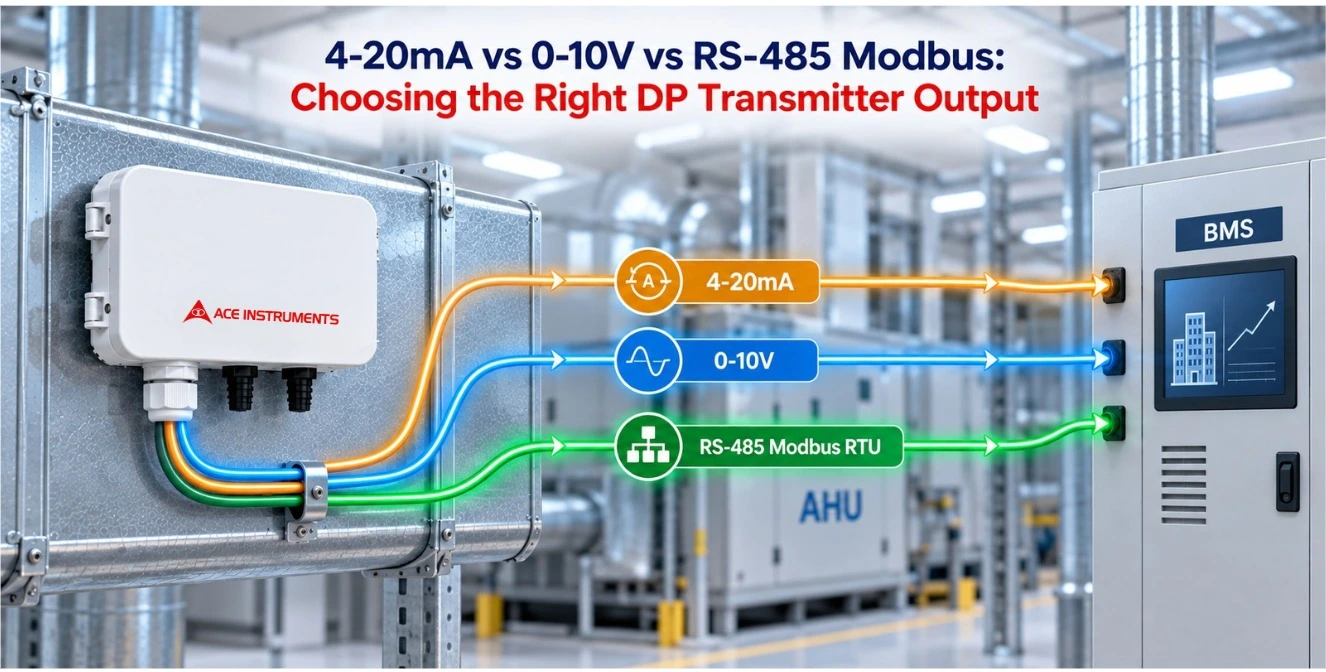
The output signal type on a differential pressure transmitter determines how it wires into a building management system, how far the cable run can extend, and how much diagnostic data is available: 4-20mA, 0-10V, and RS-485 Modbus RTU each suit different integration scenarios.
How the Three Output Types Differ
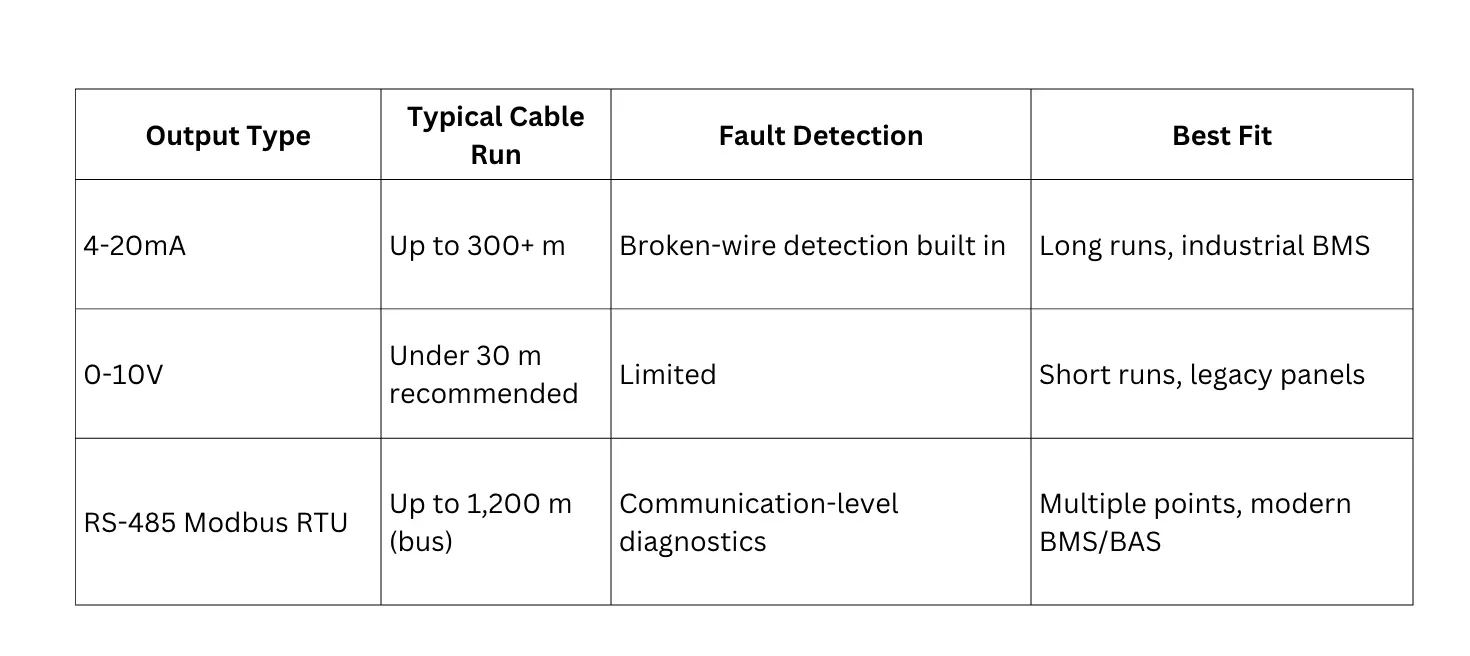
A 4-20mA current loop output is the most common choice for long cable runs, because current signals do not degrade over distance the way voltage signals can, and a reading below 4mA immediately flags a broken wire or power fault. A 0-10V output is simpler to wire into some legacy building automation panels but is more susceptible to voltage drop over long cable runs and electrical noise from nearby equipment. RS-485 Modbus RTU carries multiple readings -pressure, plus in some transmitter families temperature or diagnostic status - over a single twisted-pair cable, and lets several transmitters share one communication bus rather than needing a dedicated analogue input for each device.
Ace Instruments AI-DPTx and AI-DP-S transmitters support all three output types across the IAQ Detectors range, so the choice depends on the BMS platform already installed rather than instrument availability.
Comparing DP Transmitter Output Types
Choosing the Right Output for a Given Installation
For a single DP transmitter feeding an older analogue-input BMS controller over a short run, 0-10V is often the simplest option. For a filter bank transmitter located far from the nearest control panel common in large commercial AHU rooms, 4-20mA's immunity to voltage drop and built-in fault signalling make it the safer choice. Where a project has several pressure monitoring points across one mechanical room, such as multiple AHU filter banks plus room pressurisation points, RS-485 Modbus RTU reduces both cabling and the number of BMS input points required, at the cost of needing a Modbus-capable controller.
All three output types on the AI-DPTx and AI-DP-S provide the same underlying accuracy and calibration; the choice is purely an integration decision, not a performance trade-off.
Field Note
A retrofit project inherited a legacy 0-10V-only BMS but needed six new differential pressure points across a mechanical penthouse. Rather than adding six analogue input cards, the integrator specified AI-DPTx units on RS-485 Modbus RTU and added a single Modbus gateway to the existing BMS, cutting both cable length and panel space compared to the original 0-10V plan.
Frequently Asked Questions
What is the difference between 4-20mA and 0-10V outputs?
4-20mA is a current signal that resists degradation over long cable runs and can detect a broken wire, while 0-10V is a voltage signal that is simpler to wire but more susceptible to voltage drop and noise over longer distances.
When should RS-485 Modbus RTU be used instead of an analogue output?
RS-485 Modbus RTU is the better choice when multiple transmitters need to report to the same building management system, since several devices can share one communication bus instead of requiring a dedicated analogue input for each.
Do the AI-DPTx and AI-DP-S transmitters support all three output types?
Yes. Ace Instruments manufactures the AI-DPTx and AI-DP-S with 4-20mA, 0-10V, and RS-485 Modbus RTU output options, so the same base instrument fits different BMS integration requirements.
Why Trust IAQ Detectors
Ace Instruments manufactures the AI-DPTx and AI-DP-S transmitters under CE certification and ISO 9001:2015; IAQ Detectors instrumentation with flexible output options is deployed across more than 1,000 commercial and industrial installations worldwide.
Know the latest trends in IAQ solutions from the Ace Instruments team


Get inspired and learn more
Instruments that exceed your technical expectations
Comprehensive and customized IAQ solutions for all applications

