
OSHA, WHO and ACGIH Carbon Monoxide Exposure Limits Compared
The OSHA permissible exposure limit for carbon monoxide is 50 ppm as an eight-hour time-weighted average under 29 CFR 1910.1000 Table Z-1, and it is the only widely cited figure that carries legal force. The NIOSH recommended limit of 35 ppm and the ACGIH Threshold Limit Value of 25 ppm are health-based recommendations, and the WHO guidelines are lower again because they protect the general public rather than workers.
Searching for the carbon monoxide exposure limit returns four different numbers because four different bodies have answered four different questions. The table below normalises them so they can be compared directly.
Carbon monoxide exposure limits, normalised

Conversions use 1 ppm CO = 1.145 mg/m³ at 25 °C. The WHO figures are published primarily in mg/m³, which is why the ppm equivalents appear as awkward numbers.
Enforceable versus advisory: the distinction that decides your design
Only the OSHA figures are law, and only in the United States. Everything else in the table is a recommendation, however authoritative its source.
That does not make the recommendations optional in practice. NIOSH and ACGIH values are widely cited in general duty considerations, referenced in insurance and audit contexts, and used as the basis for corporate safety standards that operate globally. A multinational manufacturer with an Indian facility is far more likely to be designing against a corporate standard derived from the ACGIH TLV than against any local statutory limit.
For a specifier the useful hierarchy is:
- Design the ventilation so that normal operation keeps concentrations well below the most protective applicable figure, typically the 25 ppm ACGIH TLV.
- Set the monitoring alarms so that they act before the enforceable limit is approached, generally with a first stage between 25 ppm and 35 ppm.
- Document against the enforceable limit that applies in the jurisdiction, because that is what an inspection will test.
Why the averaging period is the most important column
A time-weighted average is not a maximum. An eight-hour TWA of 50 ppm is satisfied by four hours at 90 ppm followed by four hours at 10 ppm, and equally by eight hours at a steady 50 ppm. The two situations carry different acute risk and identical compliance status.
This is why exposure limits cannot be used directly as alarm setpoints, and why an instrument that only alarms cannot demonstrate compliance. Establishing that a shift stayed within a TWA requires continuous logged measurement across the shift.
It also explains the presence of ceiling values. The NIOSH ceiling of 200 ppm exists precisely because averaging permits excursions, and some excursions are unacceptable regardless of what the average works out to. A monitoring specification that captures the TWA but has no instantaneous ceiling alarm is incomplete.
Converting limits into alarm setpoints
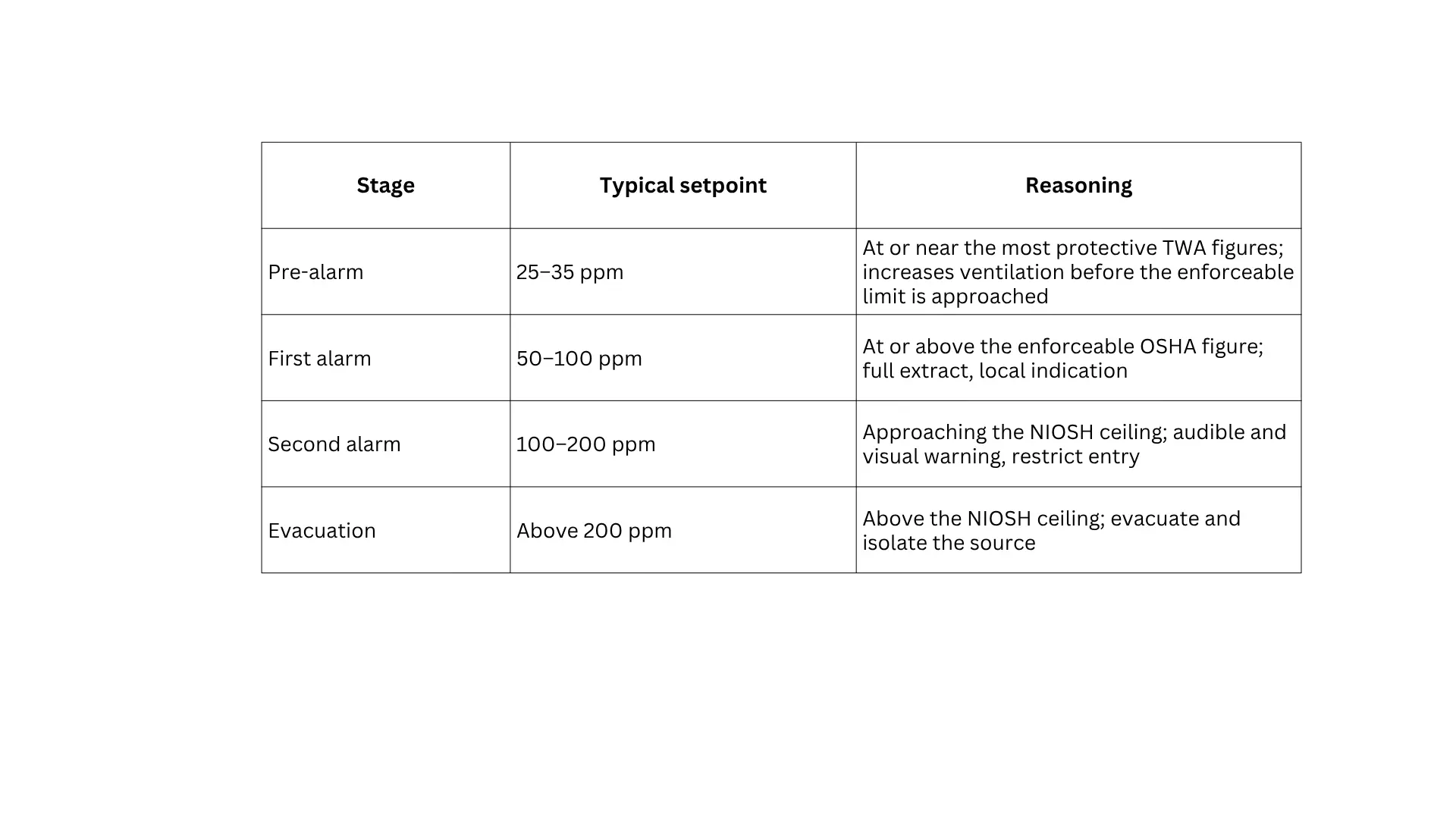
These bands reflect common practice rather than a requirement of any single standard. EN 50545-1 states that alarm levels are variable and may be adapted to national and local regulations, and the applicable authority has the final say. The reasoning is developed further in the basement car park design guide.
Where the limits bite hardest
Occupational limits matter most in spaces where people work full shifts near a combustion source. Two zones dominate.
Warehouses and loading docks operating LPG or diesel forklifts generate steady, moderate concentrations across an entire shift. This is the classic TWA exposure: nothing dramatic happens, and the eight-hour average still approaches the enforceable limit.
Diesel generator and boiler rooms present the opposite profile, with short-duration, high-concentration excursions during flue or manifold leakage. Here the ceiling value governs rather than the average.
Public spaces such as enclosed car parks are usually assessed against the lower WHO guideline figures rather than occupational limits, because the people exposed are members of the public rather than a monitored workforce.
Measuring to demonstrate compliance
Demonstrating compliance with a time-weighted limit requires instrumentation that measures continuously, logs, and holds calibration between service intervals. An instrument that has drifted low reports compliance that did not occur, which is why a documented calibration and bump testing regime is part of the compliance case rather than an operating cost.
Ace Instruments manufactures fixed carbon monoxide instrumentation under the IAQ Detectors brand for occupational and public-space monitoring. The AI-CO Carbon Monoxide Transmitter provides continuous measurement with outputs suited to logging and control, and the duct-mounted AI-CO-D covers air handling contamination. Integration options for continuous logging are covered in the guidance on BMS integration.
Ace Instruments has manufactured indoor air quality instrumentation in Hyderabad since 1991, with more than 1,000 installations worldwide. The IAQ Detectors carbon monoxide range is CE certified and manufactured under an ISO 9001:2015 registered quality system. The full range is available in the carbon monoxide category.
Frequently asked questions
What is the OSHA permissible exposure limit for carbon monoxide?
The OSHA permissible exposure limit for carbon monoxide is 50 ppm as an eight-hour time-weighted average for general industry, set in 29 CFR 1910.1000 Table Z-1. This is the enforceable legal limit in the United States. Construction work under 29 CFR 1926.55 carries the same eight-hour figure. Exceeding it is a compliance failure, not merely a health concern.
What is the ACGIH TLV for carbon monoxide?
The ACGIH Threshold Limit Value for carbon monoxide is 25 ppm, equivalent to 29 mg/m³, as a time-weighted average for a normal eight-hour workday and forty-hour workweek. It is based on the risk of elevated carboxyhaemoglobin levels in the blood. The TLV is a health-based recommendation published by a professional body and is not legally enforceable on its own.
Why do the WHO and OSHA carbon monoxide limits differ?
They protect different populations against different exposure patterns. The WHO Air Quality Guidelines protect the general public, including people with cardiovascular disease and other vulnerable groups, over continuous exposure. OSHA limits protect a healthy adult workforce over a bounded shift and additionally reflect what was demonstrably achievable when the regulation was set. Neither figure is wrong; they answer different questions.
What carbon monoxide level requires evacuation of a workplace?
No single standard prescribes a universal evacuation concentration. In practice, evacuation is commonly triggered above 200 ppm, the ceiling concentration NIOSH states should never be exceeded, with 1,200 ppm identified by NIOSH as immediately dangerous to life or health. Site evacuation thresholds should be set in the emergency plan and reflect the enforceable exposure limit, the ventilation response time and the escape route.
Know the latest trends in IAQ solutions from the Ace Instruments team


Get inspired and learn more
Instruments that exceed your technical expectations
Comprehensive and customized IAQ solutions for all applications

