Home/Products/ CO Monitors & Transmitters

Parameter category

CO Monitoring
Instruments

IAQ Detectors, the instrumentation brand of Ace Instruments, manufactures CE certified wall-mount and duct-type carbon monoxide transmitters for parking garages, mechanical rooms, generator rooms, and commercial buildings. Each instrument uses electrochemical CO detection and outputs via Modbus RS-485, 4-20mA, or relay for direct BMS and fan-control integration.

Carbon monoxide is colourless and odourless, making continuous instrumentation the only reliable detection method. WHO guidelines set an 8-hour exposure limit of 25 ppm, while OSHA 29 CFR 1910 sets an 8-hour time-weighted average workplace limit of 50 ppm.

Electrochemical CO detectionModbus RS-4854-20mARelay outputCE certified2 instruments

CO level reference — ppm

02550200
WHO annual average 9 ppm
WHO 8-hour exposure limit 25 ppm
OSHA 8-hr TWA workplace limit 50 ppm
ACGIH — headache in 2–3 hrs 200 ppm

What is CO monitoring in HVAC and building safety?

CO monitoring uses a fixed electrochemical transmitter to continuously sample carbon monoxide concentration in spaces where combustion sources or vehicle exhaust are present, such as parking garages, generator rooms, and boiler plants. Readings feed the BMS or a dedicated alarm panel to trigger exhaust fans or occupant warnings before concentrations reach unsafe levels.

Referenced standard: OSHA 29 CFR 1910, General Industry Air Contaminants

How does an electrochemical CO transmitter work?

An electrochemical CO cell oxidises carbon monoxide at a sensing electrode, generating a current proportional to gas concentration. This method gives stable, linear output across the 0–500 ppm range typical of commercial CO monitoring, without the drift associated with older semiconductor-type elements.

CO threshold reference

Standard-cited ppm levels used to configure alarm setpoints

CO LevelStatusStandard / SourceHealth / Operational Effect
9 ppmLong-term referenceWHO annual averageMaximum safe long-term exposure
25 ppmShort-term referenceWHO 8-hour averageMaximum safe 8-hour exposure
35 ppmCommon alarm setpointUS parking garage alarm conventionStandard alarm setpoint
50 ppmWorkplace limitOSHA 8-hr TWARegulatory workplace limit
200 ppmAcute exposureACGIHHeadache within 2–3 hours
All CO instrumentsWall mountDuct type
2 instruments shown
Wall mount
Wall mount photo upload in Webflow

Carbon Monoxide Transmitter

CO
RS-485Relay0-500 ppm
Parking garages · Mechanical rooms View instrument →
Duct type
Duct type photo upload in Webflow

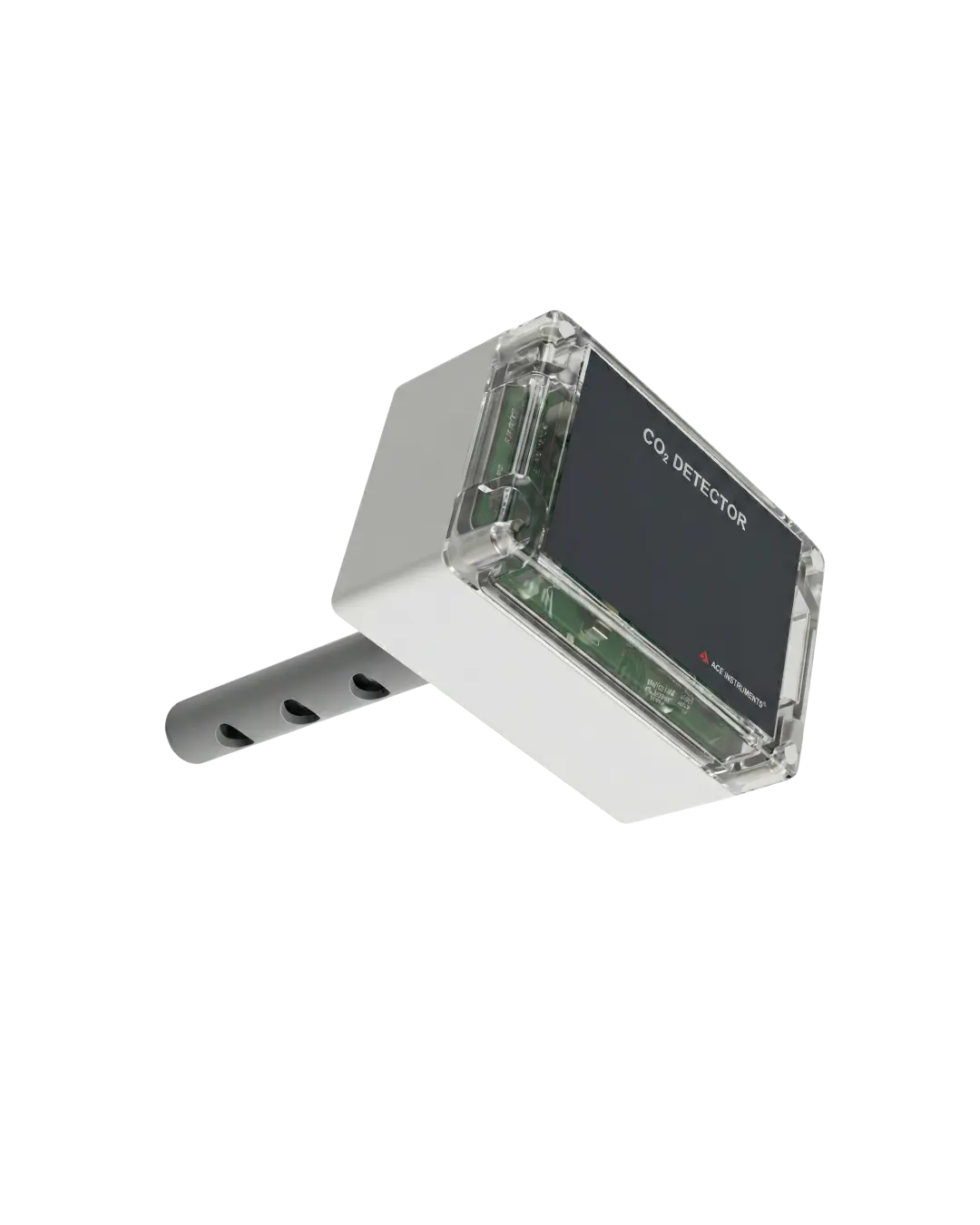
Duct Carbon Monoxide Transmitter

CO
RS-485HVACDCV ready
AHU · Ductwork View instrument →

Instrument comparison

Quick specification reference across the range

FeatureCarbon Monoxide TransmitterDuct Carbon Monoxide Transmitter
Mount typeWallDuct / In-line
CO detection
Relay output
Modbus RS-485
4-20mA
Best forParking garages, mechanical roomsAHU, HVAC ducts

Common applications

Where continuous CO monitoring is required

🅿️

Parking structures

Enclosed and semi-enclosed parking garages require continuous CO monitoring to trigger exhaust ventilation before concentrations reach alarm thresholds.

⚙️

Mechanical & generator rooms

Combustion equipment rooms are monitored continuously for CO buildup from incomplete combustion or exhaust leakage.

🏥

Hospitals & clinics

Boiler and plant rooms adjacent to occupied hospital areas are monitored per ASHRAE 170-2021 mechanical safety provisions.

🏢

Commercial buildings

Underground parking and loading dock areas in commercial buildings integrate CO transmitters with BMS-controlled exhaust fans.

🏫

Educational institutions

Boiler rooms and bus loading areas at schools are monitored for CO per NBC India mechanical safety guidance.

🏭

Industrial facilities

Enclosed production areas with combustion-based equipment monitor CO continuously for worker safety compliance.

Frequently asked questions

Answers referenced against WHO, OSHA and ACGIH exposure limits

What is a safe carbon monoxide level indoors?

WHO guidelines set a long-term annual average limit of 9 ppm and an 8-hour exposure limit of 25 ppm, while OSHA sets an 8-hour time-weighted average workplace limit of 50 ppm. IAQ Detectors CO transmitters are configured to alarm well below these thresholds so exhaust ventilation can respond before concentrations become hazardous.

How does an electrochemical CO transmitter work?

An electrochemical cell oxidises carbon monoxide at a sensing electrode, producing a current proportional to gas concentration. This provides stable, drift-resistant readings suited to continuous monitoring in parking garages and mechanical rooms.

What is the difference between a wall-mount and a duct-mounted CO transmitter?

Wall-mount CO transmitters sample ambient air in occupied or semi-occupied spaces such as parking garages, while duct-mounted transmitters install inline within HVAC ductwork to sample supply or exhaust air and feed data directly to the AHU or BMS.

Where are CO transmitters typically required?

CO transmitters are typically installed in enclosed parking structures, generator and boiler rooms, and mechanical plant areas, where a common alarm convention triggers exhaust ventilation at 35 ppm per US parking garage practice.

Can CO transmitters integrate with a building management system?

Yes. IAQ Detectors CO transmitters output via Modbus RS-485 RTU or 4-20mA, with relay contacts available on wall-mount models for direct fan-start or alarm-panel integration.

1991
Ace Instruments founded, Hyderabad, India
CE / ISO 9001:2015
CE certified, ISO 9001:2015 quality management
1,000+
Installations worldwide
10,000 sq.ft
Manufacturing & design facility, Hyderabad

Expert guidance

Not sure which CO transmitter fits your installation?

Our application engineers will recommend the right instrument based on your space type, ventilation design, BMS integration, and compliance requirements. Most enquiries answered within 24 hours.

Talk to an expert →sales@iaqdetectors.com

+91 8121025651 · Hyderabad, India